Q3 2026 CBER Approvals for Direct Patient Use

CBER's Q3 2026 approval cohort spans metabolic disease, melanoma, influenza prevention and transfusion. Four of the five entries dated July 1 through September 30 on FDA's annual CBER BLA approval list have direct patient-use indications. Q2 had two qualifying products. The excluded Q3 entry is Source Plasma for further manufacturing[1].
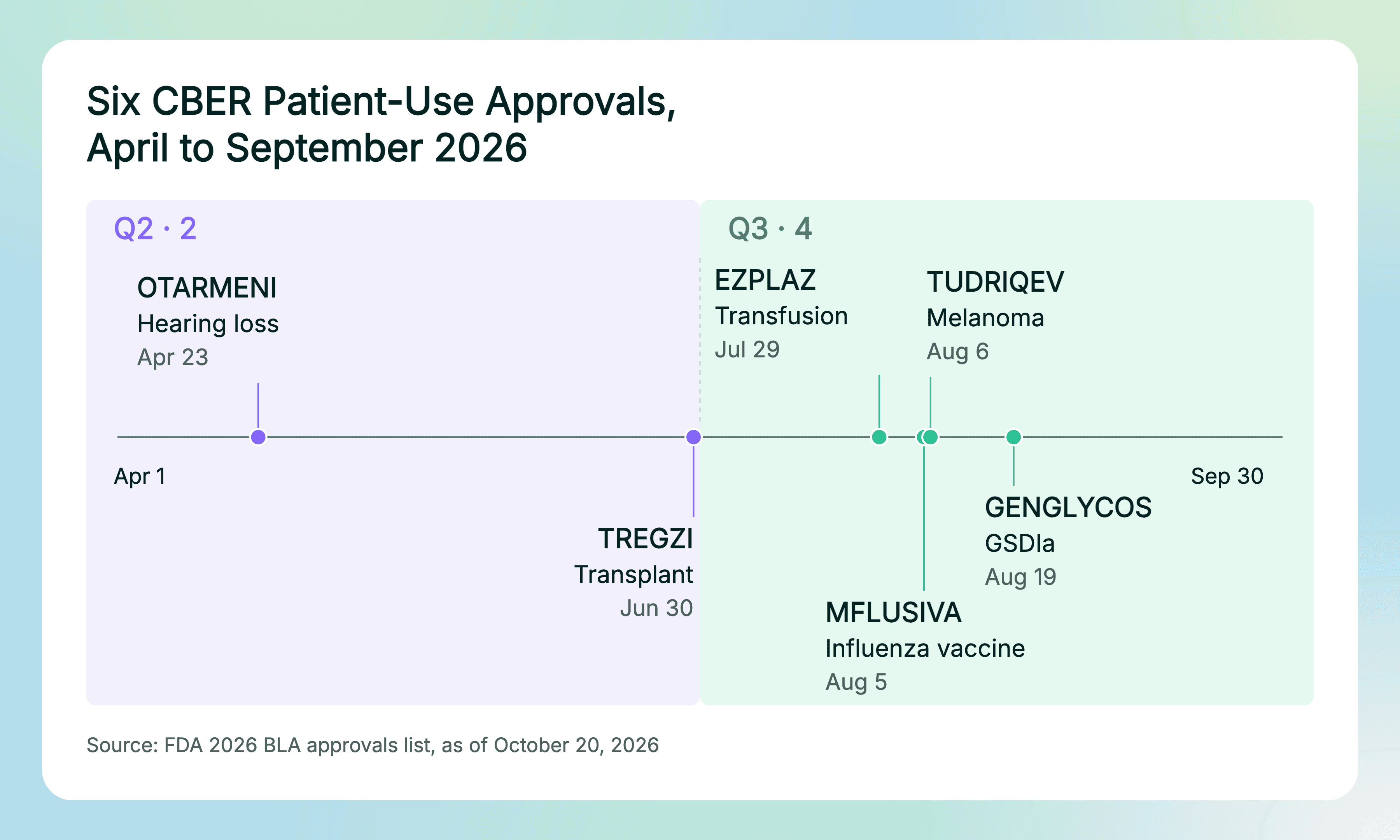
Updated October 20, 2026
The complete Q3 patient-use cohort in that list comprises the four products below, with approval dates, manufacturers and abbreviated indications reported by FDA[1].
| Product | Manufacturer | Approval date | Direct patient use |
|---|---|---|---|
| EZPLAZ | Vascular Solutions, a Teleflex subsidiary | July 29, 2026 | Adult transfusion when plasma is required and other plasma products are unavailable |
| MFLUSIVA | ModernaTX | August 5, 2026 | Influenza prevention in people aged 50 and older |
| TUDRIQEV | Replimune | August 6, 2026 | With nivolumab for adults with unresectable advanced cutaneous melanoma progressing after a PD-1-blocking regimen |
| GENGLYCOS | Ultragenyx Pharmaceutical | August 19, 2026 | Reduced daily cornstarch intake alongside nutritional management in GSDIa, age 8 and older |
The cohort uses the annual BLA list's approval-time entries, excludes supplemental approvals and manufacturing materials, and counts regulatory approvals rather than confirmed commercial launches.
Q3 Added Four Patient-Use Approvals, Up From Two
The quarter-to-quarter increase was from two products to four[1]. Quarterly counts this small can move with one or two approvals, so the product mix matters more than the change in volume. Applying the same patient-use rule to April through June yields OTARMENI, listed on April 23, and TREGZI, listed on June 30; Q3 then added one product in July and three in August, with none listed in September.
Q2's two products addressed genetically defined hearing loss and transplantation. OTARMENI treats specified OTOF-associated hearing loss, while TREGZI is used in matched-donor hematopoietic stem-cell transplantation for adults with hematological malignancies[2][3]. Q3 therefore expanded the range of clinical settings represented in the patient-use cohort. For BD and CI teams, the useful comparison pairs approval volume with the eligible population and care setting of each product.
This center-specific cohort is narrower than Maven's 2025 FDA approval review, which covers all novel approvals.
EZPLAZ Brings Transfusion Logistics Into the Cohort
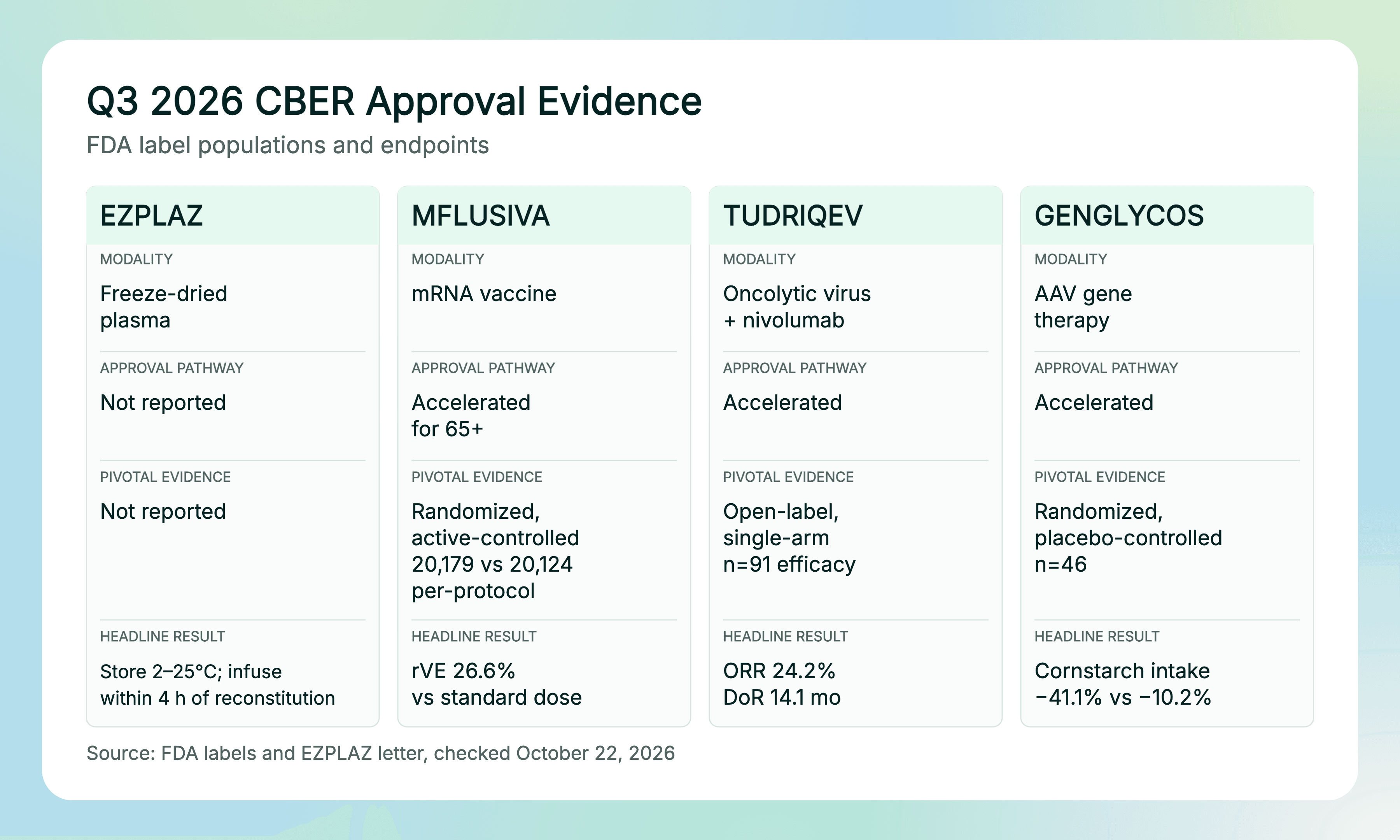
EZPLAZ is freeze-dried plasma indicated for adults when plasma is required and other plasma products are unavailable[4]. Its listed uses include replacement of multiple coagulation factors, massive transfusion with clinically significant coagulation deficiencies, and specified situations requiring reversal of warfarin's effect.
The product's circular permits storage of the unreconstituted kit at 2°C to 25°C until its labeled expiration date and requires infusion within four hours after reconstitution[5]. It is prepared from single-donor fresh frozen plasma, and the reconstituted product is equivalent to 270 mL of plasma. Those handling requirements make availability, preparation and transfusion workflow central dimensions of the product assessment.
MFLUSIVA Has Different Evidence Bases by Age
MFLUSIVA is an mRNA influenza vaccine approved for people aged 50 and older[6]. Within that population, the indication for people aged 65 and older received accelerated approval based on immune responses, with continued approval potentially contingent on a confirmatory trial[7].
The label reports relative vaccine efficacy of 26.6% (95% confidence interval, 16.7% to 35.4%) against a standard-dose inactivated influenza vaccine in a Phase 3 trial of adults aged 50 and older[7]. The per-protocol analysis included 20,179 MFLUSIVA recipients and 20,124 comparator recipients, and measured PCR-confirmed protocol-defined influenza-like illness. For older adults, the evidence also included an immunogenicity comparison with a high-dose vaccine.
The age split gives the approval two evidence contexts within one brand. A vaccine landscape can retain both the overall eligible age range and the specific basis supporting use in older adults.
TUDRIQEV Adds an Oncolytic Therapy After PD-1 Progression
TUDRIQEV's approval is for use with nivolumab in adults with unresectable advanced cutaneous melanoma whose disease progressed following a PD-1-blocking antibody-based regimen[8]. FDA describes it as a genetically modified oncolytic viral therapy and granted accelerated approval based on objective response rate and duration of response.
The label's IGNYTE efficacy population comprised 91 patients with at least one noninjected lesion within a 140-patient study cohort[9]. Objective response rate was 24.2% (95% confidence interval, 15.8% to 34.3%), and median response duration was 14.1 months. The study was open-label and single-arm, with TUDRIQEV administered by intratumoral injection and nivolumab by intravenous infusion.
These features make treatment sequence and administration relevant to the approval's commercial assessment. The starting population has already experienced progression on a PD-1-based regimen, while the combination brings intratumoral delivery into the treatment pathway.
GENGLYCOS Links Gene Therapy to Cornstarch Reduction
GENGLYCOS received accelerated approval to reduce daily cornstarch intake as an adjunct to nutritional management in patients aged 8 and older with glycogen storage disease type Ia[10]. Its indication keeps nutritional management central to the treatment setting, and continued approval may depend on confirmation of clinical benefit.
The FDA label describes an AAV vector-based gene therapy administered as a single intravenous infusion, with efficacy evaluated in a randomized, double-blind, placebo-controlled study[11]. The efficacy analysis included 46 treated patients, with 21 receiving GENGLYCOS and 25 receiving placebo. At week 48, least-squares mean daily cornstarch intake fell 41.1% with GENGLYCOS and 10.2% with placebo, a difference of 30.9 percentage points.
The endpoint places the product's initial evidence around a measurable treatment burden. An assessment of this approval therefore starts with the reduction in cornstarch requirements alongside continued dietary care, with confirmatory evidence as the next regulatory milestone.
Final Perspective
Q3's four approvals represent different patient populations, evidence packages and delivery settings. The comparison with Q2 shows a larger patient-use cohort, while the product-level detail identifies the specific clinical and operational questions behind each entry.
This approach complements Maven's analysis of new molecular and biologic entity launches, which uses a different approval boundary. For this CBER cohort, subsequent assessments can connect confirmatory evidence, label changes and documented availability to each product's original approval record.