WCLC 2026 SCLC Phase 3 Results: Two B7-H3 ADCs and MAVERICK

At WCLC 2026, two Phase 3 B7-H3 antibody-drug conjugates, tambotatug pelitecan and risvutatug rezetecan, each reduced the risk of death by 54% versus topotecan in relapsed SCLC[1][2]. MAVERICK showed better cognitive failure-free survival with MRI surveillance alone than with MRI plus prophylactic cranial irradiation, while its final overall-survival analysis remained pending[3].
Updated: October 12, 2026.
MAVERICK separates cognitive outcomes from survival follow-up
MAVERICK evaluated a surveillance strategy after initial therapy, with 304 patients who had limited-stage or extensive-stage SCLC and no brain metastases on MRI[3]. Randomization compared MRI alone with MRI plus prophylactic cranial irradiation.
After 22 months of median follow-up among living patients, MRI alone improved cognitive failure-free survival, with a hazard ratio of 0.60 and a 90% confidence interval of 0.46 to 0.78[3]. The preliminary overall-survival analysis, after 128 deaths, reported a hazard ratio of 0.90; final analysis was planned after 190 deaths.
TAISHAN-302 adds randomized survival evidence for Tam-Peli
TAISHAN-302 evaluated tambotatug pelitecan, or Tam-Peli, against topotecan after first-line platinum-based treatment, enrolling 451 patients across 85 sites in China[4].
The two relapse trials reported the following results at their interim analyses[1][2].
| Trial | Patients | Median OS, ADC / topotecan | OS hazard ratio | Median PFS, ADC / topotecan | Response rate, ADC / topotecan |
| TAISHAN-302 | 451 | 13.3 / 9.4 months | 0.46 | 7.4 / 2.8 months | 59.1% / 9.7% |
| ARTEMIS-008 | 461 | 18.5 / 10.3 months | 0.46 | 7.2 / 3.0 months | 58.3% / 12.6% |
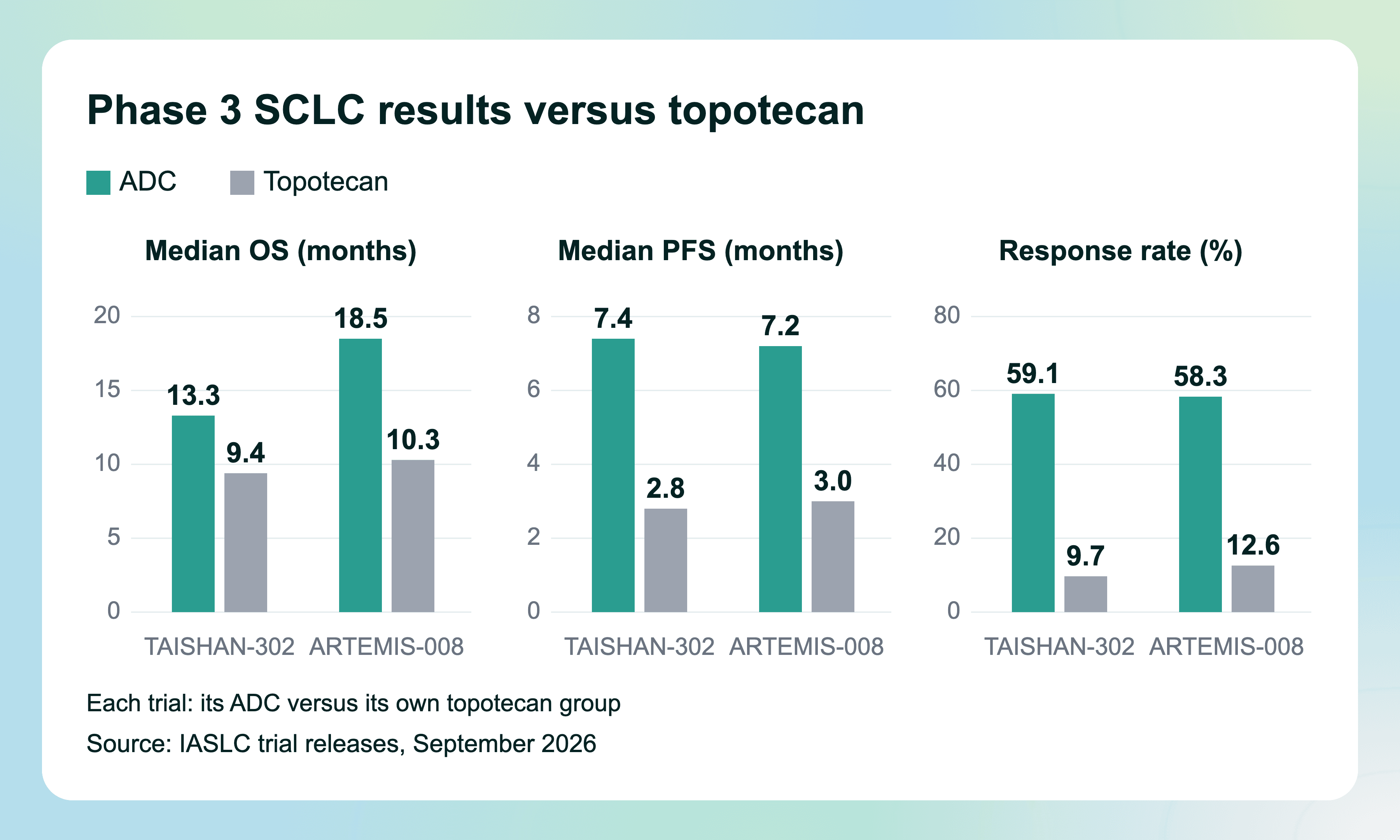
Each trial compared its ADC with topotecan separately; results are not a head-to-head comparison[1][2].
TAISHAN-302 also reported grade 3 or higher treatment-related adverse events in 46.4% of Tam-Peli recipients and 74.7% of topotecan recipients[1]. Treatment-emergent interstitial lung disease or pneumonitis occurred in 4.9% and 1.4%, respectively.
ARTEMIS-008 provides a second B7-H3 survival readout
ARTEMIS-008 tested risvutatug rezetecan, or Ris-Rez, in 461 patients in China whose SCLC had progressed after platinum-based chemotherapy[2]. At the June 6 data cutoff, median follow-up was 12.2 months.
GSK reported grade 3 or higher treatment-related adverse events in 60.9% of Ris-Rez recipients and 78.2% of topotecan recipients[5]. The most common severe treatment-related events were hematologic, including decreases in neutrophils, white blood cells and platelets, as well as anemia.
September filings connect the readouts to regional execution
MediLink reported that China's regulator accepted its Tam-Peli application on September 2, with priority review subsequently granted[4]. The company also described Roche's rights to develop, manufacture and commercialize Tam-Peli worldwide outside mainland China, Hong Kong and Macau.
Hansoh's September 13 disclosure similarly reported acceptance of the Ris-Rez application in China on September 2 and priority review[6]. GSK described development outside mainland China, Hong Kong, Macau and Taiwan, including the Phase 3 EMBOLD SCLC-301 study, with pivotal data expected in 2027[5].
Final Perspective
Taken together, the three presentations establish two lines of analysis: cognitive outcomes after initial therapy, and randomized drug outcomes after relapse. The two B7-H3 programs give the relapse field separate Phase 3 survival datasets, while MAVERICK brings treatment burden and continued survival follow-up into the assessment.