Q3 2026 Nasdaq Drug-Developer IPOs Above $100 Million

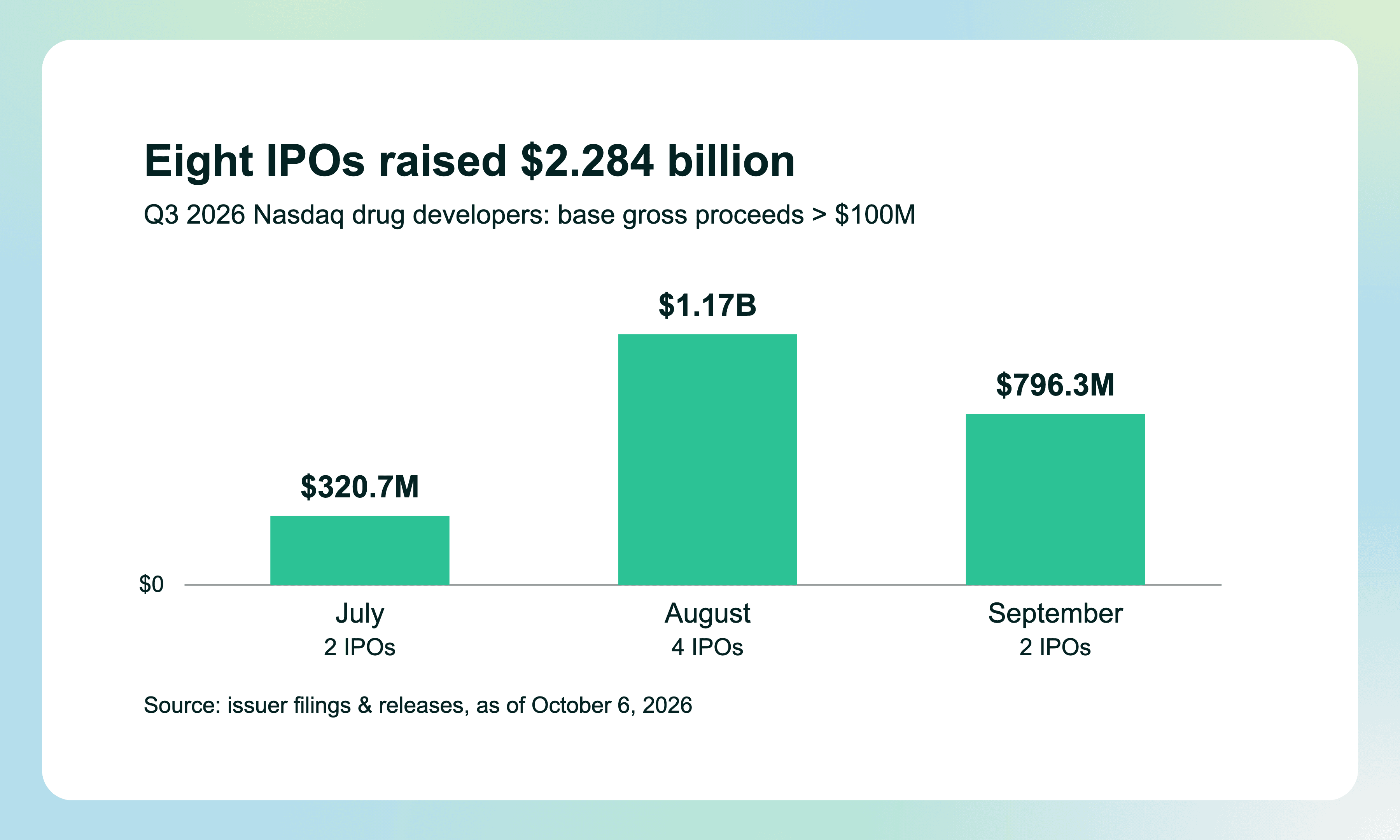
Eight Nasdaq drug-developer IPOs raised $2.284 billion in Q3 2026, with four issuers accounting for two-thirds of the proceeds, based on Renaissance Capital's IPO roster and each company's final prospectus[1]. The cohort includes every traditional Nasdaq drug-developer IPO priced from July 1 through September 30 with base gross proceeds above $100 million, cross-checked against Stock Analysis's 2026 IPO roster[2].
The quarter combined sizable financings with a spread of clinical development stages: Scribe entered public markets with a first-in-human program, while Apnimed had completed two Phase 3 trials in sleep apnea[3][4].
Updated: October 6, 2026.
Eight offerings exceeded the threshold
The qualifying offerings ranged from Scribe's $128.7 million to ADARx's $446.3 million[3][5].
| Company | Pricing date, 2026 | Principal clinical focus at IPO | Base gross proceeds |
| ADARx Pharmaceuticals | September 24 | Hereditary angioedema | $446.3M[5] (https://www.sec.gov/Archives/edgar/data/1802369/000119312526403094/d903461d424b4.htm) |
| Braveheart Bio | August 5 | Hypertrophic cardiomyopathy | $382.5M[6] (https://www.sec.gov/Archives/edgar/data/2131524/000162828026054354/braveheartbioinc-sx1a2.htm) |
| Electra Therapeutics | September 17 | Secondary hemophagocytic lymphohistiocytosis | $350.0M[7] (https://www.sec.gov/Archives/edgar/data/2088082/000119312526395670/d61940d424b4.htm) |
| Latigo Biotherapeutics | August 6 | Pain | $345.6M[8] (https://www.sec.gov/Archives/edgar/data/2056611/000119312526340329/d38775d424b4.htm) |
| Attovia Therapeutics | August 4 | Pruritic and immune-mediated skin diseases | $289.0M[9] (https://www.sec.gov/Archives/edgar/data/2058707/000119312526334997/d40469d424b4.htm) |
| Apnimed | July 30 | Obstructive sleep apnea | $192.0M[4] (https://www.prnewswire.com/news-releases/apnimed-announces-pricing-of-upsized-initial-public-offering-302839645.html) |
| BlossomHill Therapeutics | August 6 | Oncology | $150.0M[10] (https://www.sec.gov/Archives/edgar/data/1839970/000119312526340215/d98958d424b4.htm) |
| Scribe Therapeutics | July 23 | Cardiovascular disease prevention | $128.7M[3] (https://www.sec.gov/Archives/edgar/data/1853921/000119312526316503/d21355d424b4.htm) |
Note: Base gross proceeds equal base shares multiplied by the offer price, before underwriting deductions and expenses. All quarter comparisons use the same rule: traditional Nasdaq drug-developer IPOs above $100 million, excluding options, concurrent private placements, direct listings, SPAC transactions, diagnostics, devices and overseas-only listings.
Vogenx was the remaining drug developer in the quarter's nine-company parent cohort. Its August 11 offering raised $81.3 million in base gross proceeds, placing it below the threshold[11].
More IPOs raised less capital than in Q2
Q3's eight qualifying offerings followed seven in Q2 2026, when the same cohort rule produced $2.83 billion in base gross proceeds. Proceeds fell approximately 19% quarter over quarter even as the issuer count increased, reflecting a shift toward smaller average offerings.
The Q2 cohort was led by Parabilis and Kailera, which together raised $1.30 billion[12][13]. Their offerings alone supplied about 46% of the quarter's qualifying proceeds, establishing a high comparison base for Q3.
| Q2 2026 issuer | Pricing date | Base gross proceeds |
| Parabilis Medicines | June 9 | $670.0M[12] (https://www.sec.gov/Archives/edgar/data/1657677/000119312526264521/pbls_fwp.htm) |
| Kailera Therapeutics | April 16 | $625.0M[13] (https://investors.kailera.com/news-releases/news-release-details/kailera-therapeutics-announces-pricing-initial-public-offering) |
| Kardigan | June 17 | $400.0M[14] (https://ir.kardigan.bio/news-releases/news-release-details/kardigan-announces-pricing-upsized-initial-public-offering) |
| Hemab Therapeutics | April 30 | $301.5M[15] (https://ir.hemab.com/news-releases/news-release-details/hemab-therapeutics-announces-pricing-upsized-initial-public) |
| Avalyn Pharma | April 29 | $300.0M[16] (https://www.nasdaq.com/press-release/avalyn-announces-pricing-upsized-initial-public-offering-2026-04-30) |
| Odyssey Therapeutics | May 7 | $279.0M[17] (https://investors.odysseytx.com/news-releases/news-release-details/odyssey-therapeutics-announces-pricing-upsized-initial-public) |
| Seaport Therapeutics | April 30 | $254.9M[18] (https://www.sec.gov/Archives/edgar/data/1782999/000119312526199177/d22215dex991.htm) |
The year-over-year comparison is more pronounced. In Q3 2025, only LB Pharmaceuticals met the same Nasdaq and proceeds criteria in Stock Analysis's IPO roster, raising $285 million; Q3 2026 therefore had eight qualifying issuers versus one and approximately eight times the proceeds[19].
For capital-market benchmarking, these comparisons point to sustained activity across consecutive quarters in 2026 after a much narrower year-earlier window. Maven's earlier analysis of biotech funding and IPO valuations provides historical context on how public offerings followed private financing rounds.
Four issuers accounted for two-thirds of the proceeds
ADARx, Braveheart, Electra and Latigo together raised $1.52 billion, or 66.7% of Q3's qualifying proceeds. Each offering exceeded $300 million, placing these four issuers at the center of the quarter's capital formation.
The other four companies contributed $759.7 million, while the median offering was $317.3 million. Average proceeds per qualifying issuer fell from $404.3 million in Q2 to $285.5 million in Q3, showing how a larger issuer cohort could raise less aggregate capital.
August concentrated the largest number of offerings
Four qualifying IPOs priced in August, compared with two in July and two in September. August contributed $1.17 billion, just over half the cohort's total, as Attovia, Braveheart, BlossomHill and Latigo priced between August 4 and August 6.
September's two offerings contributed $796.3 million, versus July's $320.7 million. ADARx and Electra therefore supplied considerably more capital than July's two issuers, Apnimed and Scribe, despite the same offering count.
The therapeutic spread extended beyond a single category
Cardiology connected two different development approaches. Braveheart's $382.5 million offering accompanied plans for the Phase 3 LIONHEART-HCM trial of BHB-1893 in obstructive hypertrophic cardiomyopathy[6]. In contrast, Scribe's $128.7 million offering accompanied a first-in-human study of the PCSK9-directed epigenetic silencing candidate STX-1150, with enrollment planned for up to 64 adults[3].
Hereditary angioedema and immunology also featured prominently. ADARx's $446.3 million offering accompanied the Phase 3 STOP-HAE trial of onvuzosiran, with 90 adults planned[5]. Attovia's $289 million offering followed completed Phase 1 dosing for IL-31-targeting ATTO-1310, while Electra's $350 million financing accompanied the Phase 2/3 SURPASS program for ipsoprubart in secondary hemophagocytic lymphohistiocytosis[9][7].
Pain and sleep apnea supplied two further clinical settings. Latigo's $345.6 million offering followed an LTG-001 abdominoplasty study in 343 patients and plans for Phase 3 acute-pain studies[8]. Apnimed's $192 million offering followed AD109's completion of two Phase 3 trials in obstructive sleep apnea[4].
Oncology was represented by BlossomHill's $150 million offering, alongside its Phase 1/2 SOLARA trial of BH-30643 in EGFR-mutant non-small cell lung cancer and a Phase 1 trial of BH-30236 in hematologic cancers[10]. The financing supported a clinical pipeline spanning solid tumors and blood cancers.
Final Perspective
Q3 2026 broadened the qualifying IPO cohort to eight companies while raising less capital than Q2. Its therapeutic spread gives BD and investment teams a group of newly public developers to follow across cardiology, hereditary angioedema, pain, sleep apnea, immunology and oncology.
The next milestones include Phase 3 starts and clinical readouts. At IPO, Braveheart and Latigo planned Phase 3 initiations in the second half of 2026 and expected interim or topline results in the second half of 2027[6][8]. ADARx expected STOP-HAE topline data by the end of 2027, while Electra expected to complete enrollment in its registrational program in the second half of that year[5][7]. These milestones create a continuing stream of evidence for assessing how the newly raised capital translates into clinical progress.
For this cohort, Maven Bio's live intelligence can monitor company disclosures and clinical sources and keep a cohort tracker current with source-linked edits as the companies report trial starts, readouts and other developments.