Biopharma Launch Activity: New Molecular and Biologic Entities, 2021–2025

The pharmaceutical industry currently faces one of the most significant periods of Loss of Exclusivity (LOE) in its history. A critical question for investors and industry stakeholders is whether BioPharma companies can move fast enough to refill their pipelines ahead of this cliff.
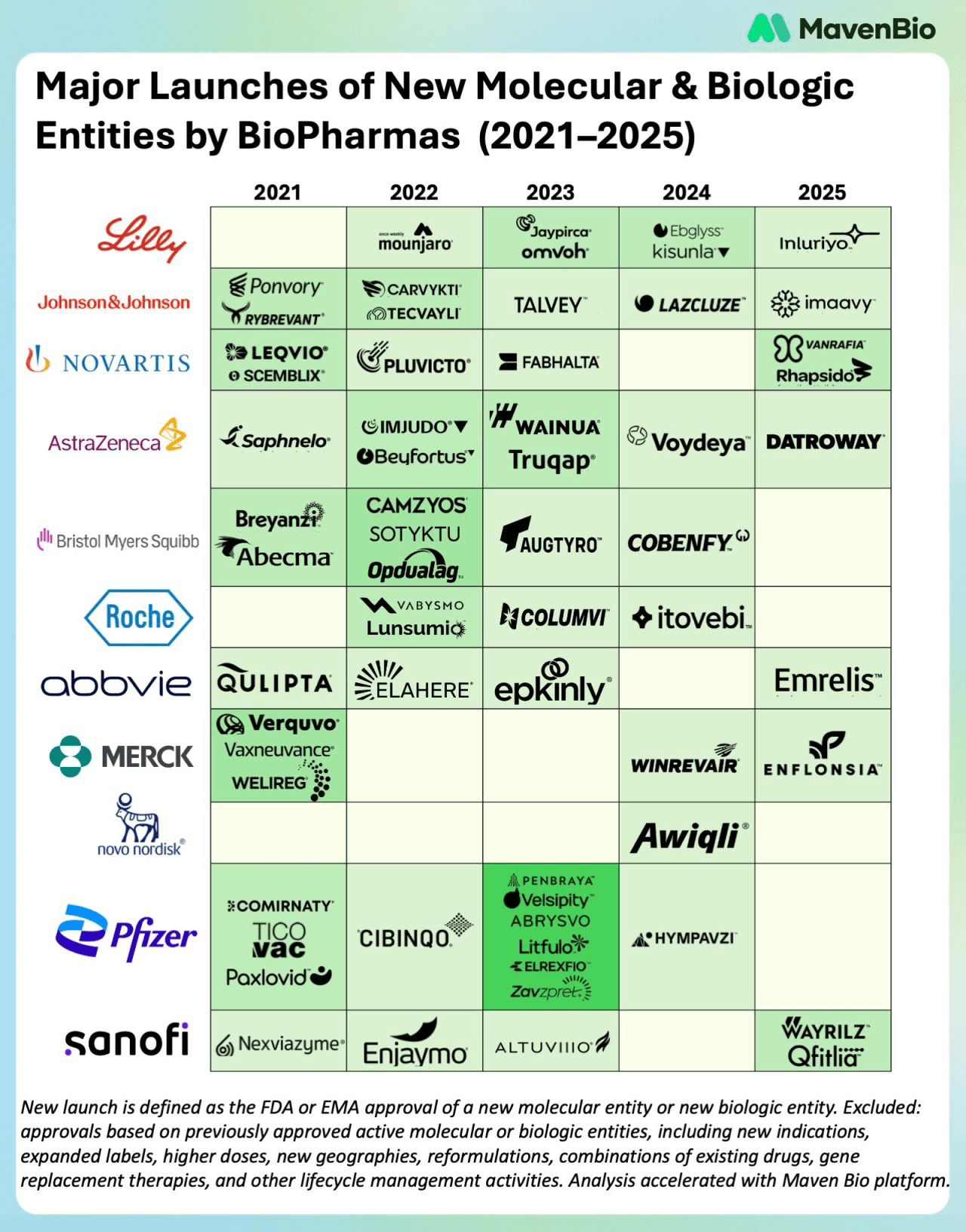
Reviewing the last five years of activity provides perspective on the velocity and nature of major new drug launches. The following analysis examines first FDA or EMA approvals of new molecular entities (NMEs) or new biologic entities (NBEs) between 2021 and 2025.
Scope of Analysis
Data in this report defines a "new launch" as the first regulatory approval (FDA or EMA) of a novel active molecular or biologic entity. This analysis excludes approvals based on previously approved active ingredients, including new indications, expanded labels, higher doses, new geographies, reformulations, fixed-dose combinations of existing drugs, gene replacement therapies, and other lifecycle management activities.
Major Biopharma NME & NBE Launches (2021–2025)
Strategic Analysis of Launch Trends
Reviewing the data from 2021 through 2025 reveals distinct shifts in how large pharmaceutical companies are deploying capital and managing R&D risk.
Pipeline Velocity and Capital Concentration: The volume of truly novel launches remains constrained, even among the largest pharmaceutical entities. The data indicates that most organizations deliver only one or two NME/NBE launches per fiscal year, with several periods showing zero output for specific companies.
This scarcity reflects a broader strategic pivot. Companies appear to be moving away from broad portfolios characterized by high volumes of early-stage risk. Instead, they are concentrating capital and R&D efforts into fewer, high-conviction programs. These priority assets are typically built around well-validated biology, genetically defined patient populations, or platforms that offer high potential for repeatability.
Oncology: The Shift to Mechanistic Refinement: Oncology remains the dominant engine for new molecule generation, yet the nature of innovation within this therapeutic area is evolving. Recent launches demonstrate a trend toward mechanistic refinement rather than the creation of entirely new therapeutic classes.
Commercial differentiation is increasingly driven by biomarker precision, toxicity management, and operational execution rather than target novelty alone. The landscape is currently dominated by targeted therapies, bispecific antibodies, and antibody-drug conjugates (ADCs). Assets including Datroway, Emrelis, Columvi, and Talvey illustrate how the industry is focused on optimizing mature modalities for superior real-world application and safety profiles.
Specialization in Immunology and Rare Disease: Immunology and rare disease continue to attract substantial focused investment, particularly in areas where disease biology is well characterized and clinical endpoints are clearly measurable.
The prevailing strategy in these verticals centers on specialist-managed populations rather than broad primary care indications. Products such as Rhapsido, targeting chronic spontaneous urticaria, and Vanrafia, developed for IgA nephropathy, exemplify a shift toward high-unmet-need niches where distinct efficacy can drive market access.
The Resilience of Small Molecules: Despite the industry's sustained investment in biologics and complex modalities, small molecules have quietly reasserted their strategic importance. A significant proportion of scalable new launches remain oral agents, spanning diverse indications in endocrinology, dermatology, cardio-renal disease, and neurology.
Launches such as Cibinqo, Litfulo, and Inlurio highlight that chemistry-driven innovation continues to underpin commercial impact. These assets offer patient-friendly delivery mechanisms and manufacturing scalability that complement the complex biologic portfolios of major BioPharma players.