Two Phase 3 CLDN18.2 ADC Readouts at ESMO 2026

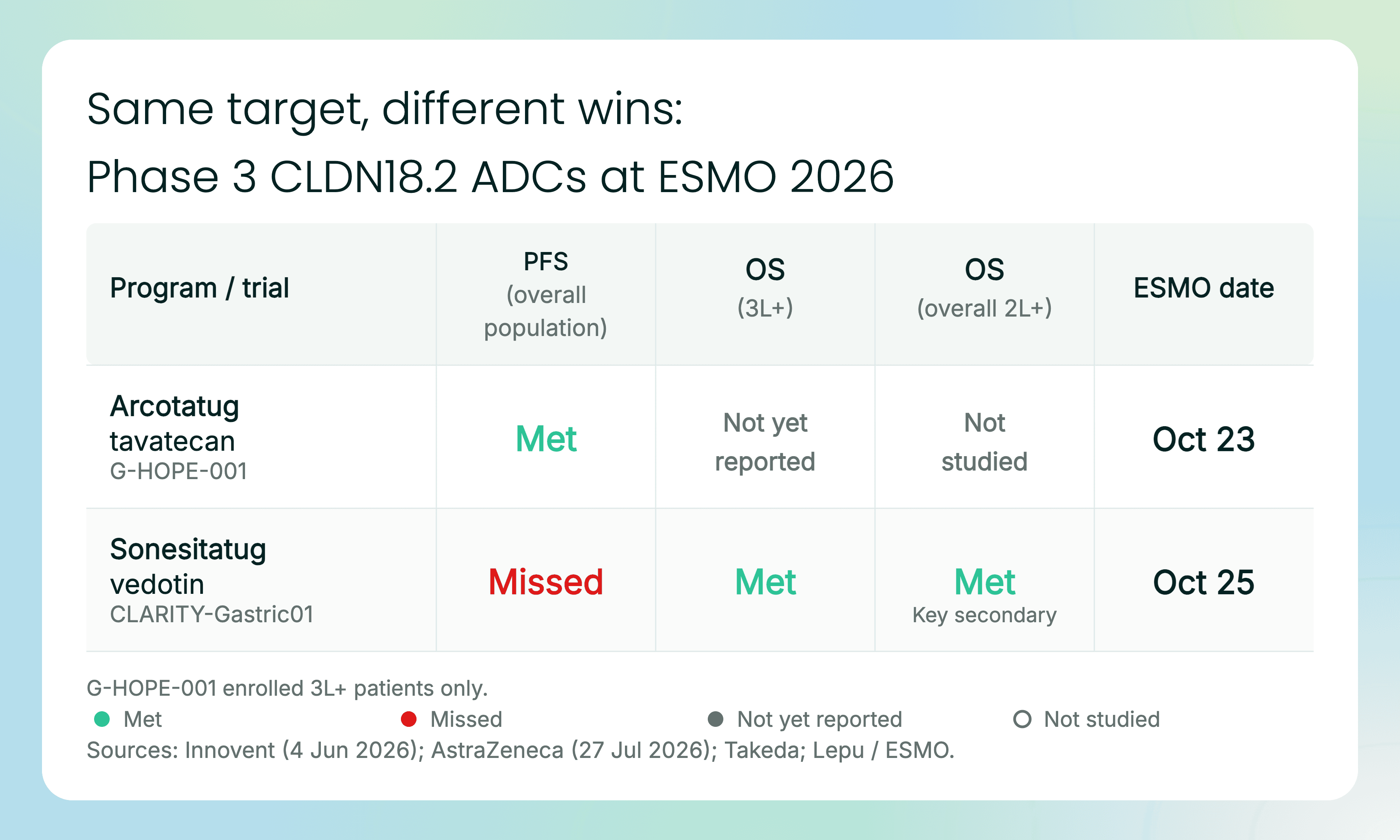
Two Phase 3 CLDN18.2 ADC trials will present late-breaking efficacy results in gastric/GEJ cancer at ESMO 2026, and both have announced a positive endpoint.[1] Arcotatug's G-HOPE-001 interim results showed progression-free survival (PFS) success at the first interim analysis[2]. Sonesitatug's CLARITY-Gastric01 topline results showed overall survival (OS) success in third-line-and-later patients, while overall-population PFS missed statistical significance[3]. The presentations are scheduled for October 23 and 25, respectively[4][5].
Updated: October 16, 2026.
ESMO's publication schedule places regular abstracts on October 19 and late-breaking abstracts on their presentation day. The October 19 release therefore will not include these two late-breaking Phase 3 readouts; their abstracts are expected on October 23 and 25, with full datasets released at the start of each presentation session[6].
Two programs address overlapping later-line populations
Arcotatug tavatecan and sonesitatug vedotin are antibody-drug conjugates (ADCs) directed at CLDN18.2, and both presentations report randomized Phase 3 efficacy in previously treated advanced gastric or gastroesophageal cancer[4][5]. Innovent's ESMO announcement and Takeda's pipeline update identify arcotatug's presentation[7]. Lepu Biopharma's ESMO announcement identifies sonesitatug's[5].
| Program and aliases | Trial / abstract | Date and named session | Public Phase 3 result |
| Arcotatug tavatecan, IBI343 / TAK-921 | G-HOPE-001 / LBA77 | October 23; Proffered paper 1: Gastrointestinal tumour, upper digestive | PFS met at first interim analysis[2] |
| Sonesitatug vedotin, CMG901 / AZD0901 | CLARITY-Gastric01 / LBA7 | October 25; Presidential Symposium II | OS met in 3L+; overall PFS not statistically significant[3] |
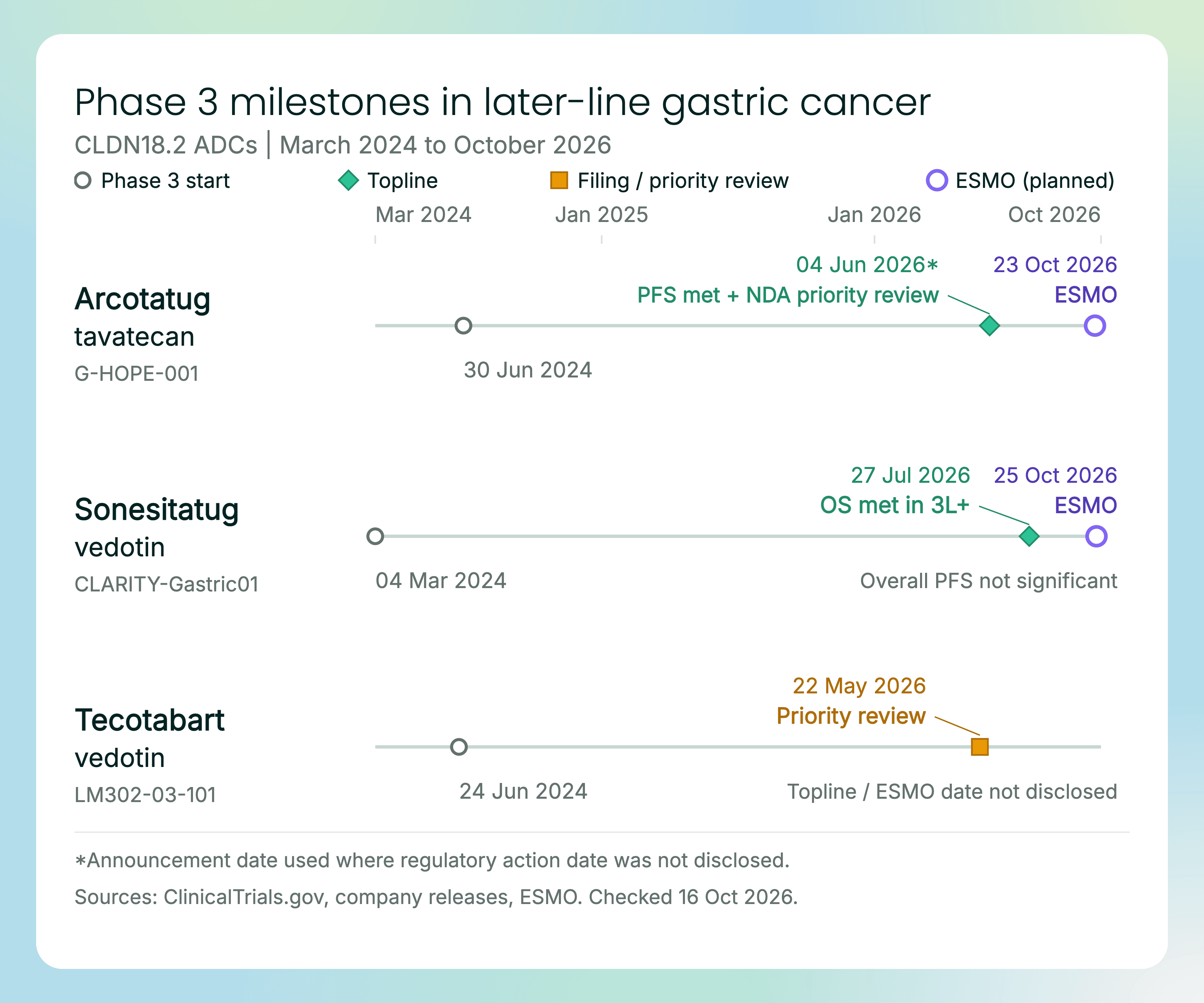
Phase 3 milestones for later-line CLDN18.2 ADCs in gastric/GEJ cancer. Markers use announcement dates where regulatory action dates were not disclosed. Sources: ClinicalTrials.gov, company releases, ESMO.[8][9][10]
Note: Excludes trials-in-progress such as CLARITY-Gastric02, 2954TiP[11].
The trials address overlapping later-line opportunities through different primary-endpoint designs. The G-HOPE-001 registry record specifies at least two prior treatment lines, while the CLARITY-Gastric01 registry record includes second-line patients and tests OS separately in its third-line-and-later population[8][9].
Arcotatug: a PFS win in a 464-patient trial
G-HOPE-001 reached its preset PFS primary endpoint at the first interim analysis, according to Innovent's June 4 announcement[2]. The ClinicalTrials.gov record lists 464 actual participants in the open-label Phase 3 study in China and Japan, with PFS and OS as primary endpoints[8]. It compares arcotatug monotherapy with investigator-selected irinotecan, paclitaxel or trifluridine/tipiracil in previously treated CLDN18.2-positive, HER2-negative gastric or gastroesophageal junction adenocarcinoma.
The trial requires progression after at least two, and no more than four, prior systemic treatment lines[8]. Innovent reported that China's NMPA had accepted its application with priority review for patients who had received at least two prior systemic therapies[2]. Takeda's September announcement says G-HOPE-001 could support a potential Japanese filing after evaluation of final results[4].
The published Phase 1 trial supplies a numerical efficacy baseline[12]. It enrolled and dosed 127 patients across escalation and expansion; among 31 patients with CLDN18.2-high gastric/GEJ adenocarcinoma treated at 6 mg/kg every three weeks, confirmed ORR was 29% and median PFS was 5.5 months. High expression meant 2+/3+ staining in at least 75% of tumor cells.
Arcotatug, also named IBI343 or TAK-921, combines a Claudin 18.2-directed antibody with an exatecan payload[4]. Takeda holds development, manufacturing and commercialization rights outside Greater China, connecting the regional Phase 3 evidence to a broader development strategy.
Sonesitatug: an OS win in a 594-patient trial
CLARITY-Gastric01 established a statistically significant OS benefit in its third-line-and-later primary-endpoint population, according to AstraZeneca's topline release of July 27[3]. OS also improved significantly in the overall second-line-and-later population, a key secondary endpoint. However, PFS assessed by blinded independent central review in the overall population, the other primary endpoint, did not reach statistical significance.
The ClinicalTrials.gov record lists 594 actual participants in this randomized, open-label, sponsor-blinded Phase 3 study[9]. Its primary OS analysis includes patients with at least two prior systemic treatment lines; the primary PFS analysis includes all randomized patients. The study includes advanced gastric, GEJ or distal esophageal adenocarcinoma after progression on at least one prior regimen containing fluoropyrimidine and platinum.
The published trial design specifies non-HER2-positive disease and CLDN18.2 staining in at least 25% of tumor cells at any intensity[13]. The selected sonesitatug dose is 2.2 mg/kg intravenously every three weeks. Investigator-choice comparators differ by treatment line: second-line options include ramucirumab plus paclitaxel, or a taxane where ramucirumab is contraindicated; third-line-and-later options include irinotecan, trifluridine/tipiracil outside China, or apatinib in China.
The earlier single-arm Phase 1 KYM901 study provides a response benchmark[14]. In its 113-patient gastric/GEJ full analysis set treated at 2.2-3.0 mg/kg across escalation and expansion, confirmed ORR was 28% (32/113; 95% CI 20-38); in the 109-patient efficacy analysis set, it was 29% (32/109; 95% CI 21-39). These Phase 1 cohorts used different biomarker cutoffs and doses, so the response rates are not directly comparable[12][14]. Among 107 gastric/GEJ patients in expansion, 68% had grade 3 or worse treatment-emergent adverse events, and one treatment-related death was reported.
Sonesitatug combines a CLDN18.2 antibody with an MMAE payload[5]. Lepu Biopharma's issuer announcement records that Lepu and Keymed developed CMG901 and licensed its global rights to AstraZeneca in 2023.
Tecotabart adds another late-stage competitor
Each ESMO asset faces the other qualifying program plus tecotabart vedotin (LM-302) in later-line CLDN18.2-positive gastric/GEJ cancer[15].
| Program | Trial / stage in the relevant setting | Competitive implication |
| Arcotatug tavatecan (IBI343 / TAK-921) | G-HOPE-001; Phase 3 interim PFS result reported; China NDA accepted with priority review; LBA77 scheduled for October 23 | Positive PFS provides a progression-control benchmark in 3L+ disease[2][4]. |
| Sonesitatug vedotin (CMG901 / AZD0901) | CLARITY-Gastric01; Phase 3 topline reported; LBA7 scheduled for October 25 | OS met in 3L+ and overall 2L+ populations; overall PFS missed statistical significance[3][5]. |
| Tecotabart vedotin (LM-302) | LM302-03-101; 3L+ Phase 3 enrollment complete; China application in priority review | Another MMAE ADC pursuing later-line CLDN18.2-positive gastric/GEJ cancer; no Phase 3 topline result identified at this update[16][15]. |
Tecotabart's third-line-and-later Phase 3 monotherapy trial completed enrollment, and its Chinese application entered priority review in May 2026 for patients with at least two prior systemic treatment lines[16][15]. Its development puts another MMAE ADC into the same later-line competitive field.
Biomarker populations also shape that field. Sonesitatug's Phase 3 design admits staining at any intensity in at least 25% of tumor cells; arcotatug's quoted Phase 1 efficacy cohort required 2+/3+ staining in at least 75%[13][12]. The ESMO data will show the efficacy and treatment burden within each pivotal trial's enrolled population.
Final Perspective
The October 23 presentation for arcotatug and October 25 presentation for sonesitatug will bring the detailed Phase 3 evidence into the later-line CLDN18.2 field[4][5]. Neither arcotatug’s topline announcement nor sonesitatug’s topline release reported numerical Phase 3 hazard ratios[2][3]. For arcotatug, the key questions are the size of the PFS effect, OS maturity and control-arm composition; for sonesitatug, they are the magnitude of the third-line-and-later OS effect and its relationship to the overall PFS result. Dose reductions, discontinuations and severe adverse events will help define the treatment burden alongside efficacy.
Together, the readouts should clarify the clinical evidence each program can bring to a later-line development strategy, with tecotabart vedotin the next competitor to assess as its application progresses[15]. Biomarker thresholds and treatment-line distributions will be central to interpreting the results and subsequent filings[13][12].