How to Build an Indication-Level Competitive Landscape

An indication-level competitive landscape defines the patient population, inclusion criteria and counting unit. Each asset links to verified development and regulatory evidence. This example covers six distinct original complement-inhibitor ingredients with FDA orphan approvals for paroxysmal nocturnal hemoglobinuria (PNH), identified on October 21, 2026.
Six steps connect scope, inclusion criteria, discovery, verification, table construction and ongoing updates.
Updated October 30, 2026
1. Define the Indication Around the Decision
The decision determines the scope. An approved-treatment map covers labeled populations and treatment roles. A licensing screen also needs investigational programs and their next evidence milestones.
The scope specifies the disease, subtype or biomarker, treatment setting and research date. This example covers U.S. FDA orphan-approved PNH ingredients across all modalities and complement targets. Each ingredient receives one row. Biosimilars, supportive care, transplantation and investigational programs fall outside the boundary.
2. Fix Inclusion Criteria Before Gathering Assets
Inclusion criteria specify stages, modalities, mechanisms and geography. Discontinued programs can occupy a separate historical view. Geography needs a precise definition. A U.S. approval screen differs from a screen for trials with U.S. sites.
Repeat approvals for one ingredient stay in one row. Treatment role occupies a separate field. Maven's 2025 FDA approvals analysis also distinguishes an approval cohort from a therapeutic landscape.
3. Gather Assets and Reconcile the Entire Universe
Discovery combines structured indication data with an independent primary-source roster. The candidate file retains generic names, brands, development codes, company associations and supporting documents. A stable identifier joins aliases while preserving original names for searches and duplicate checks.
Structured indication data supplied this example's candidates. The FDA orphan-drug search for approved products under “hemoglobinuria” returned nine approval records, including four for ravulizumab. Those records reconcile to six distinct ingredients. [1]
The final check compares all included names with the primary roster and records each exclusion reason.
4. Verify Stage and Treatment Role Against Primary Sources
Verification applies to the asset's indication and geography. FDA approval records establish regulatory events. Current U.S. labels establish populations and treatment roles. For clinical programs, registry records distinguish trial phase and recruitment status from regulatory status.
Eculizumab and ravulizumab are C5-directed monoclonal antibodies. [2] [3]
Crovalimab is also a C5-directed monoclonal antibody. Pegcetacoplan is a PEG-linked peptide that binds C3 and C3b. [4] [5]
Iptacopan targets factor B. Danicopan targets factor D and is approved as an add-on to ravulizumab or eculizumab for extravascular hemolysis in adults with PNH. [6] [7]
5. Structure the Table and Chart From the Same Rows
The review table pairs asset and brand with indication-specific status and treatment role. The working file retains modality, target, regional rights holder, source URL, source date, last-checked date and next review trigger. Clinical pipelines add trial identifiers, phase, recruitment status and milestones.
The six-ingredient table reconciles the FDA orphan-approval roster with the agency's PNH treatment review. Targets follow the U.S. labels above. [8]
| Active ingredient | U.S. brand | Complement target | PNH stage in the U.S. | Approved treatment role |
|---|---|---|---|---|
| Eculizumab | Soliris | C5 | Approved | PNH, to reduce hemolysis |
| Ravulizumab-cwvz | Ultomiris | C5 | Approved | PNH |
| Crovalimab-akkz | Piasky | C5 | Approved | PNH in patients aged 13 or older, weighing at least 40 kg |
| Pegcetacoplan | Empaveli | C3/C3b | Approved | PNH in adults |
| Iptacopan | Fabhalta | Factor B | Approved | PNH in adults |
| Danicopan | Voydeya | Factor D | Approved | Add-on to ravulizumab or eculizumab for extravascular hemolysis in adults with PNH |
All distinct original complement-inhibitor ingredients with FDA orphan approval records for PNH, identified October 21, 2026. Multiple formulations and approval records count once per ingredient.
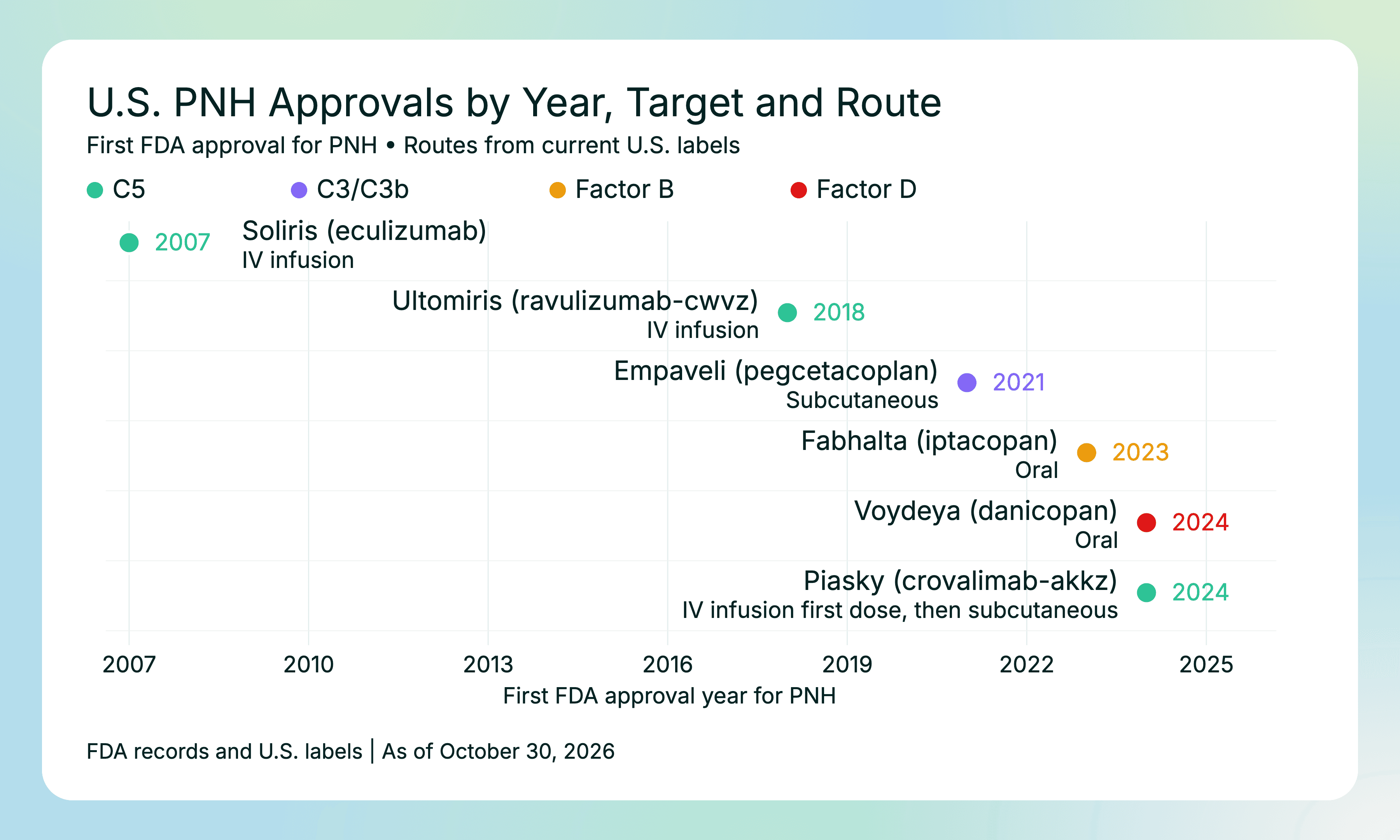
The first two approvals were IV C5 antibodies. [1] [2] [3] Later approvals added subcutaneous and oral options at C3/C3b [5], factor B [6] and factor D [7], while Piasky added a C5 antibody given by IV infusion first, then subcutaneous injection. [4]
Three ingredients target C5; one targets each remaining complement group. The table retains danicopan's add-on role. Maven's KRAS landscape analysis separates molecular scope and indication-specific development in a broader clinical map.
6. Keep the Landscape Current With Defined Review Triggers
A named owner monitors regulatory decisions, label changes, trial starts, recruitment changes, results and licensing disclosures. The decision determines the review cadence. Each update retains the previous value, replacement, source and review date.
A qualifying approval adds a row. A formulation or label extension may update an existing row. Separate membership checks from changes to existing fields. The table and chart draw from the same maintained file, so their asset counts stay aligned with the evidence.
Final Perspective
The PNH example shows how a complete approved-treatment layer becomes more useful when identity, mechanism and treatment role remain separate. An expanded pipeline can follow the same sequence, with its own stage and geography rules, evidence requirements and inclusion ledger.
Maven Bio's live intelligence monitors sources within a team's defined scope and applies source-linked edits to selected working files, including competitive landscapes, for review. [9]