Four Alzheimer Drug Readouts to Watch at CTAD 2026

Four oral reports qualify for the November 16-17 drug-outcomes preview at CTAD 2026. They are AR1001, lecanemab, remlifanserin and PRI-002. Across all 19 oral slots, these are the presentations whose titles identify a drug and original efficacy, safety or long-term trial outcomes. Together, they cover pivotal efficacy, extended treatment, psychosis and an earlier-stage oral candidate. [1]
Updated October 26, 2026
The scheduled sessions place different kinds of evidence alongside one another, making the clinical question the starting point for competitor assessment. All times below follow the organizer's Boston program. [1]
| Session | Drug / trial | Scheduled focus |
|---|---|---|
| November 16, 4:05 p.m., OC2 | AR1001 / POLARIS-AD | Phase 3 efficacy at 52 weeks; extension safety |
| November 16, 6:00 p.m., OC6 | Lecanemab / Clarity AD extension | Early findings through 60 months |
| November 17, 9:35 a.m., OC7 | Remlifanserin | Efficacy and safety in Alzheimer psychosis |
| November 17, 10:05 a.m., OC9 | PRI-002 / PRImus-AD | Phase 2b topline safety and efficacy |
Oral communications only, November 16-17; title-based drug-outcomes criteria exclude biomarker-only, review, observational, lifestyle and device reports, plus other presentation formats.
AR1001 Brings a Pivotal Efficacy Question
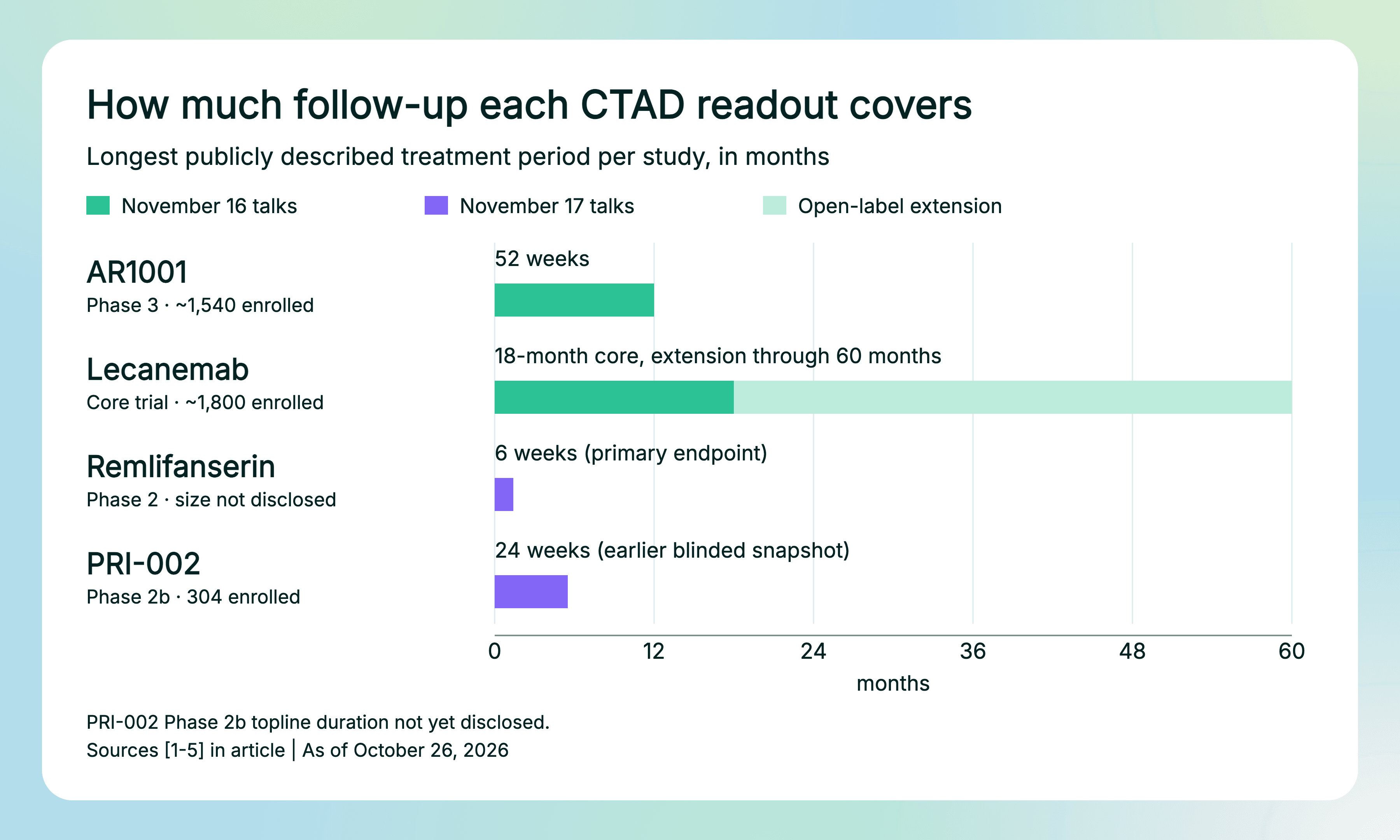
POLARIS-AD is the pivotal trial in this group. AriBio's August update described a randomized, double-blind, placebo-controlled Phase 3 study of the oral PDE5 inhibitor AR1001 in early Alzheimer's disease, with approximately 1,540 participants enrolled. Of those, approximately 1,350 completed the 52-week dosing period; the final post-treatment safety visit occurred on July 27, 2026. The company planned to present detailed Phase 3 results at CTAD. [2]
AriBio reported that 95.5% of eligible participants entered the optional extension and that it was scheduled to conclude in July 2027. [2]
CTAD is scheduled to add 52-week Phase 3 efficacy results and extension safety data.
Lecanemab Extends the Treatment Horizon
Lecanemab's clinical context is longer-term treatment after a controlled core study. Eisai's current clinical-results page describes Clarity AD as an 18-month randomized trial enrolling approximately 1,800 people with mild cognitive impairment or mild dementia due to Alzheimer's disease and confirmed amyloid pathology. Its long-term extension is open-label and single-arm, and the company's existing four-year presentation uses matched historical ADNI observations for comparison. [3]
CTAD is scheduled to add early extension findings through 60 months.
Remlifanserin Adds Detail After a Missed Primary Endpoint
Remlifanserin enters CTAD with Phase 2 topline results already disclosed. On September 24, Acadia reported that the 60 mg dose produced a week-six change of -12.6 on the SAPS-H+D psychosis scale versus -10.4 for placebo, with p=0.0603. The primary endpoint missed statistical significance; the key secondary CGI-S-ADP result had a nominal p-value of 0.0077. [4]
The company said it would continue its two ongoing Phase 3 studies while amending the program, including removing the 30 mg arm. It also reported similar rates of adverse events, serious adverse events and adverse-event discontinuations across the active doses and placebo, and planned detailed safety and efficacy data for CTAD. [4]
CTAD is scheduled to add detailed safety and efficacy data after the Phase 2 topline disclosure.
PRI-002 Moves Beyond the Earlier Safety Snapshot
PRI-002's earlier public dataset centered on safety during ongoing treatment. Priavoid's March announcement described blinded observations from the first 90 participants over 24 weeks, while the full randomized, double-blind, placebo-controlled PRImus-AD study enrolled 304 participants at 38 locations in six European countries. The sponsor describes PRI-002 as an oral all-D-peptide designed to disassemble amyloid-beta oligomers. [5]
CTAD is scheduled to add Phase 2b topline safety and efficacy results beyond the earlier blinded safety snapshot.
Final Perspective
The four presentations address different decisions, from pivotal evidence for AR1001 to proof of concept for PRI-002. Maven will update this page with the reported results after November 17.