Q2 2024 Revenue and Growth Across Ten Major Biopharma Companies

In the second quarter of 2024, all ten of the large biopharma companies compared here grew revenue year over year, and their combined revenue rose about 8%. Eli Lilly led the group at 36%, while Novo Nordisk and Amgen, outside this group, also posted strong growth.
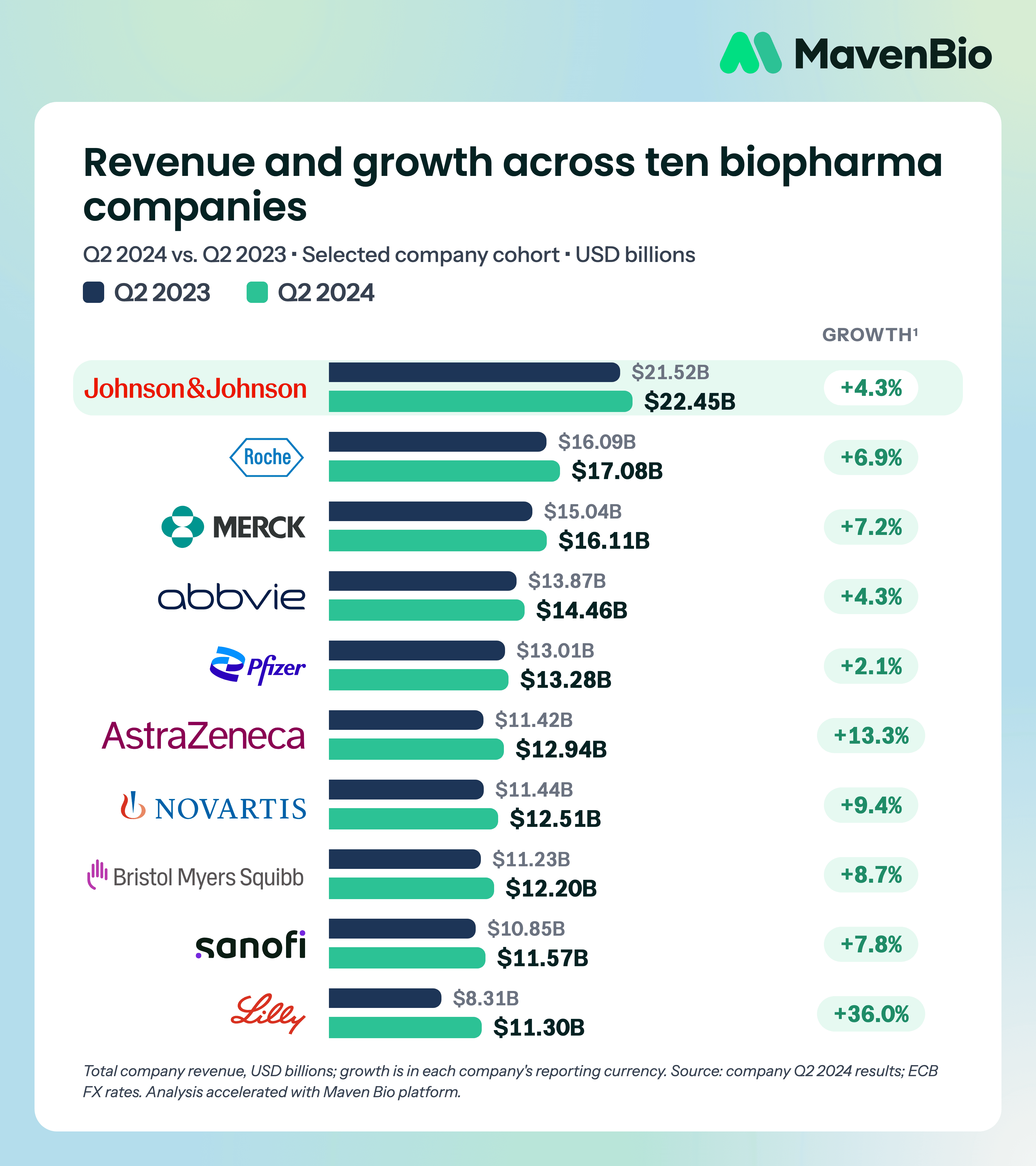
Q2 2024 Revenue and Year-over-Year Growth
The comparison uses total company revenue from continuing operations for April–June in both years. J&J includes MedTech, Roche includes Diagnostics, Merck includes Animal Health, and Sanofi includes its then-owned consumer-health business, Opella. Novartis excludes discontinued Sandoz operations and J&J excludes discontinued Kenvue operations in both periods. These are company-size comparisons, not pharmaceutical-only sales or an estimate of the pharmaceutical market.
- Johnson & Johnson: Q2 2024 revenue $22.447 billion versus $21.519 billion in Q2 2023; reported growth in its reporting currency 4.3%. Company-reported adjusted growth: 6.6% operational. Q2 results.
- Roche: Q2 2024 revenue $17.082 billion versus $16.088 billion in Q2 2023; reported growth in its reporting currency 6.9%. Underlying revenue: CHF15,449 million versus CHF14,457 million. Company-reported adjusted growth: 9% CER. Q2 results.
- Merck: Q2 2024 revenue $16.112 billion versus $15.035 billion in Q2 2023; reported growth in its reporting currency 7.2%. Company-reported adjusted growth: 11% excluding FX. Q2 results.
- AbbVie: Q2 2024 revenue $14.462 billion versus $13.865 billion in Q2 2023; reported growth in its reporting currency 4.3%. Company-reported adjusted growth: 5.6% operational. Q2 results.
- Pfizer: Q2 2024 revenue $13.283 billion versus $13.007 billion in Q2 2023; reported growth in its reporting currency 2.1%. Company-reported adjusted growth: 3% operational. Q2 results.
- AstraZeneca: Q2 2024 revenue $12.938 billion versus $11.416 billion in Q2 2023; reported growth in its reporting currency 13.3%. Company-reported adjusted growth: 17% CER. Q2 results.
- Novartis: Q2 2024 revenue $12.512 billion versus $11.437 billion in Q2 2023; reported growth in its reporting currency 9.4%. Company-reported adjusted growth: 11% constant currency. Q2 results.
- Bristol Myers Squibb: Q2 2024 revenue $12.201 billion versus $11.226 billion in Q2 2023; reported growth in its reporting currency 8.7%. Company-reported adjusted growth: 11% excluding FX. Q2 results.
- Sanofi: Q2 2024 revenue $11.569 billion versus $10.849 billion in Q2 2023; reported growth in its reporting currency 7.8%. Underlying revenue: EUR10,745 million versus EUR9,965 million. Company-reported adjusted growth: 10.2% CER. Q2 results.
- Eli Lilly: Q2 2024 revenue $11.303 billion versus $8.312 billion in Q2 2023; reported growth in its reporting currency 36.0%. Q2 results.
USD revenue is ranked within this selected ten-company cohort. EUR and CHF figures are translated using arithmetic averages of ECB daily rates for each quarter: USD/EUR 1.088679 in Q2 2023 and 1.076717 in Q2 2024; USD/CHF 1.112830 and 1.105681, respectively. Each daily USD/CHF rate is USD/EUR divided by CHF/EUR, then averaged across available business days (62 in Q2 2023; 63 in Q2 2024). Translated dollar amounts are approximate and are not company-reported USD results. Reported growth is calculated as (Q2 2024 revenue ÷ Q2 2023 revenue − 1) × 100 in each company’s reporting currency. CER, constant-currency and operational figures are separately supplied by each company; they are not calculated from these ECB conversions. Revenue is not summed into a market total because partnership accounting can overlap. ECB daily exchange-rate data.
Eli Lilly: Surging Demand for GLP-1 Therapies
Eli Lilly reported Q2 2024 revenue of $11.303 billion, up 36% as reported. Strong Mounjaro and Zepbound sales supported an increase of $3 billion in its full-year revenue guidance to $45.4–46.6 billion at that results announcement. Both products contain tirzepatide, a dual GIP/GLP-1 receptor agonist. Lilly also committed an additional $5.3 billion to its Lebanon, Indiana manufacturing site to increase production capacity. The investment addressed future supply; it was not production already available in Q2. Lilly Q2 results.
AstraZeneca: Oncology and Cardiometabolic Powerhouses
At its Q2 2024 results announcement, AstraZeneca raised its full-year total-revenue and core-EPS guidance to mid-teens percentage growth at constant exchange rates. Q2 oncology revenue rose 15% as reported and 19% at constant exchange rates. Tagrisso demand and growth in Calquence and Enhertu contributed; AstraZeneca’s recorded Enhertu revenue should not be substituted with combined partner sales. AstraZeneca Q2 results.
Farxiga sales rose 29% as reported and 32% at constant exchange rates in Q2 2024. In June 2024, its US approval expanded to improving glycemic control in children aged ten years and older with type 2 diabetes. Farxiga results and approval.
Novartis: Robust Performance and Pipeline Advancement
Novartis raised its full-year core-operating-income growth guidance in July 2024 to mid-to-high teens at constant currencies, from low-double-digit to mid-teens growth. Its net-sales growth guidance remained high-single to low-double digits at constant currencies; that part of the outlook was unchanged. Novartis outlook.
Kesimpta, Kisqali and Entresto posted Q2 2024 reported USD sales growth of 63%, 45% and 25%, respectively; the corresponding constant-currency increases were 65%, 50% and 28%. For Pluvicto, management estimated a mid-30% share in the then-approved VISION population and around 50% at established radioligand-therapy sites. Some sites exceeded 90%, but that was not a nationwide market-share figure. Product results. Pluvicto management commentary, slide 10.
Novartis also described expanding Pluvicto access through less-established sites and community oncology. In July 2024, management said roughly a third of its 475 treatment sites were near 10% share of the VISION population and needed to grow, while other sites were working to move from about 50% toward 90%. These were site-level commercial ambitions, not achieved results or a clinical efficacy measure. Q2 earnings-call discussion.
Bristol Myers Squibb: Growth Portfolio and Eliquis Success
Bristol Myers Squibb reported Q2 2024 revenue of $12.201 billion, up 8.7% using the disclosed amounts, rounded to 9% in its release (11% excluding foreign exchange). Its Growth Portfolio and Eliquis supported performance. BMS recorded $3.416 billion in Eliquis revenue, up 7%. Pfizer separately records revenue under their alliance; summing both companies’ reported figures would not measure unique worldwide Eliquis sales. BMS Q2 results. Pfizer alliance reporting.
At the July 2024 announcement, BMS raised its full-year non-GAAP EPS outlook to $0.60–0.90 from $0.40–0.70 and expected revenue growth at the upper end of the low-single-digit range. These were the forecasts issued with Q2 results, not current guidance. BMS guidance table.
Pfizer’s Performance Amid Declining COVID Revenue
Pfizer’s Q2 2024 revenue rose 2% as reported and 3% operationally; operational growth excludes foreign-exchange effects. Excluding Comirnaty and Paxlovid, operational revenue grew 14%, including contributions from the acquired Seagen business. Eliquis and the Vyndaqel family also supported growth. The ex-COVID measure was not an acquisition-adjusted organic growth rate. Pfizer Q2 results.
At that results announcement, Pfizer raised its 2024 revenue outlook by $1 billion at the midpoint to $59.5–62.5 billion, including an anticipated $8.5 billion from Comirnaty and Paxlovid. It also described a first-phase manufacturing optimization target of about $1.5 billion in savings by the end of 2027. These were management forecasts made in July 2024, rather than savings already realized. Pfizer Q2 results.
Novo Nordisk and Amgen: Additional Growth Context
Novo Nordisk and Amgen provide additional context on Q2 growth outside the ten-company comparison above.
Novo Nordisk reported Q2 2024 net sales of DKK68.060 billion versus DKK54.300 billion, up 25% both as reported and at constant exchange rates. Ozempic and Wegovy were important growth drivers. Levemir’s 82% and haemophilia B products’ 45% increases in the quarterly product table were constant-exchange-rate measures; haemophilia B is a product category, not a drug name. Novo Nordisk Q2 results and product appendix.
Amgen’s Q2 2024 product sales rose 20%, with 26% volume growth partly offset by pricing and other factors. Excluding acquired Horizon products, product sales grew 5% with 10% volume growth. Twelve products achieved double-digit sales increases, including Prolia, Evenity, Repatha, Tezspire, Blincyto and Tavneos. Amgen-recorded Tezspire sales rose 76%; that figure is not combined worldwide partner revenue. Amgen Q2 results.
Amgen reported approximately $1.1 billion of rare-disease product sales, including Tepezza, Krystexxa, Uplizna and Tavneos. Horizon, acquired in October 2023, contributed to the portfolio, but the $1.1 billion should not be described as entirely Horizon-acquired sales. Amgen rare-disease portfolio.