Post-Keytruda: Potential Growth Drivers for Merck

Winrevair: A Breakthrough in Pulmonary Arterial Hypertension
Winrevair (sotatercept) received its first U.S. approval on March 26, 2024 and EU authorization on August 22, 2024 for adults with pulmonary arterial hypertension. The activin-signaling inhibitor was studied as an addition to background PAH treatment, not a replacement for all existing therapies. Source 1; Source 2
In STELLAR, 323 patients with WHO functional class II or III PAH received sotatercept or placebo alongside background therapy. The trial's primary endpoint assessed six-minute walk distance at week 24. A secondary composite of death or clinical worsening occurred in 9 of 163 sotatercept patients versus 42 of 160 placebo patients (hazard ratio 0.16; 95% CI 0.08–0.35). The often-cited 84% reduction concerns this composite hazard; it is not an 84% reduction in mortality alone. Hemoglobin elevation, thrombocytopenia and bleeding require clinical monitoring. Source 1
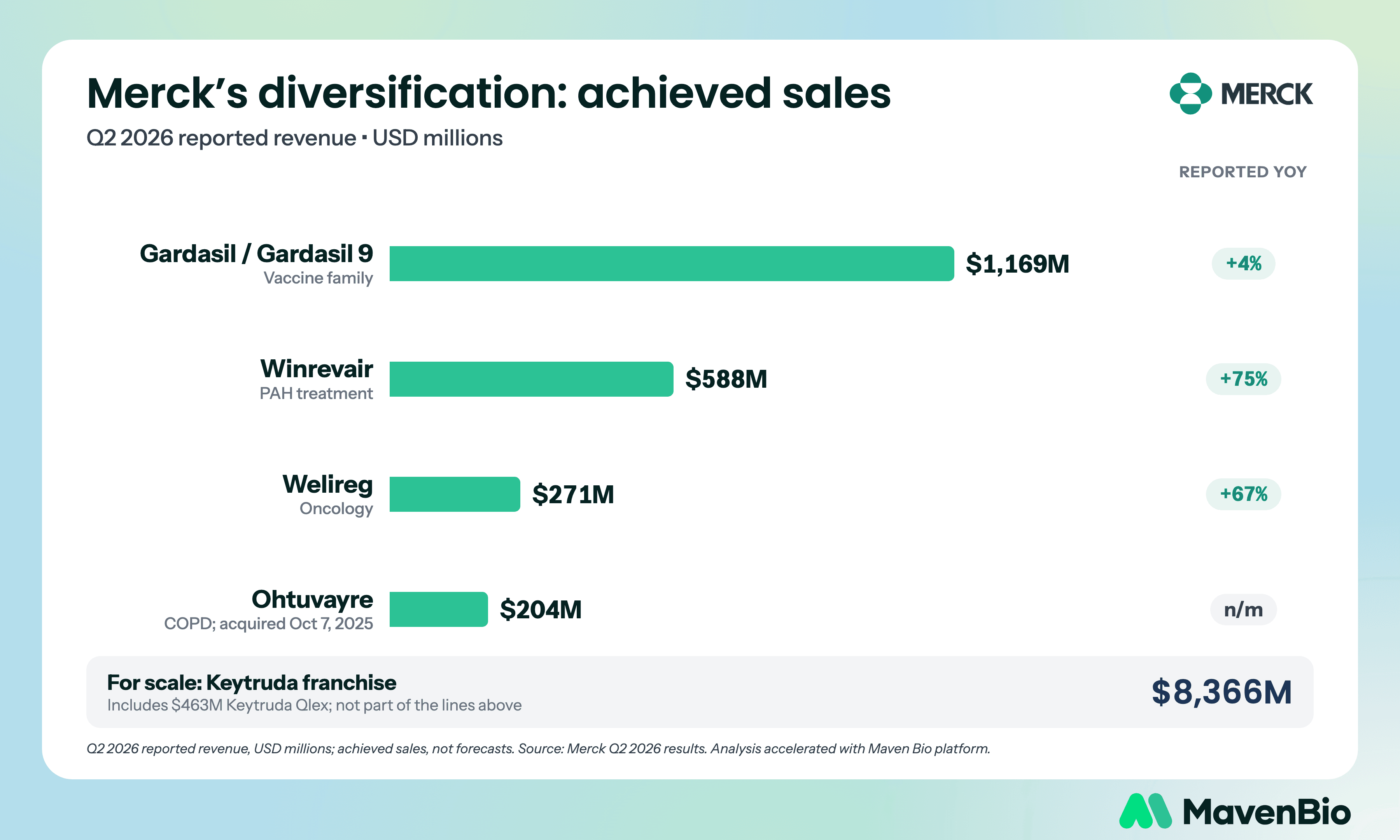
Commercial uptake now provides a firmer basis for assessing the opportunity than the original analyst peak-sales estimates. Winrevair generated $1.443 billion in 2025 and $588 million in Q2 2026, up 75% year over year as reported. Those are achieved sales, not evidence that a particular future peak-sales forecast will be met. Source 1; Source 2
Gardasil: Combating HPV-Related Cancers
Gardasil/Gardasil 9 generated $8.886 billion in 2023, but the franchise has not maintained that growth trajectory. Combined sales fell to $5.233 billion in 2025, down 39% from 2024. Merck cited China demand weakness in its results. Q2 2026 sales recovered to $1.169 billion, up 4% as reported, although one quarter of growth does not establish a return to the earlier annual peak. These figures cover both Gardasil products, not Gardasil 9 alone. Source 1; Source 2; Source 3
The access opportunity remains distinct from Merck's sales performance. WHO reported in July 2024 that 27% of adolescent girls globally had received at least one HPV-vaccine dose in 2023. Merck's proposed single-dose Gardasil 9 studies were intended to investigate a potential label change. Its May 23, 2025 statement said FDA feedback required effectiveness comparable to the three-dose regimen, efficacy beyond persistent cervical infection, and data in men. A research proposal or WHO dosing recommendation should not be presented as a U.S. single-dose approval. In January 2026, the CDC reduced its recommended adolescent HPV schedule to a single dose; Gardasil 9's U.S. label still specifies two or three doses. Source 1; Source 2
Welireg: Expanding Horizons in Renal Cell Carcinoma
The FDA's December 14, 2023 Welireg (belzutifan) approval covered advanced renal cell carcinoma following both a PD-1/PD-L1 inhibitor and a VEGF tyrosine-kinase inhibitor. It was not an unrestricted first-line RCC approval. Merck reported Q2 2024 Welireg sales of $126 million and 150% growth using its underlying unrounded figures. More recently, Q2 2026 sales reached $271 million, up 67% as reported. Source 1; Source 2; Source 3
Welireg's original August 2021 approval was for adults with von Hippel–Lindau disease requiring therapy for associated RCC, central nervous system hemangioblastomas or pancreatic neuroendocrine tumors that did not require immediate surgery. Its mechanism is HIF-2α inhibition. This defined population should remain distinct from the later advanced-RCC indication and from investigational combinations. Source 1
Ohtuvayre: Adding an Established COPD Product
Merck completed its acquisition of Verona Pharma on October 7, 2025, paying $107 per American Depositary Share for a transaction valued at approximately $10 billion. Each ADS represented eight ordinary shares. This replaces the original July 2025 expectation of a future closing. The deal added Ohtuvayre (ensifentrine), expanding Merck's respiratory business beyond PAH. Source 1
Ohtuvayre received U.S. approval in June 2024 for maintenance treatment of COPD in adults and launched that August. Verona reported $71.3 million in Q1 2025 net product sales, before the acquisition. Merck subsequently reported $204 million in Q2 2026 sales, including a benefit from specialty-pharmacy purchase timing. These are different reporting periods and owners; neither figure represents a full year of sales or an acquisition return. Source 1; Source 2
Ohtuvayre is a nebulized PDE3/PDE4 inhibitor, taken twice daily. In the placebo-controlled ENHANCE-1 and ENHANCE-2 trials, the primary week-12 endpoint showed placebo-adjusted improvements of 87 mL and 94 mL in average FEV1 over 12 hours. The 24-week moderate/severe exacerbation rate reductions were 36% and 43%; the first trial's p-value was 0.0503. Background inhaled corticosteroids were permitted with a LABA or LAMA, so these results should not be described as universally achieved 'without steroids.' Source 1; Source 2
The COPD therapies address different treatment settings. Inhaled bronchodilators and combinations such as Trelegy (ICS/LAMA/LABA) remain maintenance options. Daliresp (roflumilast) is an oral PDE4-inhibitor tablet for reducing exacerbation risk in severe COPD with chronic bronchitis and an exacerbation history—it is not inhaled. Dupixent, and since 2025 Nucala, have U.S. add-on maintenance indications for adults with inadequately controlled COPD and an eosinophilic phenotype. Source 1; Source 2; Source 3; Source 4
These trial results do not rank Ohtuvayre above triple inhalers or biologics: study populations, background treatments, endpoints and follow-up differ. The ENHANCE program was not a head-to-head comparison against those therapies. Ohtuvayre's distinct mechanism broadens Merck's portfolio, but the acquisition itself does not demonstrate superior clinical outcomes, affordability or enough future revenue to offset Keytruda's exposure. Source 1
Softening Keytruda's Patent Cliff
Merck's 2025 annual filing says U.S. biosimilar competition for Keytruda could begin in December 2028, when the primary compound patent expires. Two other composition-of-matter-family patents expire in 2029 and are expected to face litigation. Thus, 2028 is a key exposure date, not a statement that all intellectual-property protection ends simultaneously worldwide. Competition for this biologic is described as biosimilar competition, rather than conventional generic competition. Source 1
Subcutaneous pembrolizumab has progressed beyond the original trial forecast: the FDA approved Keytruda Qlex on September 19, 2025 for labeled solid-tumor indications. It changes administration, but its approval alone does not establish protection of the intravenous franchise after patent expiry. In Q2 2026, combined Keytruda/Keytruda Qlex sales were $8.366 billion, including $463 million of Qlex. These are formulation-level commercial results, not evidence that the patent exposure has disappeared. Source 1; Source 2
Conclusion
Merck now has several measurable sources of growth beyond intravenous Keytruda, including Winrevair, Welireg and Ohtuvayre. Gardasil's decline shows why diversification should be assessed across the portfolio rather than inferred from promising clinical programs alone. The relevant questions are how much incremental revenue launches generate, whether clinical evidence supports wider use, and how that revenue compares with the business exposed to future Keytruda competition. Neither acquiring a product nor changing a formulation guarantees that the gap will be filled. Source 1; Source 2; Source 3