Large Pharma M&A: Comparing Disclosed Deal Values in 2022–2023

Pfizer, Amgen, Bristol Myers Squibb and AbbVie made the largest disclosed acquisition commitments among large pharma companies in 2022–2023. Several of the biggest acquirers also faced major upcoming losses of exclusivity, while others added assets in new therapeutic areas.
Pfizer’s four acquisitions announced in 2022–2023 had approximately $62.6 billion in combined equity and base consideration: Seagen (approximately $44.5 billion), Global Blood Therapeutics ($5.8 billion), Biohaven (approximately $11.9 billion, including Pfizer’s existing shares valued at the offer price), and ReViral ($425 million before working-capital adjustments). These values exclude contingent payments and are not a measure of cash spent during the period.
BMS and AbbVie are good examples - BMS’s announced 2022–2023 acquisitions included Turning Point ($4.1 billion), Mirati ($4.8 billion), Karuna ($14.0 billion) and RayzeBio ($4.1 billion), totaling $27.0 billion in announced equity value before contingent payments. The latter three closed in 2024, so this is not cash spent during 2022–2023. BMS is facing LOEs on Opdivo and Eliquis this decade, while AbbVie's top-selling drug Humira began facing U.S. biosimilar competition in January 2023, and its global net revenues fell 32.2% in 2023 to $14.404 billion, from $21.237 billion in 2022.
M&A also gives companies access to new assets and technologies:
Pfizer’s Seagen acquisition expanded its antibody-drug conjugate portfolio, Lilly’s DICE acquisition added oral immunology drug candidates, and Novo Nordisk’s Embark acquisition added a metabolic drug program.
Meanwhile, other large companies pursued smaller individual acquisitions. Novartis acquired Chinook for $3.2 billion upfront, with up to $300 million more tied to regulatory milestones, while Sanofi agreed to acquire Provention Bio for approximately $2.9 billion in equity value.
A smaller acquisition total does not, by itself, show that a company faces less pressure from patent expiries or has a stronger internal pipeline.
Regardless of the merits of each individual deal, one thing is clear: the industry needs to ensure that the coming wave of M&A to address looming LOEs doesn't result in overpriced deals that hamper returns in the long run.
| Company (ordered by included deal value) | Included deal value (USD billions, approximate) | 2023 year-end market cap (USD billions) | Included value / year-end market cap |
|---|---|---|---|
| Pfizer | 62.63 | 162.56 | 38.5% |
| Amgen | 31.80 | 154.14 | 20.6% |
| Bristol Myers Squibb | 27.00 | 104.40 | 25.9% |
| AbbVie | 19.30 | 273.60 | 7.1% |
| Merck | 12.15 | 276.25 | 4.4% |
| Roche | 10.05 | 234.39 | 4.3% |
| GSK | 6.00 | 76.25 | 7.9% |
| Lilly | 4.32 | 553.36 | 0.8% |
| Novartis | 3.70 | 207.53 | 1.8% |
| AstraZeneca | 3.31 | 209.17 | 1.6% |
| Sanofi | 2.90 | 124.71 | 2.3% |
| Novo Nordisk | 1.12 | 461.21 | 0.2% |
| Gilead | 0.41 | 100.94 | 0.4% |
The included transactions sum to approximately $184.7B across 13 companies. This is a disclosed-value subtotal, not total industry acquisition spending. It excludes Gilead's Tmunity and XinThera, Lilly's Versanis, Emergence and Mablink, and Novo Nordisk's Inversago because the comparable consideration was not established. AstraZeneca's Neogene is also excluded: its $200M initial payment and up to $120M of mixed contingent and noncontingent payments do not establish a full, comparable noncontingent equity value. The scope covers drug developers and excludes device, diagnostics and supplement businesses. Merck's Caraway acquisition is excluded because its November 2023 announcement disclosed only a potential $610M total, including an unspecified upfront payment and contingent milestones. Other scope exclusions include Sanofi's Qunol (supplements) and Roche's LumiraDx's point-of-care business (diagnostics); BIOCORP is excluded as a device business.
The market-cap denominators are CompaniesMarketCap's published 2023 year-end USD estimates. Using year-end values places the denominator after the 2022–2023 announcement window, unlike the original June 30, 2023 comparison. The ratios indicate the scale of disclosed deal values relative to company equity value at that endpoint; they do not measure affordability, cash expenditure or investment returns. Provider estimates and rounding can affect the ratios. Pfizer Amgen Bristol Myers Squibb AbbVie GSK Merck Roche Novartis AstraZeneca Sanofi Lilly Novo Nordisk Gilead
Acquisition sources by buyer: Pfizer: Global Blood Therapeutics; Biohaven; Seagen; ReViral; Amgen: ChemoCentryx; Horizon; Bristol Myers Squibb: Turning Point Therapeutics; Mirati Therapeutics; Karuna Therapeutics; RayzeBio; AbbVie: Syndesi Therapeutics; DJS Antibodies; Mitokinin; ImmunoGen; Cerevel Therapeutics; GSK: Sierra Oncology; Affinivax; BELLUS Health; Merck: Imago BioSciences; Prometheus Biosciences; Roche: Good Therapeutics; Telavant; Carmot Therapeutics; Novartis: Chinook Therapeutics; DTx Pharma; AstraZeneca: CinCor; Gracell; Icosavax; TeneoTwo; LogicBio; Sanofi: Provention Bio; Lilly: DICE; POINT; Akouos; Sigilon; Novo Nordisk: Forma; Embark; Gilead: MiroBio;
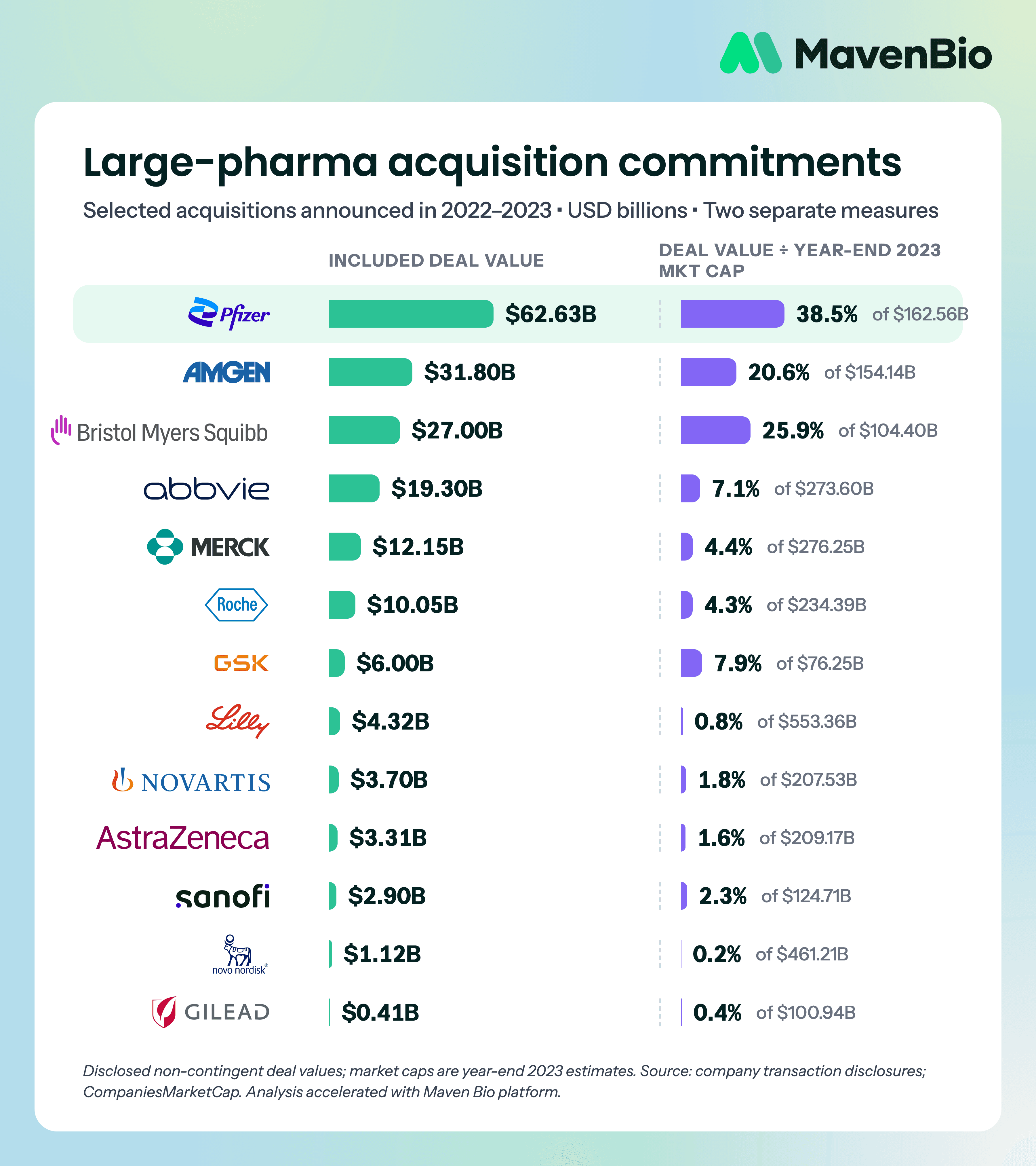
Methodology: This comparison covers the selected transactions listed below, rather than a complete ranking of every acquisition by each company. Comparison basis: disclosed upfront or noncontingent equity values for acquisitions announced in 2022–2023, including deals that closed in 2024. Amounts exclude contingent milestones and CVRs, acquired-cash deductions, fees and later purchase-accounting adjustments. They measure announced deal value, not cash spent. Undisclosed or noncomparable values are excluded from the subtotals rather than treated as zero.