FDA Biosimilar Approvals Through Q3 2026 and Their Competition

Biosimilar approvals carry different competitive stakes when they introduce a reference product's first alternative or add another entrant to an established field. FDA's January–September 2026 list contains 8 entries, a third fewer than the 12 listed for the same months of 2025[1]. Immgolis and Immgolis Intri introduce the first biosimilars to Simponi and Simponi Aria, while the other products join markets with existing FDA-approved biosimilars[2][3].
Updated November 4, 2026
The cohort spans 6 sponsors, with brand-specific approval dates, reference products, and current license types recorded in FDA's Purple Book[3].
| Biosimilar and proper name | Sponsor | FDA approval date | Reference product | Purple Book license type |
|---|---|---|---|---|
| Filkri (filgrastim-laha) | Accord BioPharma | January 15, 2026 | Neupogen | 351(k) Biosimilar |
| Ponlimsi (denosumab-adet) | Teva Pharmaceuticals | March 27, 2026 | Prolia | 351(k) Interchangeable |
| Langlara (insulin glargine-aldy) | Sunshine Lake Pharma | April 29, 2026 | Lantus | 351(k) Interchangeable |
| Ennumo (pegfilgrastim-pccg) | Accord BioPharma | May 7, 2026 | Neulasta | 351(k) Biosimilar |
| Immgolis (golimumab-sldi) | Accord BioPharma | May 15, 2026 | Simponi | 351(k) Interchangeable |
| Immgolis Intri (golimumab-sldi) | Accord BioPharma | May 15, 2026 | Simponi Aria | 351(k) Interchangeable |
| Ranluspec (ranibizumab-hkdz) | Lupin Limited (Biotech Division) | June 2, 2026 | Lucentis | 351(k) Interchangeable |
| Garzulys (insulin aspart-fsan) | Emerge Bioscience | July 24, 2026 | Novolog | 351(k) Interchangeable |
| Zimrixby (rituximab-cdxx) | Dr. Reddy's Laboratories SA | July 31, 2026 | Rituxan | 351(k) Biosimilar |
| Degevma (denosumab-adet) | Teva Pharmaceuticals | September 25, 2026 | Xgeva | 351(k) Interchangeable |
Golimumab opens a new biosimilar market
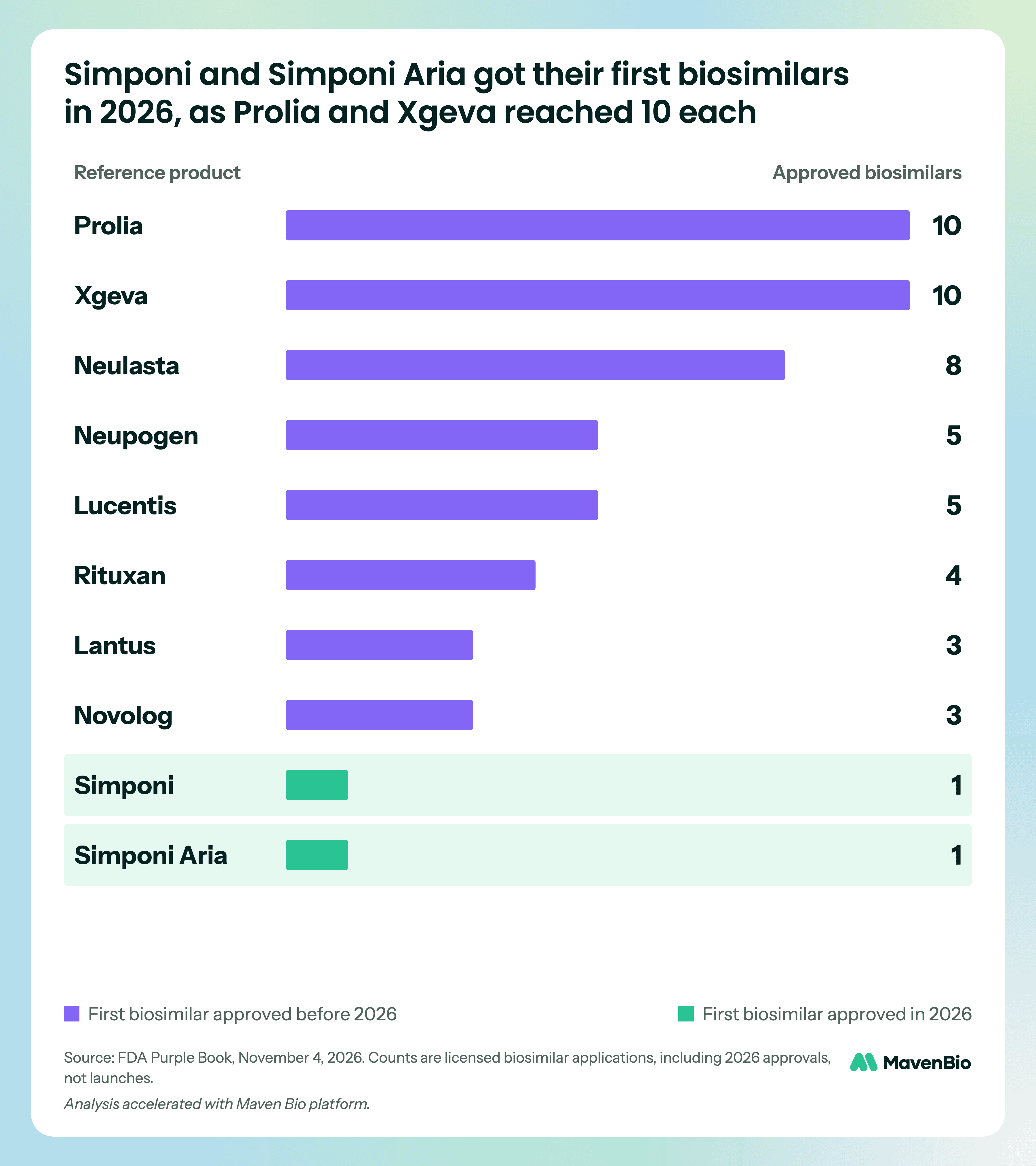
Accord BioPharma's Immgolis and Immgolis Intri are the cohort's first biosimilars for their respective reference products, which each now face 1 FDA-approved biosimilar[2][3]. Immgolis is given by injection under the skin, while Immgolis Intri is given by intravenous infusion. Both have interchangeable designations for their respective reference products.
Those routes place the products in separate comparisons with Simponi and Simponi Aria, despite their shared golimumab-sldi proper name. Their competitive distinction is first entry into each reference-product market, whereas the rest of the cohort adds approved alternatives to fields that already contain biosimilars.
Denosumab entrants face the largest approved fields
Prolia and Xgeva each now face 10 FDA-approved biosimilars, including Teva's Ponlimsi and Degevma, respectively; neither Teva product is the first biosimilar to its reference product[3]. Sandoz's Jubbonti and Wyost preceded them in March 2024, and both Teva products now carry interchangeable designations. These are the largest approved competitor fields among the reference products represented in this cohort.
Ponlimsi and Degevma also have different approval dates and reference products. The Purple Book records Ponlimsi's Prolia approval on March 27, 2026, and Degevma's Xgeva approval on September 25, 2026[4][5]. Teva therefore enters both denosumab reference-product markets with an approved portfolio, but its competitive position depends on access and availability within fields that already have multiple alternatives.
Insulin and supportive-care entrants join established competition
Sunshine Lake Pharma's Langlara joins Semglee and Rezvoglar, bringing Lantus to 3 approved biosimilars, while Emerge Bioscience's Garzulys joins Merilog and Kirsty, bringing Novolog to 3[3]. Neither is a first biosimilar, and both have interchangeable designations. Their approvals add choices within existing insulin competition rather than introduce biosimilar competition to a new reference product.
Accord BioPharma's Filkri brings Neupogen to 5 approved biosimilars alongside Zarxio, Nivestym, Releuko, and Nypozi; its Ennumo brings Neulasta to 8 alongside Fulphila, Udenyca, Ziextenzo, Nyvepria, Fylnetra, Stimufend, and Armlupeg[3]. Neither is first, and the Purple Book lists both as biosimilars without interchangeable designations. These approvals broaden Accord's portfolio across filgrastim and pegfilgrastim products while adding entrants to already established competitor sets.
Ranibizumab and rituximab gain additional competitors
Lupin's Ranluspec entered a Lucentis field that already included Byooviz, Cimerli, and Nufymco, and has an interchangeable designation[3]. Lucentis now faces 5 approved biosimilars following the October 27 approval of Xbrane Biopharma's Lucamzi, which falls outside the Q3 cohort[6]. Ranluspec was therefore an additional entrant at approval, and the approved field has expanded again since the quarter closed.
Dr. Reddy's Zimrixby brings Rituxan to 4 approved biosimilars alongside Truxima, Ruxience, and Riabni[3]. Zimrixby is not first and has no interchangeable designation in the Purple Book. Both reference-product markets require comparisons against an existing biosimilar field, so an approval alone provides little basis for assuming a new entrant's commercial position.
Interchangeability changes the substitution question
The Purple Book lists 7 cohort brands as interchangeable and 3 as biosimilars without that designation[3]. Garzulys illustrates why the designation needs a current check, as its initial approval was July 24, 2026, followed by interchangeability approval on September 15, 2026. A review limited to the initial approval date would miss its current regulatory status.
FDA states that an interchangeable biosimilar may be substituted for its reference product without consulting the prescriber, subject to state pharmacy laws; both biosimilars and interchangeable biosimilars meet the agency's approval standards[7]. The designation therefore adds information about substitution to the competitive comparison, while product availability and access require separate commercial evidence.
Final Perspective
The cohort creates different commercial starting points. Accord's golimumab products introduce first approved alternatives, while Teva's denosumab products enter the most populated approved fields in this group. Subsequent launch and access announcements can establish how those contrasting regulatory positions translate into available treatment options.
For the next quarterly assessment, additional approvals and designation changes will need to be considered alongside those commercial developments. Lucamzi's October approval and Garzulys's later interchangeability approval already show how the competitive picture can change after the initial cohort is defined.
Methodology. FDA's biosimilar list and live Purple Book records were re-checked on November 4, 2026, retaining January–September 2026 as the approval cohort and using November 4 for current competitor counts and designations[1][3]. FDA's summary list groups the cohort into 8 rows covering 10 trade names versus 12 rows and 18 names for the same months of 2025. Competitor totals count distinct licensed 351(k) applications for each reference product, including the cohort member, with strengths and presentations deduplicated; sponsors are the Purple Book applicants, and approval counts do not imply commercial availability. Brand-specific Purple Book records govern dates and reference products, including Degevma's September 25 approval against Xgeva, which FDA's summary list groups with Ponlimsi under March and Prolia.