Q1 2024 Sales of 15 Immunology Medicines

Several of immunology’s biggest medicines were facing US biosimilar competition in 2024 or preparing for it in 2025, while others were pursuing sales growth and additional indications: [Source] [Source]
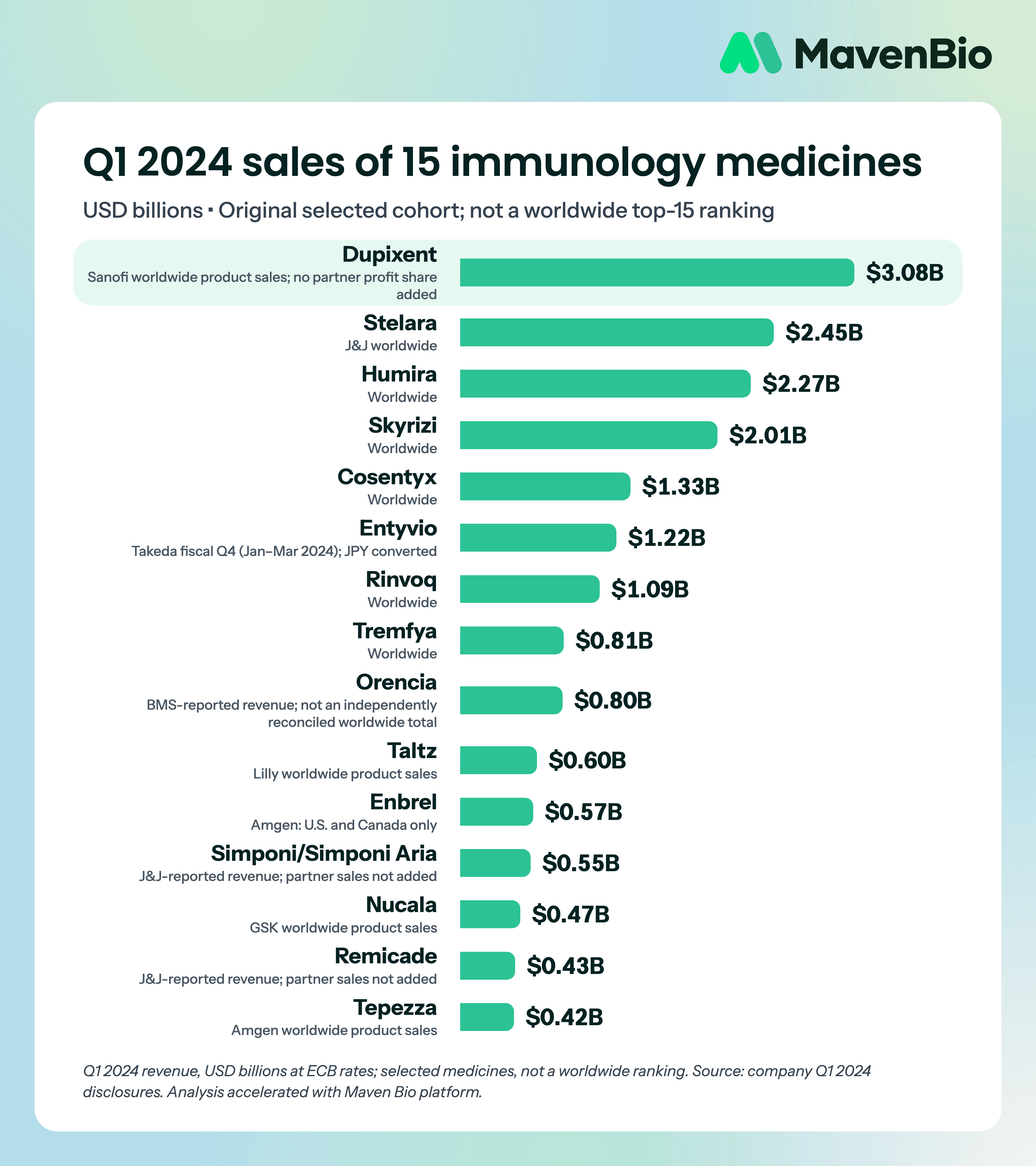
1. Humira sales continue to evolve: in Q1 2024, Humira achieved $2.270B in worldwide sales. Multiplying that quarter by four gives a $9.08B annualized rate, compared with actual full-year sales of $14.404B in 2023 and $21.237B in 2022. The annualized figure is not a full-year forecast. Q1 sales fell 35.9% year over year; that single comparison does not establish where revenue will settle. [Source] [Source]
AbbVie was relying on Skyrizi and Rinvoq to support the transition. In February 2024, AbbVie raised its combined 2027 sales forecast for the two drugs to more than $27B, up from more than $21B previously. These were management’s expectations at that time. [Source]
2. J&J’s Stelara was expected to face US biosimilar competition in early 2025. J&J’s 2023 annual report anticipated entry from January 2025, while Biocon’s February 2024 settlement permitted its proposed biosimilar to launch in February 2025, subject to FDA approval. [Source] [Source]
3. Dupixent continues to power ahead. In 2023, it achieved €10.715B in worldwide sales, approximately $11.6B at the 2023 average exchange rate. Sanofi’s February 2024 outlook projected approximately €13B for 2024; this was a forecast rather than an achieved result. [Source]
One potential boost was indication expansion for COPD. Update: on May 31, 2024, Sanofi reported that the FDA had extended its review to September 27, 2024. On that date, the FDA approved Dupixent as add-on maintenance treatment for adults with inadequately controlled COPD and an eosinophilic phenotype. [Source] [Source]
Q1 sales comparison
| Medicine | Reported Q1 2024 revenue | USD equivalent, billions | Sales basis |
| Dupixent | EUR 2,835 million | 3.08 | Worldwide; do not add Regeneron profit share |
| Stelara | USD 2,451 million | 2.45 | JNJ worldwide |
| Humira | USD 2,270 million | 2.27 | Worldwide |
| Skyrizi | USD 2,008 million | 2.01 | Worldwide |
| Cosentyx | USD 1,326 million | 1.33 | Worldwide |
| Entyvio | JPY 181,600 million | 1.22 | Takeda fiscal Q4 (Jan–Mar 2024); JPY converted |
| Rinvoq | USD 1,093 million | 1.09 | Worldwide |
| Tremfya | USD 808 million | 0.81 | Worldwide |
| Orencia | USD 798 million | 0.80 | BMS-reported revenue; not an independently reconciled worldwide total |
| Taltz | USD 604.1 million | 0.60 | Lilly worldwide product sales |
| Enbrel | USD 567 million | 0.57 | Amgen: U.S. and Canada only |
| Simponi/Simponi Aria | USD 554 million | 0.55 | J&J-reported revenue; partner sales not added |
| Nucala | GBP 374 million | 0.47 | GSK worldwide product sales |
| Remicade | USD 434 million | 0.43 | J&J-reported revenue; partner sales not added |
| Tepezza | USD 424 million | 0.42 | Amgen worldwide product sales |
The comparison retains the 15 medicines shown in the original chart. It is a selected product comparison, not an exhaustive ranking of all immune-mediated disease treatments. It leaves out some larger medicines, including Ocrevus (about $1.90 billion) and Xolair (about $0.97 billion across Roche and Novartis). Figures cover January–March 2024; Takeda reports that period as fiscal 2023 Q4. Enbrel's $567 million is Amgen's U.S. and Canada sales, not worldwide sales. Pfizer separately reported $159 million outside those territories, but its international reporting quarter ended February 25, 2024; that amount is not added to this calendar-quarter table. Pfizer Q1 disclosure
Non-USD figures are translated using the arithmetic mean of 63 ECB daily exchange rates from January 2 through March 28, 2024: USD/EUR 1.085787, USD/JPY 0.006738871 and USD/GBP 1.268053. Cross-rates are calculated daily before averaging. USD equivalents are estimates rounded to two decimal places in billions. Entyvio's underlying disclosure is rounded to ¥181.6 billion. ECB daily rates
Dupixent uses Sanofi's product sales once, without adding Regeneron's share of collaboration profits. Orencia uses BMS-reported revenue; Simponi/Simponi Aria and Remicade use J&J-reported revenue. Partner sales are not added where supply revenue or profit-sharing could overlap. These figures have different geographic and accounting scopes and should not be summed into a worldwide market total. BMS partner accounting J&J revenue accounting