Select Eli Lilly U.S. Patent Expiries

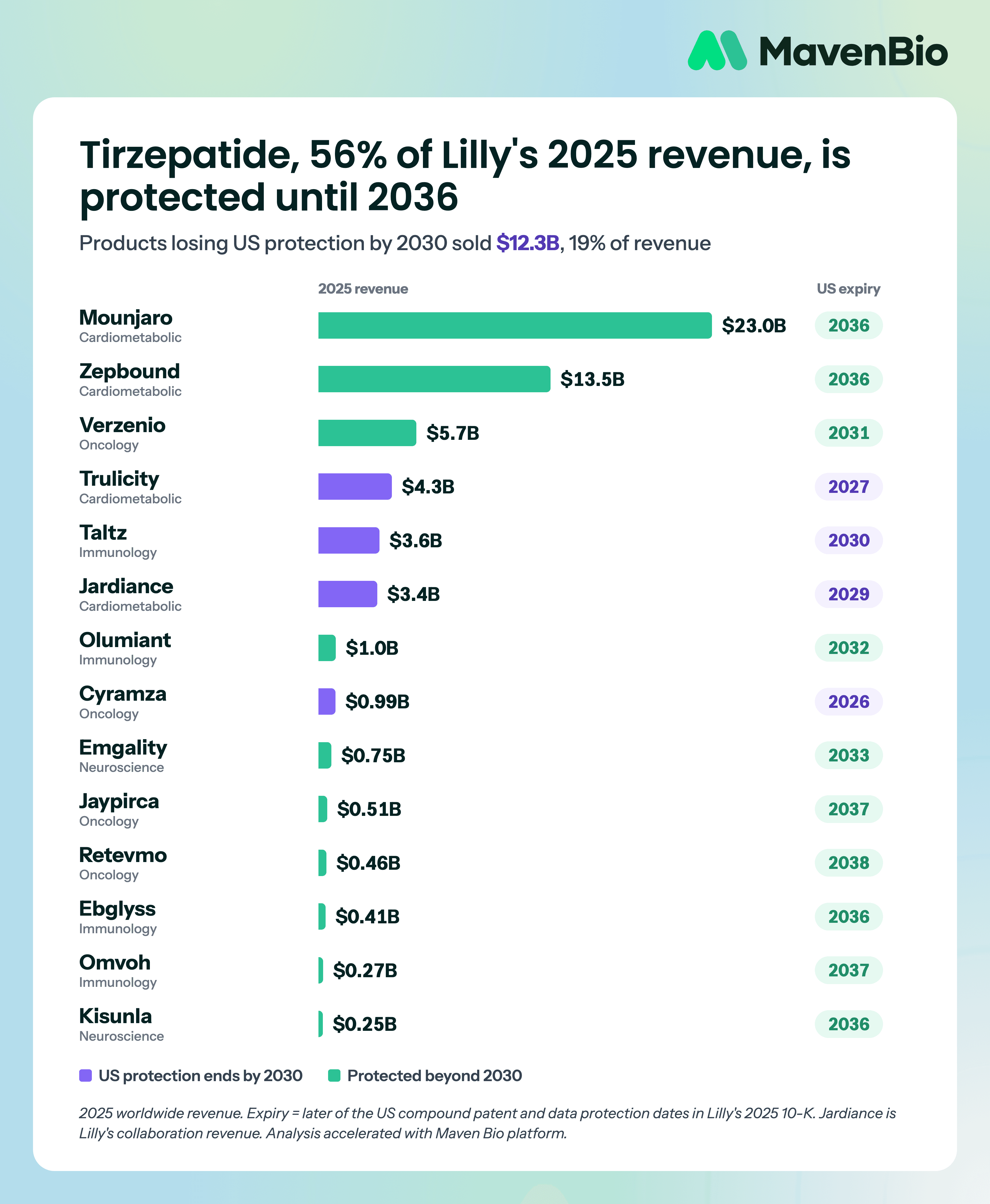
Eli Lilly's growth rests on tirzepatide, which generated $36.5B in 2025 as Mounjaro and Zepbound, 56% of the company's $65.2B in revenue, and its US compound patent runs to 2036. The rest of the portfolio is more exposed, as products that sold $12.3B in 2025, about 19% of revenue, lose key US patent or data protection by the end of 2030.
This analysis covers when Lilly's main products lose US protection, how its oncology and immunology franchises compare with competitors, and where new patent challenges have emerged since 2024.
Cardiometabolic: protected until 2036, with Trulicity as the near-term exposure
Mounjaro and Zepbound keep compound patent protection until 2036, 4 years after the US compound patent on semaglutide, the molecule in Novo Nordisk's Ozempic and Wegovy, expires in 2032. Generic manufacturers filed applications against both tirzepatide brands in July 2026, and Lilly sued them in August 2026, so the 2036 date is now subject to litigation.
Trulicity is the nearest large expiry. Its compound patent and biologics data protection both end in 2027, its sales fell from $7.1B in 2023 to $4.3B in 2025, and Medicare negotiated pricing applies from 2028. Jardiance, which Lilly sells with Boehringer Ingelheim and which generated $3.4B of collaboration revenue for Lilly in 2025, follows with a compound patent expiry in 2029.
Lilly added an oral option in April 2026, when the FDA approved orforglipron as Foundayo for obesity, and the drug generated $0.18B in Q3 2026.
Oncology: Verzenio leads its class into the 2030s
Verzenio generated $5.7B in 2025, more than Pfizer's Ibrance ($4.1B) and Novartis's Kisqali ($4.8B), and its US compound patent runs to 2031. Ibrance loses its US basic patent in 2027, whereas Kisqali is protected until 2031, so Verzenio and Kisqali will compete under patent protection after Ibrance's expiry. Cipla has filed a generic application against Verzenio, and the trial is set for May 2028.
Cyramza reached its disclosed US expiry year in 2026 for both its compound patent and data protection, although the FDA had approved no ramucirumab biosimilar as of late October 2026. Jaypirca and Retevmo are protected until 2037 and 2038, and Retevmo outsold its RET-inhibitor rival Gavreto, now marketed in the US by Rigel Pharmaceuticals, by about 6.5 to 1 in the US in 2025.
Immunology and neuroscience: newer launches carry longer protection
Taltz is Lilly's largest immunology product at $3.6B in 2025, with biologics data protection until 2028 and its compound patent until 2030. Newer launches are protected for longer, as Omvoh is covered until 2037 and Ebglyss, whose compound patent expires in 2026, keeps biologics data protection until 2036.
In neuroscience, Kisunla generated $0.25B in its first full year and $0.48B in the first nine months of 2026, with protection until 2036. Emgality's position weakened in April 2026, when an appeals court revived Teva's patent claims against it.
Implications
Lilly's revenue base is protected for a decade and is also concentrated, as Mounjaro, Zepbound, and Foundayo accounted for 66% of revenue in the first nine months of 2026. The tirzepatide litigation therefore carries more revenue than all of Lilly's expiries before 2030 combined, $36.5B against $12.3B in 2025 sales.
Patent dates set the outer limit of protection, and settlements, litigation, and Medicare price negotiation can move competition earlier or later.
Teams that track patent and exclusivity evidence across companies often compare several research platforms, and our guide to Cortellis alternatives sets out the main options.
Methodology: Revenue is full-year 2025 worldwide revenue from Lilly's Q4 2025 financial workbook and 2025 10-K, and 2026 figures are from Lilly's Q3 2026 workbook and 10-Q. Expiry years are the US compound patent and data protection dates in Lilly's 2025 10-K, and the chart uses the later of the two. Jardiance is Lilly's collaboration revenue and includes a one-time $370M benefit and a $200M milestone in 2025. Competitor figures are from Pfizer's and Novartis's 2025 annual filings and Rigel's 2025 10-K. Kisqali's date is Novartis's combined compound patent or regulatory exclusivity date. US market only.