Biopharma Licensing Partnerships in 2025: The Largest Deals and What Changed Since 2023

The 10 largest pharma companies paid $6.4B in upfront payments across their 10 largest licensing deals of 2025, led by Bristol Myers Squibb's $1.5B payment to BioNTech for a PD-L1xVEGF bispecific antibody. China has become a central source of those assets, as 39% of large-cap in-licensing deals with at least $50M upfront came from Chinese companies in 2025, up from 19% in 2023, according to J.P. Morgan's analysis of DealForma data.
This review compares the largest 2025 deals with 2023, when Merck's agreement with Daiichi Sankyo was the year's largest, and covers the modalities and deal structures that defined 2025 and the first 10 months of 2026.
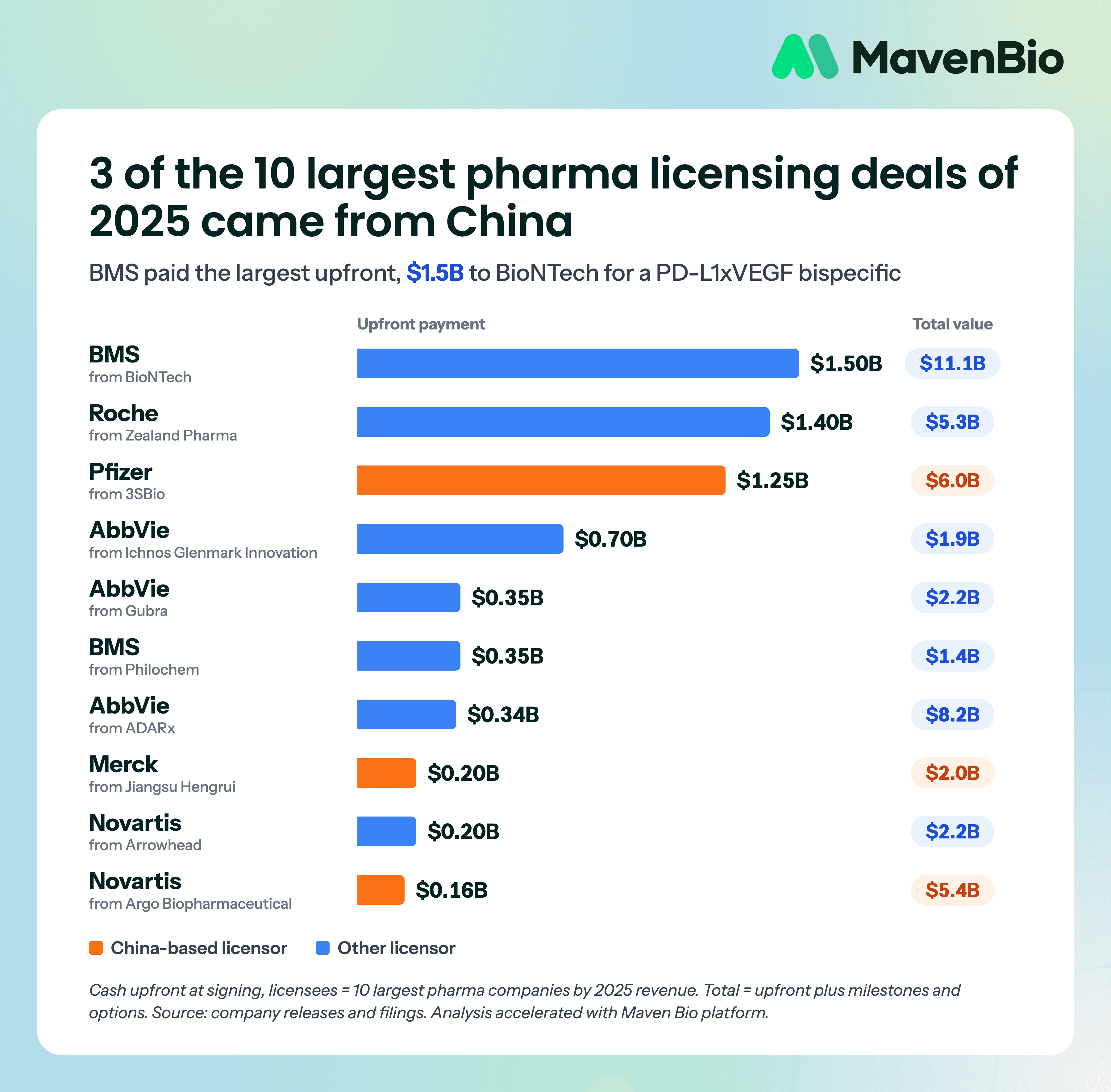
The largest licensing deals of 2025
| Licensee | Licensor | Asset | Area | Upfront | Total potential value |
|---|---|---|---|---|---|
| Bristol Myers Squibb | BioNTech | BNT327, PD-L1xVEGF bispecific | Oncology | $1.5B | Up to $11.1B |
| Roche | Zealand Pharma | Petrelintide, amylin analog | Obesity | $1.4B | Up to $5.3B |
| Pfizer | 3SBio (China) | SSGJ-707, PD-1xVEGF bispecific | Oncology | $1.25B | Up to $6.05B |
| AbbVie | Ichnos Glenmark Innovation | ISB 2001, trispecific antibody | Multiple myeloma | $700M | Up to $1.9B |
| AbbVie | Gubra | Amylin analog | Obesity | $350M | About $2.2B |
| Bristol Myers Squibb | Philochem | OncoACP3, radiopharmaceutical | Prostate cancer | $350M | Up to $1.35B |
| AbbVie | ADARx | siRNA platform (option) | Multiple areas | $335M | About $8.2B |
| Merck | Jiangsu Hengrui (China) | HRS-5346, oral Lp(a) inhibitor | Cardiovascular | $200M | Up to $1.97B |
| Novartis | Arrowhead | ARO-SNCA, siRNA | Parkinson's disease | $200M | About $2.2B |
| Novartis | Argo Biopharmaceutical (China) | siRNA programs | Cardiovascular | $160M | About $5.4B |
What changed since 2023
In 2023 the year's largest deal was Merck's agreement with Daiichi Sankyo for 3 antibody-drug conjugates, worth $4.0B upfront plus $1.5B in continuation payments and up to $22B in total. None of the 2025 deals by the 10 largest companies matched that upfront, although total biopharma licensing deal value reached more than $252B in 2025, the highest level since 2016, according to J.P. Morgan.
Loss of exclusivity continues to shape deal terms. Merck's Keytruda, the world's top-selling drug, loses its key US patent in 2028, and J.P. Morgan reports that large companies paid higher upfronts for near-market assets in 2025, including materially higher upfronts for Phase III programs.
The source of assets has shifted the most. China accounted for 19% of large-cap in-licensing deals with at least $50M upfront in 2023, 27% in 2024, and 39% in 2025, and 3 of the 10 deals in the table above came from Chinese licensors.
Bispecifics, obesity, and RNA medicines led the 2025 deals
PD-(L)1xVEGF bispecific antibodies took 2 of the 3 largest upfronts, with Bristol Myers Squibb paying $1.5B to BioNTech and Pfizer paying $1.25B to 3SBio, and AbbVie added RemeGen's RC148 from the same class in January 2026 for $650M upfront.
Obesity deals focused on amylin analogs, as Roche paid $1.4B at closing for Zealand Pharma's petrelintide and AbbVie paid $350M for Gubra's program. RNA medicines accounted for 3 of the top 10, through AbbVie's siRNA option deal with ADARx and Novartis's deals with Arrowhead and Argo.
Deal structures moved toward guaranteed payments beyond the upfront, such as the $2B in non-contingent anniversary payments in the BioNTech deal, toward options, as in the ADARx and Argo agreements, and toward 50:50 profit sharing, as in the BioNTech and Zealand agreements.
The largest deals of 2026 so far
The largest licensing deals of 2026 continue the China trend. AstraZeneca paid $1.2B upfront to CSPC Pharmaceutical for 8 long-acting peptide programs in obesity and metabolic disease, worth up to $18.5B, AbbVie paid $650M to RemeGen, and Pfizer paid $650M to Innovent Biologics for 12 early-stage ADC and multispecific programs worth up to $10.5B.
The largest 2026 deals with US partners were Sanofi's expanded immunology alliance with Regeneron, with $1.0B upfront and up to $8B in total, and Roche's agreement with Nurix Therapeutics for an oral BTK degrader, with $700M upfront.
Implications
Large pharma companies are paying for late-stage and clinically validated assets as their top-selling products approach loss of exclusivity, and a growing share of those assets comes from China. Deal value has also moved from upfront cash toward guaranteed future payments, options, and profit sharing, which spreads the cost of each asset over several years.
Teams that screen licensing opportunities and track competitors' deals often compare several research platforms, and our guide to the best AI tools for biopharma business development sets out the main options.
Methodology: The table covers licensing, co-development, and collaboration agreements signed in 2025 where the licensee is one of the 10 largest pharma companies by 2025 revenue (Johnson & Johnson, Roche, Eli Lilly, Merck, Pfizer, AbbVie, AstraZeneca, Novartis, Sanofi, and Bristol Myers Squibb), ranked by cash upfront at signing. Acquisitions are excluded. Total value is upfront plus disclosed milestone and option payments, from the companies' press releases and filings. China share figures are from J.P. Morgan's Q4 2025 Biopharma Licensing and Venture Report, based on DealForma data through December 15, 2025, and cover deals between large-cap biopharma and China-domiciled companies with at least $50M upfront.