AbbVie Q2 Earnings: Immunology Strength Overshadows Aesthetics Challenges

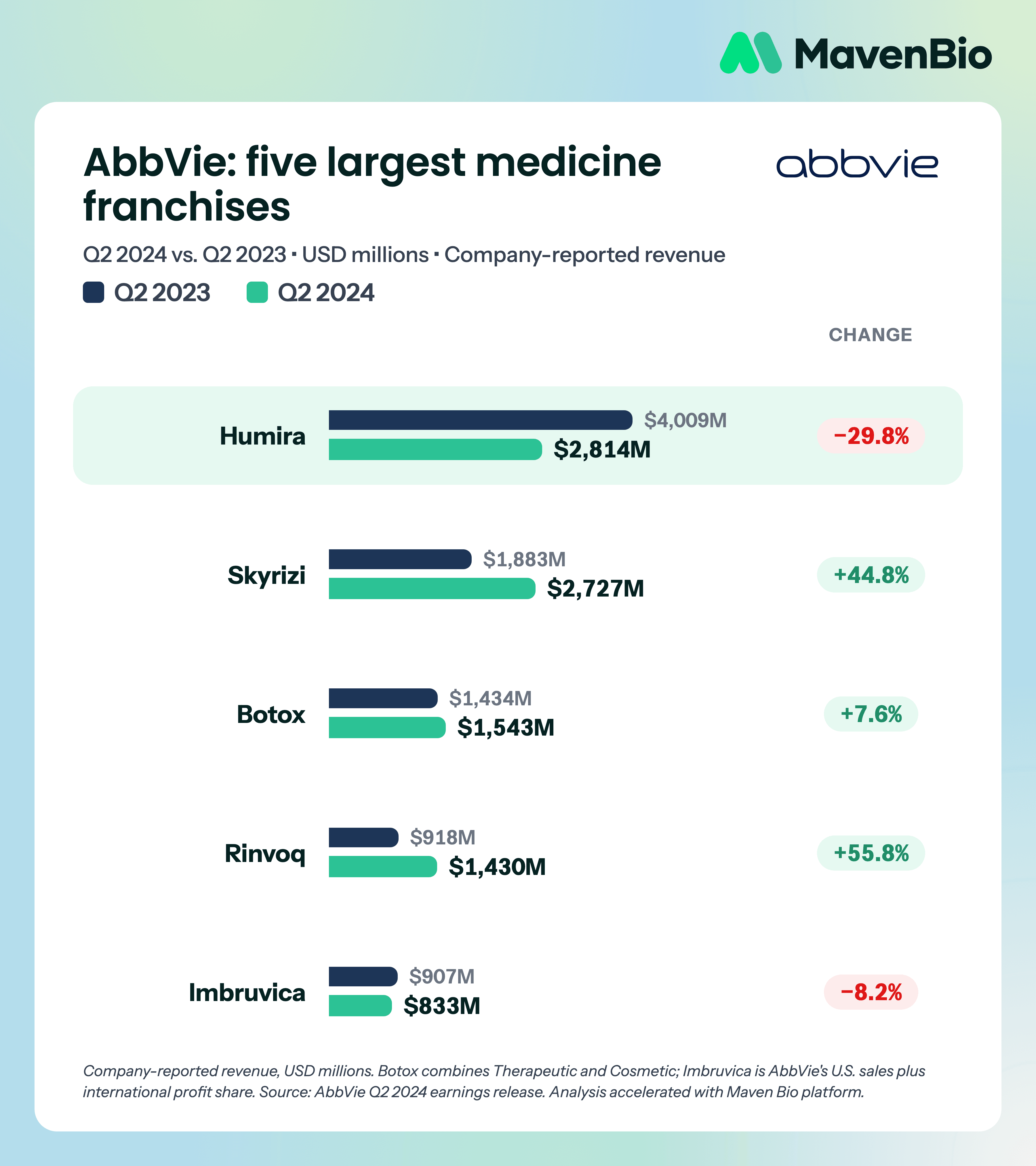
AbbVie reported its Q2 2024 earnings on July 25, 2024, raising guidance for the second time that year, as it continues to find growth post-Humira. This analysis will focus on the strength in the immunology segment and the challenges faced in the aesthetics segment.
Immunology Strength
The strong performance by Skyrizi and Rinvoq continues to drive overall results, with the two delivering combined reported revenue growth of approximately 48% in Q2 2024.
Guidance Raised
- AbbVie raised its 2024 global sales guidance for Skyrizi by $300 million to $11 billion. [July 2024 guidance]
- AbbVie raised its 2024 global sales guidance for Rinvoq by $100 million to $5.7 billion, citing continued uptake in inflammatory bowel disease.
Notable Market Share Figures (US)
Skyrizi:
- Approximately 38% of U.S. biologic prescriptions in psoriasis, according to management in July 2024. [Q2 call]
- Approximately 15% of U.S. biologic prescriptions in psoriatic arthritis within the dermatology segment, according to management.
Rinvoq:
- 10% U.S. total prescription share in atopic dermatitis, as reported by management.
Gastrointestinal (GI) Focus
GI is a big focus area for these two medicines. Skyrizi received FDA approval for adults with moderately to severely active ulcerative colitis in June 2024. On the July 2024 call, management reported combined U.S. Crohn's in-play share above 40% for Skyrizi and Rinvoq, with Skyrizi about 13 percentage points ahead of Stelara. These were in-play share figures, not total-market patient shares. [Q2 call] [UC approval]
The SEQUENCE head-to-head trial supported Skyrizi's clinical positioning in Crohn's disease. Among adults with moderate-to-severe disease after inadequate response or intolerance to anti-TNF treatment, clinical remission at week 48 (CDAI below 150) was 60.8% with Skyrizi versus 40.8% with Stelara. This was a secondary endpoint; the primary endpoints were clinical remission at week 24 and endoscopic remission at week 48. [SEQUENCE publication]
J&J was also advancing Tremfya in Crohn's disease. In the May 2024 GALAXI 2/3 pooled results, week-48 clinical remission was 70.3% and 65.4% for the two Tremfya regimens versus 62.9% with Stelara. Those numerical differences were not statistically significant (p=0.058 and p=0.512); superiority was demonstrated on the prespecified pooled endoscopic endpoints. Tremfya subsequently received FDA approval for adults with moderately to severely active Crohn's disease on March 20, 2025. [GALAXI results] [Subsequent FDA approval]
Comparing these percentages across studies does not establish whether Skyrizi or Tremfya is more effective: SEQUENCE and GALAXI studied different populations and designs, and neither directly compared those two medicines.
Overall, the IL-23 space is a crowded one, and the competition shows no signs of slowing down.
Aesthetics Remain a Weak Spot in the Short Run
While immunology remains an area of strength, aesthetics showed more challenged results. Overall segment sales rose 0.5% as reported from the prior year, with 6.4% growth in Botox Cosmetic partly offset by a 6.8% decline in Juvéderm.
Management attributed the weaker performance to economic headwinds. It called out Juvéderm's higher price point as being the cause for its larger relative decline.
Botox’s competitive position cannot be reduced to permanent trademark and trade-secret protection. Allergan has also asserted formulation and manufacturing patents against a competitor, while AbbVie’s 2023 filing acknowledges existing Botox competitors and the risk that trade secrets can become known or be independently discovered. [AbbVie 2023 filing] [Revance litigation disclosure]
Management remained optimistic about longer-term aesthetics demand, but that outlook depended on improving economic conditions; it was not a guarantee of growth. [Q2 call]