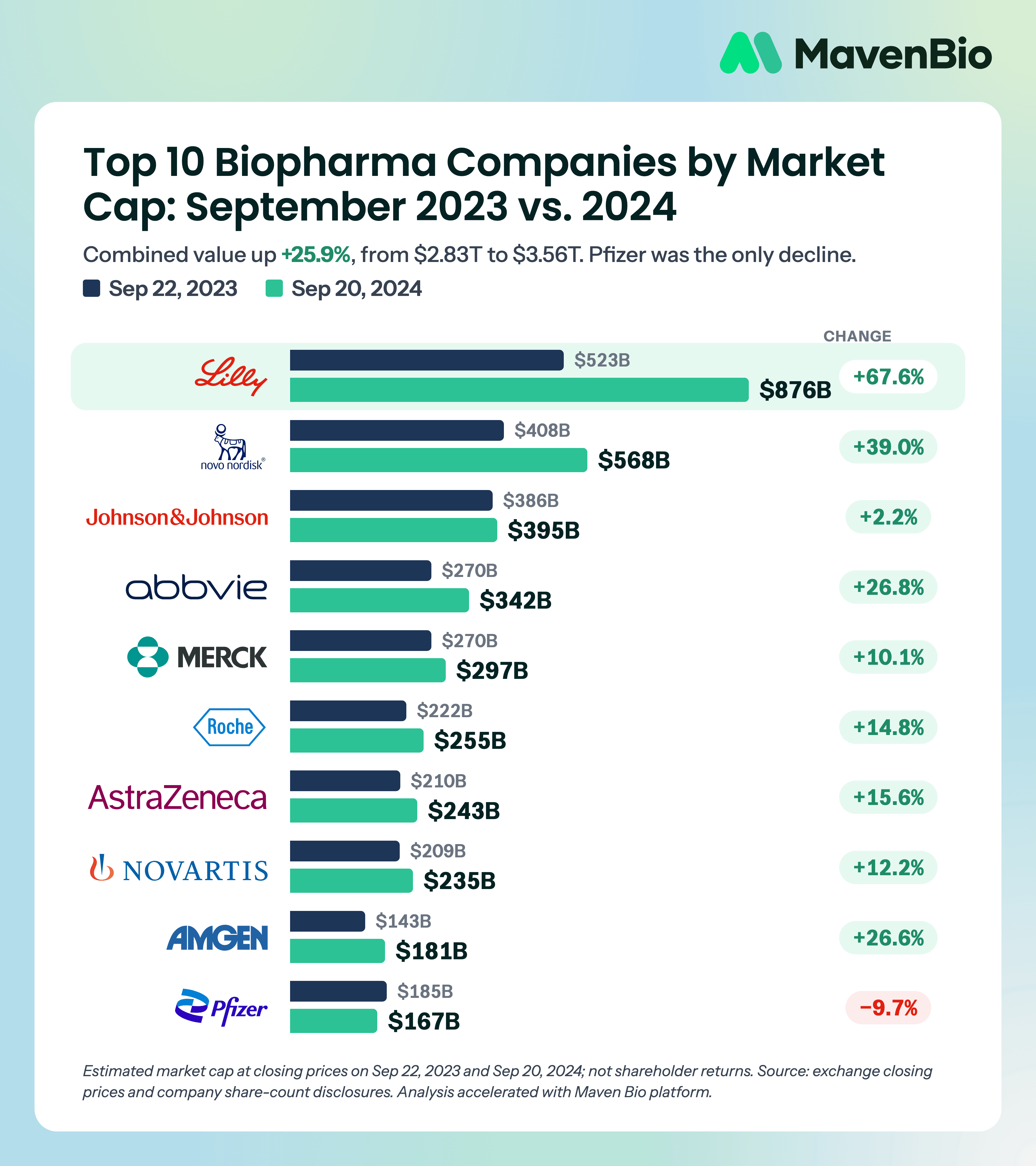
Top 10 Biopharma Companies by Market Cap: September 2023 vs. 2024

Eli Lilly and Novo Nordisk led the biggest market capitalization gains among the ten largest biopharma companies between September 2023 and September 2024, rising 68% and 39% as both expanded their GLP-1 businesses. Together, the ten companies grew from $2.83 trillion to $3.56 trillion, up about 26%. Pfizer was the only one to lose value, falling 9.7%.
Eli Lilly and Novo Nordisk: Riding the Wave of GLP-1 Success
Eli Lilly and Novo Nordisk expanded their diabetes and obesity businesses during the period. Lilly reported Q2 2024 revenue growth led by Mounjaro, Zepbound and Verzenio, alongside increased production of its incretin medicines. Novo Nordisk's first-half 2024 results also showed growth in diabetes and obesity care. These operating developments provide context for the companies' portfolios; they do not isolate what caused a change in market capitalization. Source. Novo Nordisk results.
AbbVie: Diversifying Growth Drivers
AbbVie's immunology drugs Skyrizi and Rinvoq reported worldwide Q2 2024 revenue growth of 44.8% and 55.8%, respectively. The approximately 43% and 58% figures refer to U.S. growth, not worldwide sales. In February 2024, AbbVie raised its forecast for combined 2027 Skyrizi and Rinvoq sales to more than $27 billion, approximately $6 billion above its previous outlook. Those operating results and forecasts do not establish the cause of a market-cap change. Source 1. Source 2.
AbbVie acquired ImmunoGen in February 2024. Elahere (mirvetuximab soravtansine), its ovarian-cancer antibody-drug conjugate, received full FDA approval on March 22, 2024, following accelerated approval in November 2022. The approved population includes adults with FRα-positive, platinum-resistant epithelial ovarian, fallopian tube or primary peritoneal cancer after one to three prior systemic regimens. In September 2024, the CHMP recommended European authorization. Subsequent update: the European Commission granted authorization in November 2024. Source 1. Source 2. Source 3.
In the MIRASOL trial, Elahere reduced the hazard of disease progression or death by 35% and the hazard of death by 33% versus investigator-selected chemotherapy. Median progression-free survival was 5.6 versus 4.0 months; median overall survival was 16.5 versus 12.7 months. The 33% figure is a relative reduction in the hazard of death, not a 33% increase in survival duration. Source.
Amgen: Diversifying Therapeutic Areas
Amgen's portfolio expanded with the completion of its Horizon Therapeutics acquisition on October 6, 2023. In Q2 2024, the company reported growing sales of Evenity and Repatha and continued development of MariTide. These developments occurred during the comparison period, but their individual contributions to Amgen's market-cap change cannot be established from the two observation dates. Source. Horizon completion.
As of September 2024, Amgen was studying MariTide in Phase 2 and planning a broad Phase 3 program. MariTide is an investigational antibody-peptide conjugate that activates the GLP-1 receptor and inhibits the GIP receptor. Amgen was evaluating monthly or less frequent dosing; this remained an investigational dosing strategy, rather than an established advantage over Wegovy or Zepbound. Source.
Methodology: Market caps are estimates based on closing prices on September 22, 2023 and September 20, 2024 and each company's latest disclosed share count. Life-science tools and diversified healthcare companies such as Thermo Fisher, Danaher and Abbott are excluded. Figures do not include dividends or the October 2023 Sandoz spin-off, so they are not shareholder returns. Sources: Closing prices; Lilly share counts; J&J share counts; AbbVie share counts; Merck share counts; Amgen share counts; Pfizer share counts; Novo 2023 count; Novo 2024 count; AstraZeneca 2023 count; AstraZeneca 2024 count; Novartis counts; Roche 2023 counts; Roche 2024 counts; ECB exchange rates; Kenvue exchange; Sandoz separation