Sanofi Revenue by Category - Q2 '24 Earnings Recap

Sanofi's Strategic Moves and Market Dynamics: A Comprehensive Overview
Sanofi raised its 2024 business EPS guidance in Q2 to stable at constant exchange rates, from a low-single-digit decline. A deep dive into Sanofi’s strategies, particularly around its blockbuster drug Dupixent and its ventures into vaccine collaborations and consumer health, reveals a multifaceted approach to sustaining growth. Q2 2024 results
Dupixent: A Catalyst for Sanofi's Growth
A key driver of Sanofi's optimistic outlook is Dupixent, which delivered Q2 2024 sales growth of 28.9% as reported and 29.2% at constant exchange rates, keeping it on track at the time for Sanofi’s approximately €13 billion 2024 target. In July 2024, the European Commission approved Dupixent for adults with uncontrolled COPD characterized by raised blood eosinophils, becoming the first biologic approved for this condition in the EU. Subsequent outcome — September 27, 2024: the FDA approved it as add-on maintenance treatment for adults with inadequately controlled COPD and an eosinophilic phenotype. This replaced the pending FDA decision described when the article was written. Q2 results; FDA approval announcement
Notably, Dupixent’s revenue exhibits a strong US-centric profile: €2.407 billion of its €3.303 billion Q2 2024 global sales, or 72.9%, came from the US. Sanofi records global Dupixent product sales; Regeneron reports its share of collaboration profits separately. Adding that collaboration income to Sanofi’s product sales would double-count part of the same business. Sales by geography; Regeneron reporting basis
Strategic Vaccine Collaboration
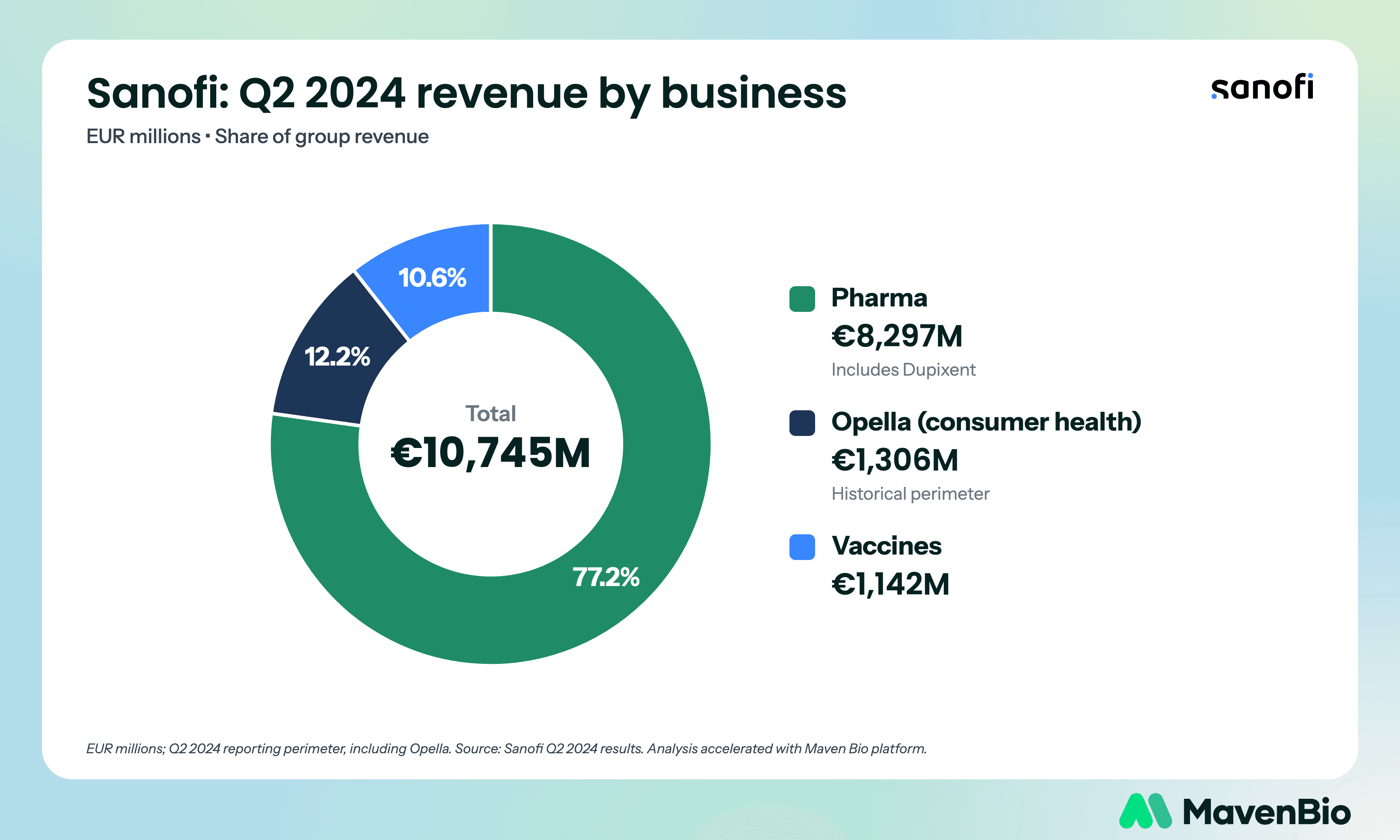
Sanofi’s active business development initiatives resulted in a significant vaccine collaboration with Novavax. This reinforces Sanofi's long-standing vaccines business, which generated €1.142 billion, or 10.6% of company net sales, in Q2 2024. The May 2024 agreement granted co-exclusive rights to commercialize Novavax’s standalone COVID-19 vaccine, subject to territory exclusions, and a sole license to use it in combination with Sanofi’s flu vaccines. Novavax retained the right to develop its own flu–COVID-19 combination. The proposed combination offered a development opportunity; the agreement itself did not establish clinical benefit or predict vaccine uptake. Revenue categories; Licensing terms
The agreement included a $500 million upfront payment to Novavax and up to $700 million in development, regulatory and launch milestones. The milestone amounts were contingent, rather than cash received at signing. Agreement terms
Consumer Health Divestiture: A Trend Among Giants
Opella, Sanofi's consumer health division, delivered Q2 2024 sales growth of 6.6% as reported and 9.6% at constant exchange rates, with Qunol contributing approximately seven percentage points to growth. Sanofi then targeted separation no earlier than Q4 2024. Subsequent outcome — April 30, 2025: Sanofi completed the sale of a 50.0% controlling stake to CD&R, retaining 48.2%; Bpifrance held 1.8%. This decision aligns with a trend observed in several large Biopharma companies: J&J separated Kenvue in August 2023, Novartis sold its consumer-health joint-venture stake to GSK in June 2018, and GSK demerged Haleon in July 2022. These transactions prompt a discussion on finding the right balance between focusing on key areas and maintaining diversification. Q2 results; Opella closing; Kenvue separation; Novartis transaction; Haleon demerger
Looking Forward
Sanofi’s strategic maneuvers, including the bolstering of its product portfolio with new indications for Dupixent, engaging in significant vaccine collaborations, and divesting its consumer health division, reflect a comprehensive approach to growth and market adaptation. The Dupixent trajectory and the Novavax collaboration highlight Sanofi’s commitment to addressing unmet medical needs and leveraging synergies between vaccines. Meanwhile, the divestiture of the consumer health division aligns with an industry-wide recalibration towards core pharmaceutical innovation.
As Sanofi and its peers navigate the complexities of market dynamics, strategic decisions around product development, collaborations, and portfolio optimization, it remains to be seen whether the divestment of consumer health arms will truly enable these companies to be more focused, or whether it will result in more volatile business performance navigating the ebbs and flows of LOEs.