Pfizer Delivers Robust Q2 2024 Performance, Raises Full-Year Guidance

Pfizer’s financial results in Q2 2024 were driven by strong commercial execution and solid progress on its strategic priorities. The company's diversified portfolio enabled it to navigate the anticipated decline in COVID-19 product sales, while its non-COVID product portfolio witnessed a 14% YoY operational revenue increase, including Seagen. Pfizer notably raised its full-year 2024 revenue guidance by $1 billion to a range of $59.5 billion to $62.5 billion.
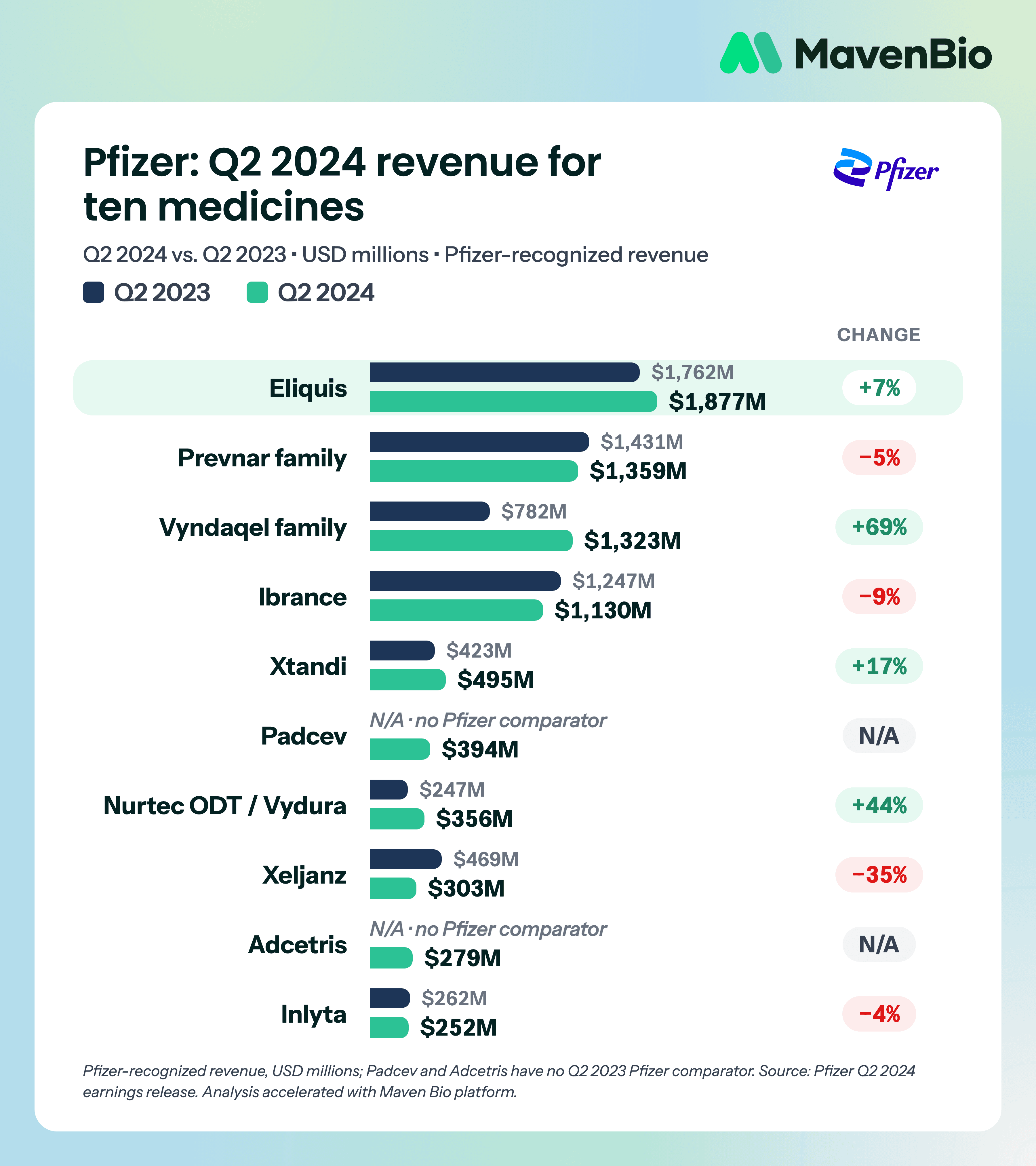
| Product / family | Q2 2024 ($m) | Q2 2023 ($m) |
| Eliquis | 1877 | 1762 |
| Prevnar family | 1359 | 1431 |
| Vyndaqel family | 1323 | 782 |
| Ibrance | 1130 | 1247 |
| Xtandi | 495 | 423 |
| Padcev | 394 | Not reported by Pfizer |
| Nurtec ODT / Vydura | 356 | 247 |
| Xeljanz | 303 | 469 |
| Adcetris | 279 | Not reported by Pfizer |
| Inlyta | 252 | 262 |
Data sources: sec.gov labeling.pfizer.com sec.gov fda.gov investors.pfizer.com fda.gov investor.lilly.com
Key Growth Drivers
1. Vyndaqel Family
The Vyndaqel family of drugs, composed of Vyndaqel, Vyndamax, and Vynmac, emerged as a standout performer globally, with a remarkable 69% YoY growth in Q2. This first-in-class, blockbuster treatment for transthyretin amyloid cardiomyopathy (ATTR-CM) was approved by the FDA in 2019 and granted fast track and orphan drug designations. Q2 growth was fueled by sustained demand in the U.S. and international developed markets.
Pfizer was seeking a U.S. patent term extension for Vyndaqel/Vyndamax to 2028. A basic patent's expiry does not by itself establish when a generic will launch. Separately, BridgeBio's acoramidis was under FDA review with a target action date of November 29, 2024. Acoramidis is a distinct medicine from tafamidis, the active ingredient in Vyndaqel/Vyndamax. Subsequent update (November 22, 2024): the FDA approved acoramidis as Attruby. FDA approval record.
2. Eliquis (Collaboration with Bristol-Myers Squibb)
Eliquis, a collaboration with Bristol-Myers Squibb, was Pfizer's top-selling drug in Q2, generating nearly $2 billion in sales according to Pfizer's reported revenue share. This growth was driven by continued adoption and market share gains in the non-valvular atrial fibrillation indication across the U.S. and key European markets, and partially offset by declines due to loss of exclusivity and generic competition in certain international regions.
3. Xtandi (Collaboration with Astellas Pharma)
Pfizer's Xtandi revenue, which comes from its U.S. alliance with Astellas Pharma, demonstrated a 17% year-over-year increase in Q2. Initially approved by the FDA for metastatic castration-resistant prostate cancer (mCRPC) in 2012, Xtandi has since received FDA approval for additional indications and solidified its position as a standard of care across various stages of prostate cancer.
In November 2023, Xtandi secured FDA approval for non-metastatic castration-sensitive prostate cancer with biochemical recurrence at high risk for metastasis, based on the EMBARK trial. In April 2024, the European Commission also expanded its indication to high-risk biochemical recurrent non-metastatic hormone-sensitive prostate cancer.
Pfizer was also evaluating Xtandi in combination with Talzenna in the Phase 3 TALAPRO-3 trial for metastatic castration-sensitive prostate cancer with DNA damage repair gene alterations. Source
4. Nurtec ODT/Vydura
Nurtec ODT/Vydura, Pfizer's migraine medicine, saw a 44.1% year-over-year increase in sales, driven primarily by strong demand in the U.S. and recent launches in international markets. In CHALLENGE-MIG, reported in June 2023, Eli Lilly's Emgality did not achieve superiority over Nurtec ODT on the proportion of participants with at least a 50% reduction in monthly migraine headache days over three months. This result does not establish equivalence or superiority of Nurtec ODT.
5. Oncology Portfolio and Legacy-Seagen Products
Pfizer's Oncology portfolio witnessed exceptional growth, with strong revenue contributions from its legacy-Seagen products, acquired from the Seagen acquisition in December 2023. The company reported global revenues of $845 million from legacy-Seagen products in Q2 2024, highlighting the contribution of this acquisition in bolstering Pfizer's oncology pipeline.
At its July 2024 results, Pfizer anticipated full-year operational revenue growth of 9% to 11%, excluding COVID-19 products and including Seagen. The company reiterated its 2024 goal of $4 billion in net cost savings from its cost realignment program. Additionally, Pfizer launched a Manufacturing Optimization Program with anticipated cost savings of approximately $1.5 billion by the end of 2027, further underscoring its commitment to operational efficiency and long-term sustainability.