Moderna's Strategic Shift: Paving the Way for Diversification and Profitability

Moderna announced its portfolio reprioritization on September 12, 2024, aiming to reduce spending and expand beyond COVID-19 vaccines. By September 23, 2026, the picture is mixed: R&D spending has fallen, respiratory vaccine approvals have expanded, and the melanoma program has reported positive Phase 3 results. Those advances have not yet established profitability or a commercial oncology business. Source 1, Source 2, Source 3
Reducing R&D Expenses and Targeting Profitability
At the 2024 R&D Day, Moderna forecast annual R&D spending of $4.8 billion for 2024 and $3.6–3.8 billion in 2027. Actual spending was $4.543 billion in 2024 and $3.132 billion in 2025. Spending therefore fell below the original 2027 range two years earlier. Moderna attributed the 2025 reduction to lower clinical development and manufacturing costs, portfolio prioritization and the absence of the prior year's priority-review-voucher purchases. Source 1, Source 2
Lower costs did not deliver a profit: Moderna reported a $2.822 billion net loss in 2025 on revenue of $1.944 billion, mostly from COVID vaccines. The original 2028 target concerned operating cash-cost breakeven, excluding stock-based compensation, depreciation and amortization—not GAAP net income. On July 31, 2026, management forecast $2.9 billion of 2026 R&D spending. It reported $6.9 billion in cash and investments at June 30, before a $950 million litigation settlement payment in July. These figures separate achieved cost reductions from remaining financing and profitability risks. Source 1, Source 2, Source 3
Prioritizing Vaccines and Oncology
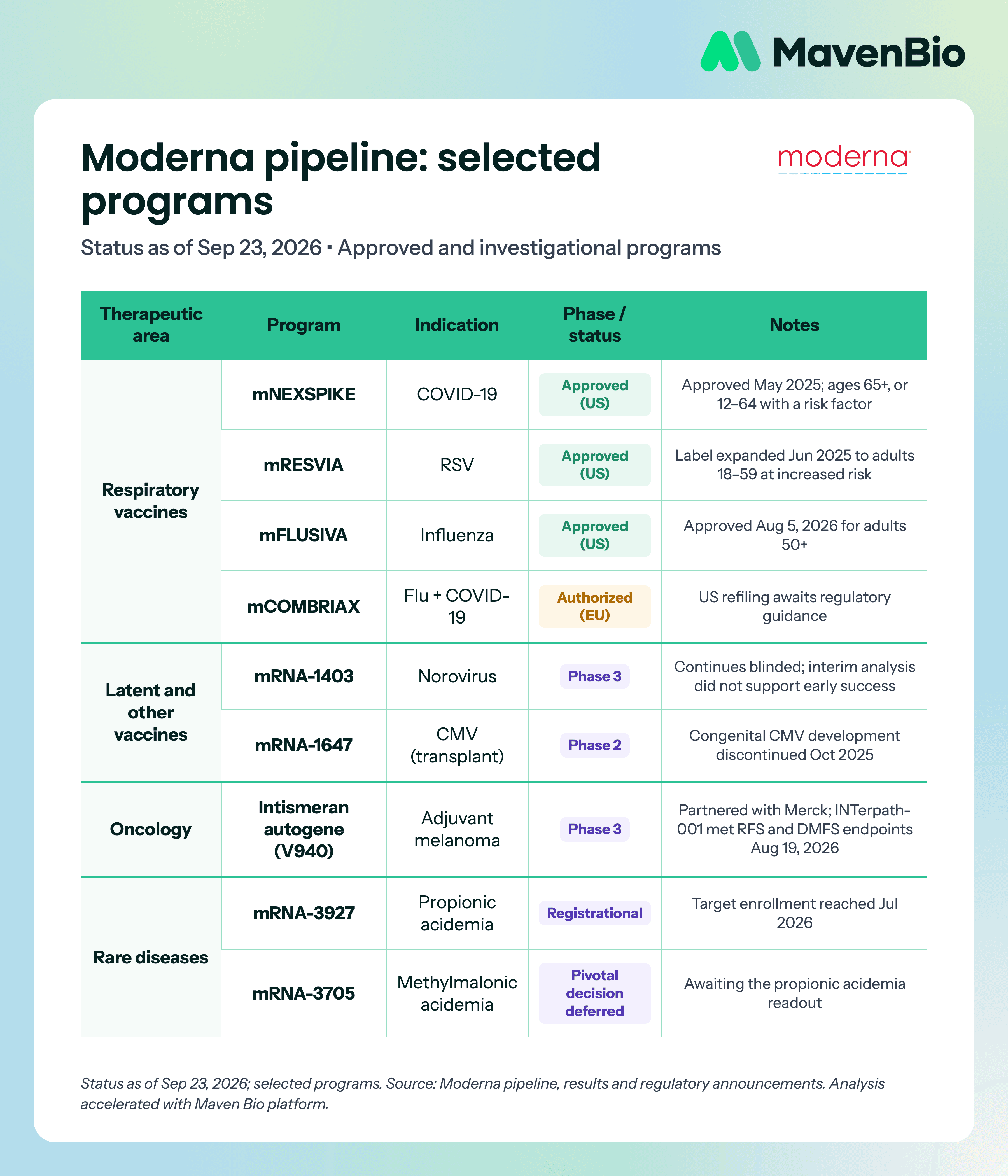
Respiratory expansion has produced approvals. The FDA approved mNEXSPIKE in May 2025; its current indication covers people aged 65 and older and those aged 12–64 with an underlying condition increasing the risk of severe COVID-19. mRESVIA's June 2025 expansion added adults aged 18–59 at increased risk of RSV lower respiratory tract disease, alongside adults aged 60 and older. On August 5, 2026, the FDA approved mFLUSIVA for influenza prevention in adults aged 50 and older. Source 1, Source 2, Source 3
The flu/COVID combination mCOMBRIAX had received European Commission authorization by July 2026. That is distinct from U.S. approval: Moderna's July update said it was awaiting FDA guidance on refiling. Progress outside respiratory vaccines remains uneven. In July, the norovirus candidate mRNA-1403 missed the threshold for early success at its Phase 3 interim analysis; the trial remained blinded and ongoing. This was not a final efficacy result. Source 1
The September 2024 ambition of ten approvals over three years remains a dated target, not an achieved result. In the rare-disease portfolio, Moderna reported in July 2026 that mRNA-3927 for propionic acidemia had reached target enrollment in its registrational study. A decision on a pivotal mRNA-3705 study for methylmalonic acidemia was deferred until the propionic-acidemia readout. Enrollment and planned readouts should not be counted as regulatory approvals. Source 1, Source 2
The oncology program has advanced beyond the original enrollment update. On August 19, 2026, Moderna and Merck reported that INTerpath-001 (NCT05933577) met its recurrence-free-survival primary endpoint and distant-metastasis-free-survival secondary endpoint. The Phase 3 trial compared intismeran autogene (mRNA-4157/V940) plus pembrolizumab with pembrolizumab alone after complete resection of stage IIB–IV melanoma. The announcement did not disclose numerical Phase 3 effect estimates; the separately reported 49% recurrence-or-death risk reduction belongs to Phase 2b follow-up. Overall-survival follow-up continues, and intismeran remains investigational. Source 1
Portfolio Prioritization and Discontinued Programs
The September 2024 cuts covered endemic-coronavirus mRNA-1287, the seronegative-infant RSV program, KRAS-directed mRNA-5671, triplet immuno-oncology mRNA-2752 and relaxin mRNA-0184. The infant RSV decision did not discontinue the adult mRESVIA franchise. A later setback came in October 2025: mRNA-1647 failed its Phase 3 primary endpoint of preventing CMV infection in seronegative women aged 16–40. Moderna discontinued congenital-CMV clinical development while continuing a separate Phase 2 study in transplant recipients. Source 1, Source 2
The evidence supports a narrower conclusion than the original promise of a diversified, profitable business. Moderna has reduced spending and expanded its respiratory offering; positive melanoma results strengthen the case for a future oncology product. Whether that becomes a durable source of revenue depends on regulatory review, subsequent clinical evidence and commercial uptake. For teams tracking the portfolio, the next useful comparisons are non-COVID revenue contribution, cash use and indication-specific clinical outcomes—not the number of programs alone. Source 1, Source 2