J&J's Q2 Earnings and Key Milestones in Immunology and Oncology

Johnson & Johnson (J&J) reported its Q2 2024 earnings on July 17, 2024, providing insights into the performance of its core divisions, Innovative Medicines and MedTech, following the spin-off of its consumer arm, Kenvue. This report will focus on the Innovative Medicines division, which accounts for approximately two-thirds of J&J's total sales.
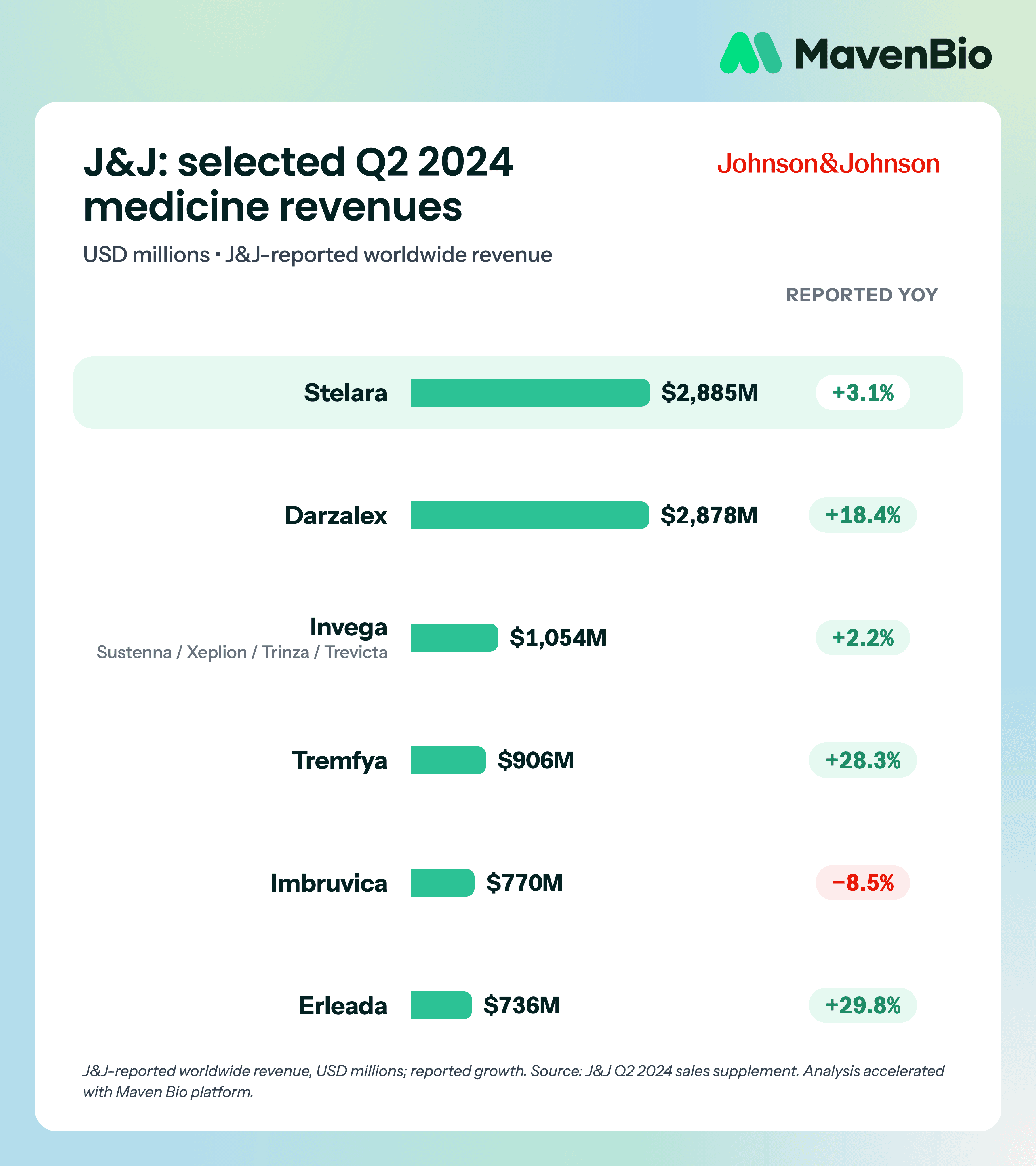
Immunology and Oncology: Key Growth Drivers
Oncology and Immunology are the two largest segments of J&J's BioPharma business, contributing about two-thirds (68%) of the segment's sales. Both segments have promising developments in their respective pipelines, with two notable highlights:
Immunology: Tremfya's Potential in Crohn's Disease
In June 2024, J&J announced an additional FDA filing for Tremfya, an IL-23 inhibitor, for the treatment of moderately to severely active Crohn's disease. At that point, a fully subcutaneous regimen was investigational. Update — March 20, 2025: the FDA approved Tremfya for adults with moderately to severely active Crohn’s disease, with either subcutaneous or intravenous induction.
The pooled Phase 3 GALAXI 2 and 3 results presented in May 2024 showed superior endoscopic outcomes for Tremfya versus Stelara in adults with moderately to severely active Crohn's disease. At week 48, endoscopic remission occurred in 37.2% and 33.2% of patients receiving the two Tremfya maintenance regimens, versus 24.7% with Stelara; both comparisons were statistically significant. [Source]
Clinical remission, defined as a Crohn's Disease Activity Index (CDAI) score below 150, was numerically higher with the two Tremfya regimens: 70.3% and 65.4%, versus 62.9% with Stelara. Those comparisons were not statistically significant (p=0.058 and p=0.512), so the endoscopic findings should not be described as superiority across every outcome. [Source]
At the Q2 2024 reporting date, Stelara was expected to face U.S. biosimilar competition in 2025, so any growth J&J could achieve with Tremfya in Crohn's disease will be particularly helpful in maintaining its position in the immunology market.
Oncology: Rybrevant's Potential in Lung Cancer
One of the developing parts of J&J's oncology portfolio was Rybrevant. By Q2 2024, it was approved in the US with carboplatin and pemetrexed as first-line treatment for locally advanced or metastatic NSCLC with EGFR exon 20 insertion mutations, and as a single agent after progression on platinum-based chemotherapy in that molecular subgroup. [Source]
J&J was also developing Rybrevant plus lazertinib for the more common EGFR exon 19 deletions and exon 21 L858R substitutions. In the first-line MARIPOSA trial, the combination reduced the hazard of progression or death by 30% versus osimertinib (Tagrisso); median progression-free survival was 23.7 versus 16.6 months. [Source]
Overall survival data were immature at the 2024 analysis. Update — August 19, 2024: the FDA approved Rybrevant plus Lazcluze (lazertinib) as first-line treatment for locally advanced or metastatic NSCLC with EGFR exon 19 deletions or exon 21 L858R substitutions. Tagrisso offered a single oral treatment, whereas the studied combination required intravenous amivantamab plus oral lazertinib. MARIPOSA reported more EGFR- and MET-related adverse events with the combination; discontinuation of all study drugs because of treatment-related adverse events occurred in 10% versus 3%. Those differences matter alongside the progression-free-survival benefit. [Source] [Source]
Overall Performance and Corporate Profile
J&J's Innovative Medicine sales grew 5.5% as reported and 7.8% operationally in Q2 2024. The company retained its MedTech division after separating Kenvue, giving it businesses across pharmaceuticals and medical technology; that mix alone does not demonstrate lower earnings volatility. [Source]