Inside Big Pharma's Portfolios: What Drove Q3 2025 Revenue

Company Portfolio Analysis
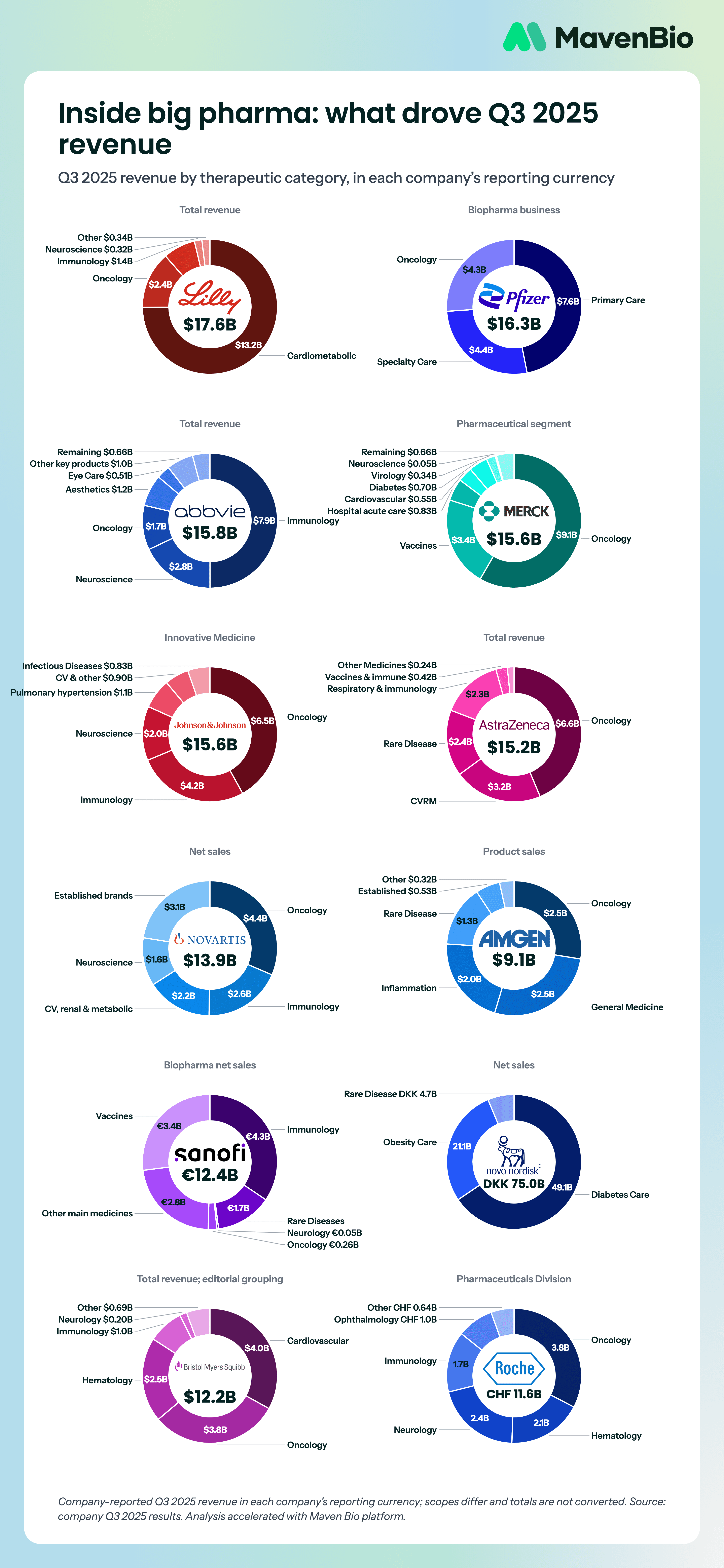
The pharmaceutical industry faces critical revenue challenges as multiple blockbuster drugs approach Loss of Exclusivity (LOE). Consequently, future growth across large pharmaceutical firms will be increasingly contingent upon aggressive portfolio diversification, strategic business development (BD), and accretive mergers and acquisitions (M&A). Analysis of Q3 2025 pharmaceutical revenue highlights the distinct portfolio structures and strategic responses employed by the industry's major players.
Lilly
Reporting Q3 2025 revenue of $17.6008 billion, Lilly maintained a highly concentrated portfolio. Its Cardiometabolic Health category was the dominant revenue driver, generating $13.1779 billion, or 74.9% of total revenue. Mounjaro and Zepbound contributed $10.1032 billion combined, with volume growth driving the company's revenue increase. Oncology contributed $2.4076 billion, Immunology $1.3624 billion, Neuroscience $315.7 million and Other revenue $337.2 million. Subsequent partnerships added development programs: SanegeneBio announced an RNAi collaboration for metabolic diseases on November 8, 2025, and MeiraGTx announced an ophthalmology genetic-medicines collaboration on November 10, led by AAV-AIPL1. Both announcements came after Q3 and did not contribute to this quarter's revenue mix. Sources: Lilly Q3 Form 10-Q, revenue by product. Q3 results. SanegeneBio announcement. MeiraGTx announcement.
Pfizer
Pfizer recorded Q3 2025 total revenue of $16.654 billion, including $16.310 billion from its Biopharma business. Primary Care contributed $7.646 billion, Specialty Care $4.411 billion and Oncology $4.253 billion within Biopharma. CentreOne added $344 million outside that business. Total revenue declined 7% operationally as COVID-19 product sales fell, while the non-COVID portfolio grew 4% operationally. Eliquis remained a substantial contributor, generating $2.015 billion in combined alliance and product revenues for Pfizer. Pfizer announced its agreement to acquire Metsera on September 22, 2025, but completed the acquisition on November 13, after the quarter ended. The transaction added investigational obesity programs to its pipeline, rather than contributing to the Q3 sales mix. Q3 results and revenue tables. Metsera announcement. Acquisition completion.
AbbVie
AbbVie reached $15.776 billion in total revenue in Q3 2025, up 9.1% on a reported basis. Immunology remained the leading therapeutic area at $7.885 billion. Skyrizi and Rinvoq contributed $6.892 billion combined, with reported growth of 46.8% and 35.3%, respectively, while Humira declined 55.4% to $993 million. Immunology revenue grew 11.9% overall, showing that the newer medicines more than offset Humira's decline in this quarter. Beyond immunology, Neuroscience generated $2.841 billion, up 20.2%, and Oncology contributed $1.682 billion, down 0.3%. These figures show a growing neuroscience business alongside a broadly stable oncology portfolio. Source: AbbVie Q3 2025 results.
Merck
With KEYTRUDA's primary U.S. compound patent expiring in December 2028, Merck is focused on diversification while leveraging the continued strength of its flagship asset. Merck reported $15.611 billion in Q3 2025 pharmaceutical revenue, within total company sales of $17.276 billion. The oncology products listed in its results contributed $9.111 billion, including $8.142 billion from KEYTRUDA. WINREVAIR generated $360 million, while GARDASIL/GARDASIL 9 declined 24% to $1.749 billion. Subsequent transactions expanded the pipeline: Verona's acquisition closed on October 7, 2025, adding OHTUVAYRE for COPD; the agreement to acquire Cidara, including its investigational influenza-prevention antiviral CD388, was announced on November 14. Neither transaction contributed to Q3 sales. The comparison uses Merck's full vaccine and diabetes totals; other categories sum the named product rows, with remaining pharmaceutical revenue shown separately to avoid double counting. Sources: Q3 results, Table 3a and footnotes. KEYTRUDA patent disclosure. Verona completion. Cidara agreement.
Johnson & Johnson (J&J)
J&J's Innovative Medicine business generated $15.563 billion in Q3 2025 sales, within total company sales of $23.993 billion. Its major therapeutic areas were Oncology ($6.529 billion), Immunology ($4.168 billion) and Neuroscience ($2.024 billion). Oncology and Neuroscience drove operational growth, with contributions from Darzalex, Carvykti, Erleada, Tecvayli, Talvey and Rybrevant/Lazcluze in Oncology, and Spravato and acquired Caplyta in Neuroscience. Immunology sales declined 9.8% as reported despite Tremfya growth, as Stelara faced biosimilar competition and Medicare Part D changes. The oncology portfolio includes bispecific antibodies and CAR-T therapies. Sources: Q3 results. Segment sales tables. Q3 earnings presentation, slide 15.
AstraZeneca
AstraZeneca delivered Q3 2025 total revenue of $15.191 billion, up 12% as reported and 10% at constant exchange rates. Oncology revenue was $6.636 billion, up 19% as reported, with Tagrisso, Imfinzi and Enhertu among its growing products. Beyond oncology, Cardiovascular/Renal/Metabolism contributed $3.221 billion, Rare Disease $2.416 billion and Respiratory & Immunology $2.259 billion. Vaccines & Immune Therapies added $416 million and Other Medicines $242 million. Total revenue includes product sales, alliance revenue and collaboration revenue; partner-product figures therefore reflect AstraZeneca's reported accounting share, rather than combined worldwide sales by all partners. Source: Q3 2025 results, Tables 3–5.
Novartis
Novartis generated $13.909 billion in net sales in Q3 2025. Oncology was the largest contributor at $4.375 billion, supported by Kisqali and Pluvicto. Immunology added $2.611 billion across Cosentyx, Ilaris and ex-US Xolair, while Cardiovascular, Renal and Metabolic medicines and Neuroscience generated $2.185 billion and $1.609 billion, respectively. Established brands contributed $3.129 billion, including contract manufacturing. Novartis reported 8% sales growth in US dollars and 7% at constant currencies, despite generic erosion. Its oncology and neuroscience businesses grew. Source: Q3 2025 results.
Amgen
Amgen delivered $9.137 billion in Q3 2025 product sales; total company revenue was $9.557 billion after including $420 million of other revenue. Summing the products under the release's commercial groupings gives $2.518 billion in Oncology, $2.474 billion in General Medicine, $1.953 billion in Inflammation and $1.342 billion in Rare Disease. Established Products contributed $533 million and Other Products $317 million. Blincyto, Tezspire, Prolia and Repatha all grew year over year, although the drivers differed: Amgen attributed Prolia's increase primarily to favorable changes in estimated sales deductions. Source: Q3 2025 results.
Sanofi
Sanofi reported €12.434 billion in Q3 2025 Biopharma net sales. Immunology contributed €4.287 billion, including €4.156 billion from Dupixent. The Vaccines reporting category contributed €3.357 billion, including €739 million from Beyfortus. Sanofi includes Beyfortus, a monoclonal antibody for RSV prevention, in its Vaccines reporting category. Rare Diseases contributed €1.675 billion across a range of treatments, including ALTUVIIIO, Fabrazyme and Nexviazyme. The remaining categories were Other Main Medicines, including Industrial Sales (€2.806 billion), Oncology (€260 million) and Neurology (€49 million). These amounts exclude the discontinued Opella consumer-health business. Source: Q3 2025 results. Beyfortus mechanism.
Novo Nordisk
Novo Nordisk generated DKK 74.976 billion in Q3 2025 net sales, with a highly concentrated portfolio. Diabetes Care accounted for DKK 49.149 billion and Obesity Care DKK 21.106 billion, together representing 93.7% of sales. Rare Disease contributed DKK 4.721 billion. Ozempic generated DKK 30.744 billion and Wegovy DKK 20.354 billion within those totals. Quarterly sales grew 5% as reported and 11% at constant exchange rates. This concentration makes the performance of diabetes and obesity treatments central to Novo Nordisk's revenue mix. Source: Q3 2025 financial report, Appendix 6.
Bristol Myers Squibb
Bristol Myers Squibb reported $12.222 billion in Q3 2025 revenue. In the therapeutic grouping below, Cardiovascular contributed $4.042 billion, Oncology $3.764 billion and Hematology $2.480 billion. The oncology total includes $67 million from Opdivo Qvantig. BMS reported 18% growth (17% excluding foreign exchange) in its Growth Portfolio, led by immuno-oncology, Reblozyl, Camzyos and Breyanzi, while its Legacy Portfolio declined 12% (13% excluding foreign exchange). Revlimid and Pomalyst/Imnovid fell 59% and 25%, respectively, as generic competition affected the legacy business. Source.
The BMS therapeutic categories are editorial groupings of reported brand revenues, not company-reported segments. Zeposia's full revenue is assigned to Neurology here, although its indications include ulcerative colitis as well as multiple sclerosis. Neurology also includes Cobenfy, approved for schizophrenia. Hematology includes blood-cancer medicines such as Revlimid, Pomalyst, Breyanzi, Abecma and Sprycel alongside Reblozyl, so Oncology here covers solid tumors and immuno-oncology only. Other reported product groups remain unallocated. Rounded product figures sum to $12.225 billion; a −$3 million rounding adjustment reconciles them to the reported total. Source.
Roche
Roche's Pharmaceuticals Division generated CHF 11.570 billion in Q3 2025, up 7% at constant exchange rates. Oncology and Hematology together contributed CHF 5.846 billion, followed by Neurology at CHF 2.385 billion. Immunology added CHF 1.690 billion and Ophthalmology CHF 1.010 billion. These figures exclude CHF 3.348 billion of Diagnostics sales. The portfolio spans cancer, blood disorders, neurology, immunology and eye disease. Source: quarterly results.
Roche's Q3 category amounts are calculated by subtracting first-half product-group totals from nine-month totals. MabThera/Rituxan's rheumatoid arthritis sales remain in Immunology, following Roche's allocation. Other Pharma is the CHF 639 million residual needed to reconcile the category figures to divisional sales. Sources: first-half presentation and nine-month presentation.
Figures use each company's reported currency. USD, EUR, DKK and CHF totals are not a common-currency ranking. Category labels use company reporting groups or the explicit editorial mappings described above, rather than a standardized classification of diseases; Sanofi's Vaccines category, for example, includes the Beyfortus antibody. Sanofi and Amgen category totals are calculated from the product rows in their results releases.
| Company / reporting scope | Q3 2025 revenue shown (billions; currency stated) | Portfolio categories (billions in the same currency) |
| Lilly — total revenue | USD 17.6008 | Cardiometabolic Health: 13.1779; Oncology: 2.4076; Immunology: 1.3624; Neuroscience: 0.3157; Other: 0.3372 |
| Pfizer — Biopharma business | USD 16.310 | Primary Care: 7.646; Specialty Care: 4.411; Oncology: 4.253 |
| AbbVie | USD 15.776 | Immunology: 7.885; Neuroscience: 2.841; Oncology: 1.682; Aesthetics: 1.193; Eye Care: 0.509; Other Key Products: 1.006; Remaining revenue (total less listed categories): 0.660 |
| Merck — Pharmaceutical segment | USD 15.611 | Listed Oncology products: 9.111; Vaccines (full category): 3.370; Listed Hospital Acute Care products: 0.829; Listed Cardiovascular products: 0.554; Diabetes (full category): 0.703; Listed Virology products: 0.340; Listed Neuroscience product: 0.047; Remaining pharmaceutical revenue: 0.657 |
| Johnson & Johnson — Innovative Medicine | USD 15.563 | Oncology: 6.529; Immunology: 4.168; Neuroscience: 2.024; Pulmonary Hypertension: 1.115; Cardiovascular/Metabolism/Other: 0.899; Infectious Diseases: 0.829; Rounding adjustment: −0.001 |
| AstraZeneca — total revenue | USD 15.191 | Oncology: 6.636; Cardiovascular/Renal/Metabolism: 3.221; Rare Disease: 2.416; Respiratory & Immunology: 2.259; Vaccines & Immune Therapies: 0.416; Other Medicines: 0.242; Rounding adjustment: +0.001 |
| Novartis — net sales | USD 13.909 | Oncology: 4.375; Immunology: 2.611; Cardiovascular, Renal and Metabolic: 2.185; Neuroscience: 1.609; Established brands: 3.129 |
| Amgen — product sales | USD 9.137 | Oncology: 2.518; General Medicine: 2.474; Inflammation: 1.953; Rare Disease: 1.342; Established Products: 0.533; Other Products: 0.317 |
| Sanofi — Biopharma net sales | EUR 12.434 | Immunology: 4.287; Rare Diseases: 1.675; Neurology: 0.049; Oncology: 0.260; Other Main Medicines including Industrial Sales: 2.806; Vaccines reporting category: 3.357 |
| Novo Nordisk — net sales | DKK 74.976 | Diabetes Care: 49.149; Obesity Care: 21.106; Rare Disease: 4.721 |
| Bristol Myers Squibb — total revenue; editorial grouping | USD 12.222 | Cardiovascular: 4.042; Oncology: 3.764; Hematology: 2.480; Immunology: 1.044; Neurology: 0.204; Other: 0.691; Rounding adjustment: −0.003 |
| Roche — Pharmaceuticals Division | CHF 11.570 | Oncology: 3.778; Hematology: 2.068; Neurology: 2.385; Immunology: 1.690; Ophthalmology: 1.010; Other Pharma (residual): 0.639 |
Q3 2025 results show that portfolio concentration and growth can coexist. Lilly and Novo Nordisk depended heavily on diabetes and obesity medicines, while AbbVie's newer immunology products more than offset Humira's quarterly decline. At BMS, growth in newer products accompanied falling legacy sales; J&J's Oncology and Neuroscience businesses grew as Immunology declined. These differences make product-level exposure, competitive pressure and launch execution important when assessing a portfolio. Revenue breadth alone cannot establish future resilience, and announced acquisitions should be assessed separately from the sales a company already generates.