ESMO 2024: Recap of Notable Advances in Oncology

Immunotherapy Breakthroughs
AstraZeneca's Imfinzi Extends Survival in Bladder Cancer
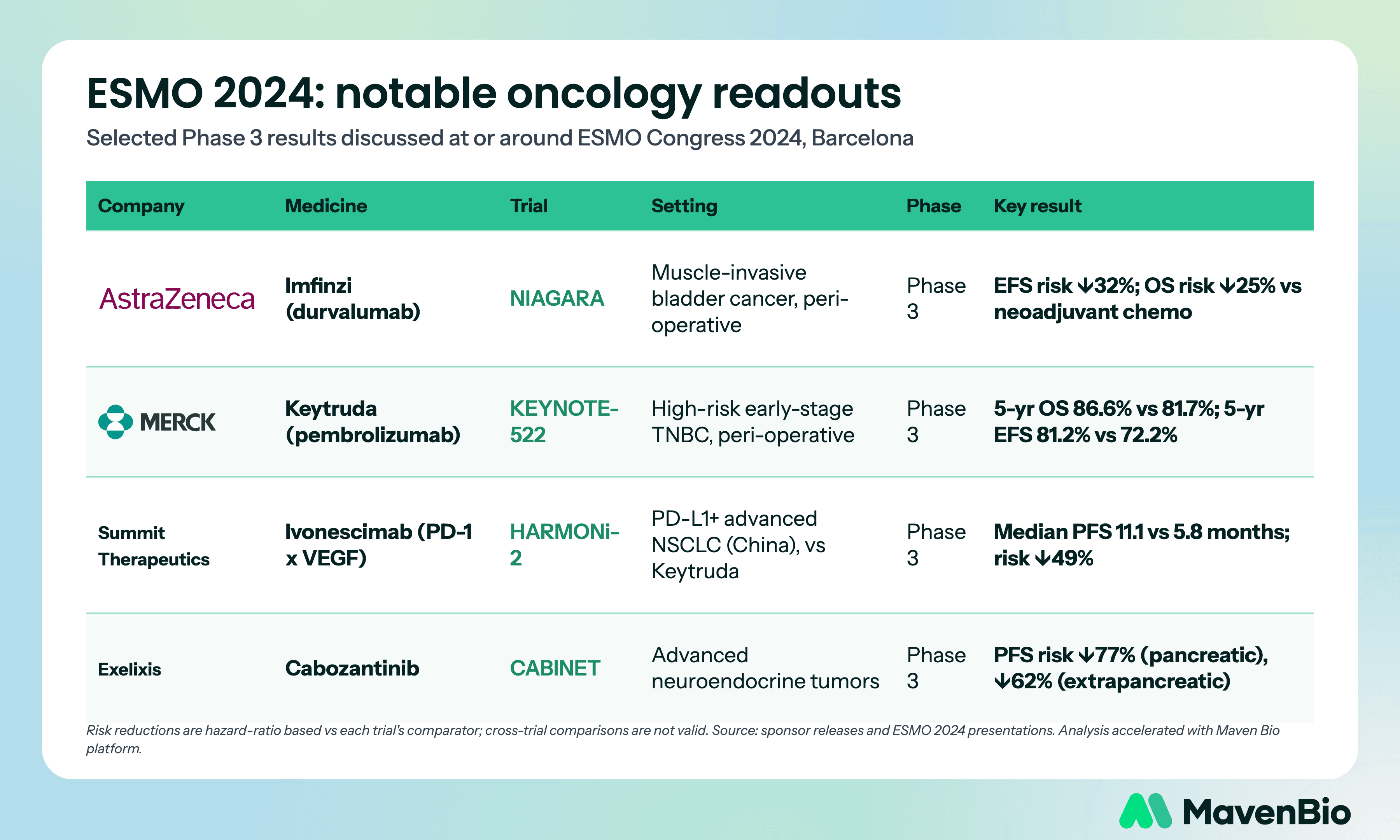
In a landmark achievement, AstraZeneca's immunotherapy drug Imfinzi (durvalumab) became the first PD-1/L1-based regimen to demonstrate a survival benefit in muscle-invasive bladder cancer (MIBC). The phase III NIAGARA trial evaluated the addition of Imfinzi to neoadjuvant chemotherapy before radical cystectomy and as a monotherapy after surgery. Compared to neoadjuvant chemotherapy alone, the Imfinzi regimen significantly improved event-free survival (EFS) by 32%, and overall survival (OS) by 25%.
While the trial did not distinguish the impact of pre-surgery versus post-surgery Imfinzi treatment, the overall results are highly promising for patients facing this challenging disease.
Merck's Keytruda Improves Survival in Early-Stage Triple-Negative Breast Cancer
Merck's blockbuster Keytruda (pembrolizumab), when combined with chemotherapy before surgery and used alone post-operation, demonstrated better overall survival compared to chemotherapy alone in patients with high-risk, early-stage triple-negative breast cancer (TNBC). The KEYNOTE-522 study reported the following clinically meaningful results:
- 5-year EFS rate: 81.2% with Keytruda versus 72.2% with chemotherapy alone.
- 5-year OS rate: 86.6% with Keytruda versus 81.7% with chemotherapy alone, a statistically significant difference.
These findings position the Keytruda regimen as a potential new standard of care for treating this aggressive form of early-stage breast cancer, which has historically had limited treatment options and a poor prognosis.
Subcutaneous Keytruda Formulation on the Horizon
Merck also announced plans to release data from the KEYNOTE-D77 trial on a subcutaneous formulation of Keytruda later this year or in early 2025. Two dosing options for the subcutaneous version are being evaluated: once every three weeks or every six weeks. This development could help Merck transition more gradually upon the expiration of Keytruda's patents, as the subcutaneous formulation will still be under patent protection.
Summit Therapeutics' Ivonescimab Outperforms Keytruda in Lung Cancer
Just before ESMO, Summit Therapeutics announced pivotal Phase III results from its HARMONi-2 study, where its bispecific antibody ivonescimab, targeting PD-1 and VEGF, demonstrated superiority over Merck's blockbuster Keytruda in lung cancer. Conducted in China with 398 patients enrolled, HARMONi-2 results showed a median PFS of 11.1 months with ivonescimab compared to 5.8 months with Keytruda, representing a 49% reduction in the risk of disease progression or death. As Summit expands to global phase III trials beyond China, ivonescimab holds significant potential in the treatment of lung cancer.
BioNTech's BNT327 Shows Promising Early Results in NSCLC
BioNTech unveiled encouraging phase II data for its PD-L1xVEGF bispecific antibody, BNT327, in non-small cell lung cancer (NSCLC). With a similar mechanism to ivonescimab, BNT327 received a significant amount of attention at ESMO.
In a single-arm trial of 64 patients with EGFR-mutant NSCLC in China, BNT327 achieved a confirmed ORR of nearly 58%. In patients with high PD-L1 expression, the confirmed ORR was an impressive 92%. While these early results are promising, the impact on overall survival and progression-free survival remain to be evaluated.
Immunotherapy in Brain Tumors: Promising but Challenging
While immunotherapy has shown groundbreaking success in treating various cancers, its efficacy in primary brain tumors, such as glioma, has been limited. Immunotherapies have not yet provided a greater survival benefit over established treatments.
Multiple recent phase III trials of Opdivo (nivolumab) in newly diagnosed or recurrent glioblastoma have yielded disappointing results. However, encouraging objective response rates were reported for immunotherapy in treating brain parenchymal metastases at the ESMO Congress.
Phase II clinical trial data presented at the conference showcased the potential of various immunotherapeutic approaches in neuro-oncology, including checkpoint inhibitors, viral therapies, vaccines, cytokine-based therapies, and cell therapies. While immunotherapy holds promise for brain tumors, significant challenges remain, and further research is crucial.
Targeted Therapies and Novel Approaches
Exelixis' Cabozantinib Demonstrates Efficacy in Neuroendocrine Tumors
Exelixis presented final results from the phase III CABINET study, which evaluated cabozantinib in neuroendocrine tumors. The drug demonstrated a 62% reduction in the risk of disease progression or death in patients with extrapancreatic neuroendocrine tumors, and 77% in patients with pancreatic neuroendocrine tumors. Approval of cabozantinib for neuroendocrine tumors is anticipated in April.
Pfizer's Ponsegromab: Potential First-in-Class Treatment for Cancer Cachexia
Pfizer revealed plans to initiate a registration-enabling study next year for ponsegromab, a GDF-15-directed monoclonal antibody, in cancer patients with cachexia. This condition, characterized by muscle loss and life-threatening weight loss, currently lacks approved treatments. Ponsegromab has the potential to be a first-in-class therapy for cancer cachexia, addressing a critical unmet medical need.
Breastfeeding After Breast Cancer Treatment: Safe and Feasible
Two international studies presented at ESMO 2024 provided the first evidence that breastfeeding after breast cancer treatment is safe and feasible for young women. After a median follow-up of seven years from giving birth, there was no difference in the number of breast cancer recurrences or new breast cancers in women who breastfed their babies compared to those who did not.
Merck and Daiichi Sankyo's Patritumab Deruxtecan Shows Promise in Lung Cancer
Months after an FDA rejection over manufacturing concerns, Merck and Daiichi Sankyo announced positive topline phase III results for patritumab deruxtecan, their HER3 antibody-drug conjugate (ADC).
The HERTHENA-Lung02 study evaluated patritumab deruxtecan in lung cancer patients and demonstrated a statistically significant improvement in PFS compared to doublet chemotherapy, although specific data was not disclosed. Based on these findings, Merck and Daiichi plan to begin regulatory discussions for patritumab deruxtecan.
Emerging Trends and Challenges
Rising Rates of Early-Onset Colorectal Cancer: A Cause for Concern
Globally, the incidence of early-onset colorectal cancer (CRC) has increased by an alarming 64.3% between 1990 and 2019. Metastatic CRC (mCRC) remains a disease with a poor prognosis, with a 5-year survival rate of only 14%.
Data from the CITRIC phase II study presented at ESMO 2024 showed that patients with mCRC who received cetuximab and irinotecan exhibited significantly improved disease control rate and nearly double the median progression-free survival compared to the control arm. While these results are clinically meaningful and promising, more research is urgently needed to understand the underlying causes of higher rates of early-onset CRC, as lifestyle changes, diet, and pollution all conspire to increase the disease burden and threaten to reverse the progress made in recent years.
Looking Ahead
The ESMO Congress 2024 showcased numerous groundbreaking developments in cancer treatment and research, ranging from immunotherapy breakthroughs to novel targeted therapies and emerging trends. While significant challenges remain, the findings presented at this prestigious conference offer hope for improved outcomes and better quality of life for cancer patients worldwide.