Advancing Beyond Statins: Emerging Cholesterol-Lowering Medicines Reshaping Lipid Management

CDC estimates that about 86 million US adults aged 20 or older had total cholesterol above 200 mg/dL in 2017–2020. Statins remain the foundation of lipid management, but some patients need additional LDL-C lowering or cannot tolerate recommended statin therapy. Non-statin options now span injectable antibodies, oral medicines, RNA-based approaches and investigational gene editing. Source 1. Source 2.
The 2026 ACC/AHA dyslipidemia guideline recommends adding non-statin treatment when lifestyle measures and statins do not adequately lower LDL-C, with choices guided by risk and patient characteristics. Ezetimibe, bempedoic acid and PCSK9 monoclonal antibodies are among the established options. Newer mechanisms also target triglycerides and lipoprotein(a), which require their own endpoints and outcomes evidence. Source.
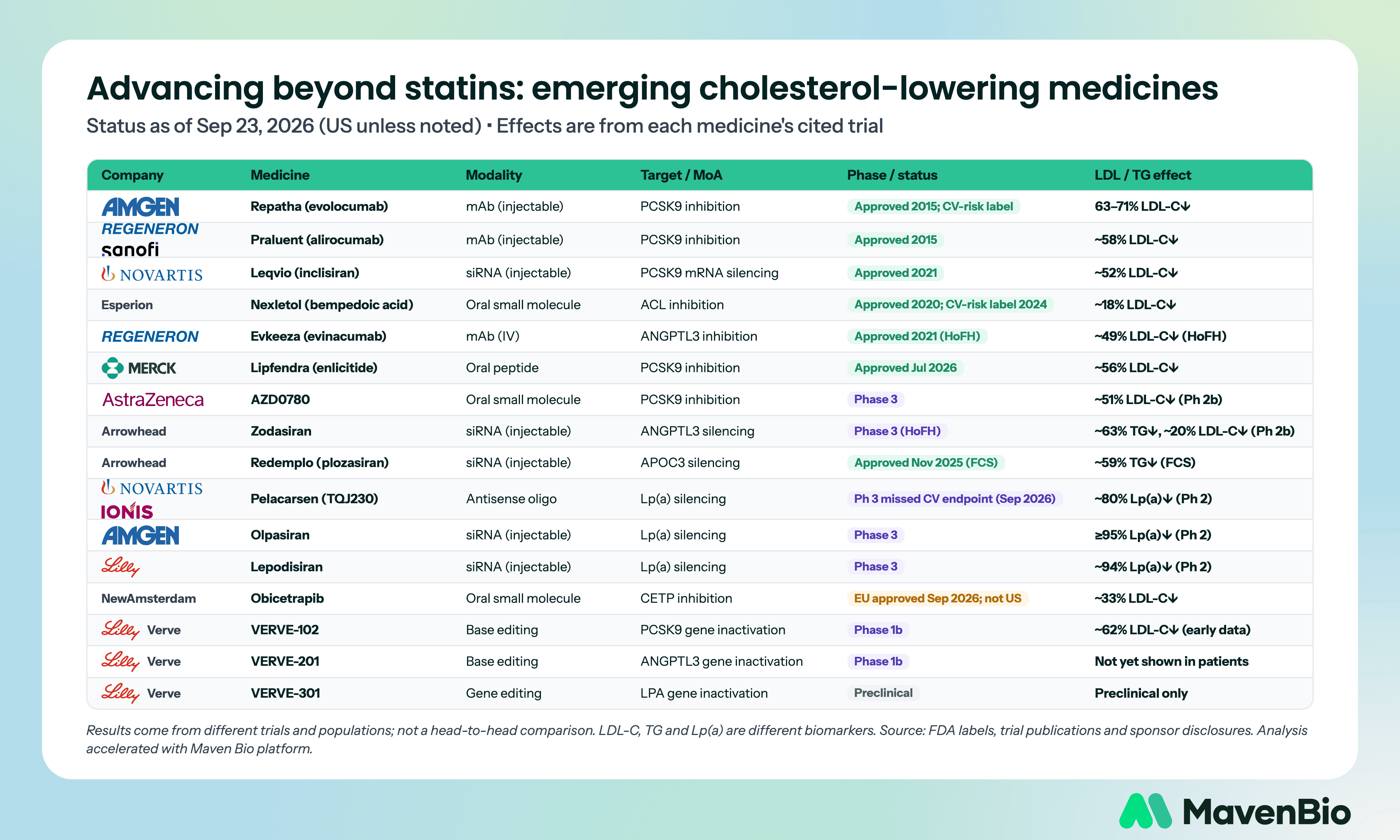
Cholesterol-Lowering Therapies Beyond Statins
The table summarizes selected approved medicines and investigational programs, with regulatory status checked on September 23, 2026. It is not an exhaustive treatment list. Each row identifies a specific study or evidence limitation; doses describe the cited trials and are not prescribing instructions.
| Company | Medicine | Modality / target | Regulatory / development status | Study population, regimen and timing | Endpoint-specific evidence |
| Amgen | Repatha (evolocumab) | SC monoclonal antibody; PCSK9 | US approved; initial approval 2015. Includes CV-risk reduction in eligible adults. | LAPLACE-2 (NCT01763866): hypercholesterolemia on background statins; 140 mg every 2 weeks or 420 mg monthly; week 12. | LDL-C: 71 and 63 percentage points lower than placebo, respectively. These are trial-specific estimates, not class-wide expectations. [1] |
| Regeneron (US) | Praluent (alirocumab) | SC monoclonal antibody; PCSK9 | US approved; initial approval 2015. Includes CV-risk reduction in eligible adults. | ODYSSEY LONG TERM (NCT01507831): 2,341 adults needing further LDL-C reduction on maximally tolerated statins; 150 mg every 2 weeks; week 24. | LDL-C: 58 percentage points lower than placebo. [2] |
| Novartis | Leqvio (inclisiran) | SC siRNA; PCSK9 mRNA | US approved since 2021. Current label includes adults with hypercholesterolemia and specified pediatric FH populations aged 12+. | ORION-10 (NCT03399370): 1,561 adults with ASCVD; 284 mg on days 1, 90, 270 and 450; day-510 endpoint. | LDL-C: 52 percentage points lower than placebo. The approved lipid-lowering indication is distinct from a drug-specific CV-outcomes claim. [3] |
| Esperion | Nexletol (bempedoic acid) | Oral small molecule; ATP-citrate lyase | US approved since 2020; LDL-C reduction and CV-risk reduction in specified adult populations. | Label Trial 2 (NCT02666664): 2,230 adults with HeFH and/or CVD on maximally tolerated statins; 180 mg daily; week 12. | LDL-C: 18 percentage points lower than placebo. CV-event evidence comes from a separate outcomes trial. [4] |
| Regeneron | Evkeeza (evinacumab) | IV monoclonal antibody; ANGPTL3 | US approved since 2021; HoFH, now adults and children aged 1+. | ELIPSE-HoFH (NCT03399786): 65 patients aged 12+ with HoFH on other lipid-lowering treatment; 15 mg/kg every 4 weeks; week 24. | LDL-C: 49 percentage points lower than placebo. Not a general hypertriglyceridemia indication. [5] |
| Merck | Lipfendra (enlicitide; MK-0616) | Oral macrocyclic peptide; PCSK9 | US approved July 2026 for adult hypercholesterolemia, including HeFH. | CORALreef Lipids (NCT05952856): 2,904 adults with hypercholesterolemia and ASCVD history or increased risk; 20 mg daily; week 24. | LDL-C: 56 percentage points lower than placebo in the label primary analysis. [6] |
| AstraZeneca | AZD0780 | Oral small molecule; PCSK9 | Investigational; Phase 3 development. | PURSUIT Phase 2b: 428 randomized adults on moderate/high-intensity statins, with or without ezetimibe; 30 mg daily; week 12. | LDL-C: 50.7 percentage points lower than placebo at the 30-mg dose. This is Phase 2b evidence, not a Phase 3 result. [7] |
| Arrowhead | Zodasiran | SC siRNA; ANGPTL3 mRNA | Investigational; Phase 3 YOSEMITE in HoFH. | ARCHES-2 (NCT04832971): 204 adults with mixed hyperlipidemia; 200 mg at day 1 and week 12; week-24 endpoint. | TG: 63.1 percentage points lower than placebo; LDL-C: 19.9 points lower. These mixed-hyperlipidemia results are not HoFH Phase 3 results. [8] |
| Arrowhead | Redemplo (plozasiran; ARO-APOC3) | SC siRNA; APOC3 mRNA | US approved November 2025, adjunct to diet for adult familial chylomicronemia syndrome (FCS). | PALISADE (NCT05089084): 75 adults with FCS; label-dose comparison 25 mg every 3 months (n=26) versus placebo (n=25); month 10. | TG median change: −80% with treatment, −17% with placebo; estimated treatment difference −59 percentage points. The estimate is not simple subtraction of the two medians. [9] |
| Novartis / Ionis | Pelacarsen (TQJ230) | SC antisense oligonucleotide; apo(a) production | Investigational; Phase 3 Lp(a)HORIZON missed its primary CV endpoint, announced September 4, 2026. | Phase 2 (NCT03070782): 286 patients with CVD and elevated Lp(a); 20 mg weekly; approximately 6-month endpoint. | Lp(a): 80% reduction from baseline at this dose versus 6% with placebo. Biomarker lowering did not establish CV benefit in the subsequent HORIZON trial. [10] |
| Amgen | Olpasiran | SC siRNA; apo(a) production | Investigational; Phase 3 CV-outcomes trials ongoing. | OCEAN(a)-DOSE: 281 patients with ASCVD and Lp(a) >150 nmol/L; doses of 75 mg or 225 mg every 12 weeks; week 36. | Lp(a): at least 95% reduction versus placebo at these doses. No head-to-head comparison with other Lp(a) candidates. [11] |
| Lilly | Lepodisiran | SC siRNA; apo(a) production | Investigational; Phase 3 ACCLAIM program. | ALPACA (NCT05565742): 320 adults with elevated Lp(a); pooled groups given 400 mg at baseline; days 60–180. | Lp(a): placebo-adjusted time-averaged change −93.9 percentage points. This is not LDL-C lowering or a CV-event result. [12] |
| NewAmsterdam / Menarini (Europe) | Obicetrapib | Oral small molecule; CETP | Not US approved. EU approval of Ubeslo and the ezetimibe combination Evlarco announced September 21, 2026. | BROADWAY (NCT05142722): 2,530 patients with ASCVD or HeFH on maximally tolerated lipid-lowering therapy; obicetrapib 10 mg daily; day 84. | LDL-C: −29.9% from baseline versus +2.7% with placebo; adjusted difference −32.6 percentage points. CV-outcomes trial PREVAIL is separate. [13] |
| Lilly / Verve | VERVE-102 | Single IV base-editing infusion; PCSK9 gene | Investigational; Phase 1b Heart-2. | Heart-2 (NCT06164730): May 2026 interim analysis, 35 adults with HeFH or premature coronary artery disease across six dose cohorts. | LDL-C: mean reduction 62% in the 1.0-mg/kg cohort; no placebo group. Follow-up across the study extended to 18 months, not 18 months for every cohort. [14] |
| Lilly / Verve | VERVE-201 | IV base-editing candidate; ANGPTL3 gene | Investigational; Phase 1b Pulse-1. | Adult refractory hypercholesterolemia; early safety and tolerability evaluation. | Human efficacy is not established in the cited evidence. The sponsor’s published LDL-C example is from non-human primates, not patients. [15] |
| Lilly / Verve | VERVE-301 | Gene-editing candidate; LPA gene | Preclinical/research program; not approved. | Preclinical development; human efficacy and safety are not established. | Designed to reduce Lp(a); no established human lipid-lowering or CV-event benefit. [16] |
US status is shown unless a different jurisdiction is explicitly named. LDL-C, triglycerides (TG) and lipoprotein(a) [Lp(a)] are distinct measures. A placebo-adjusted difference in percentage change is expressed in percentage points; it is not the same as change from baseline. Differences in populations, background treatment, doses, analysis methods and follow-up prevent these rows from establishing a head-to-head efficacy ranking. Lipid lowering alone does not establish a drug-specific reduction in heart attacks or strokes.
Sources for the Medicine Landscape
[1] Repatha US label, sections 1 and 14. Source.
[2] Praluent US label, sections 1 and 14. Source.
[3] Leqvio US label, revised August 2026, sections 1, 2 and 14. Source.
[4] Nexletol US label, sections 1 and 14. Source.
[5] Evkeeza US label, sections 1, 2 and 14. Source.
[6] Lipfendra FDA label, July 2026, sections 1, 2 and 14. Source.
[7] PURSUIT report and Phase 3 study listing. Source 1. Source 2.
[8] ARCHES-2 publication, Table 2; YOSEMITE July 2026 enrollment update. Source 1. Source 2.
[9] FDA Redemplo trial snapshot, efficacy table. Source.
[10] Pelacarsen Phase 2 publication/methods and September 2026 HORIZON announcement. Source 1. Source 2. Source 3.
[11] OCEAN(a)-DOSE results and August 2026 pipeline update. Source 1. Source 2.
[12] ALPACA publication and sponsor trial report. Source 1. Source 2.
[13] BROADWAY publication and September 2026 European approval announcement. Source 1. Source 2.
[14] Lilly May 2026 Heart-2 interim results. Source.
[15] VERVE-201 sponsor program page: clinical study and nonclinical data. Source.
[16] Verve pipeline: VERVE-301 research program. Source.
PCSK9 Inhibition: From Injectables to Oral Agents
Monoclonal antibodies such as Repatha and Praluent established PCSK9 inhibition as an option for additional LDL-C lowering. Both have US cardiovascular-risk-reduction indications for eligible adults as well as lipid-lowering indications. Their trial results should be interpreted in the populations and treatment settings studied, rather than as a universal percentage reduction for every patient. Source 1. Source 2.
Inclisiran offers a different dosing schedule: a healthcare professional administers 284 mg initially, again at three months, and every six months thereafter. Its US approval began in 2021. The current label includes adults with hypercholesterolemia and specified pediatric familial-hypercholesterolemia populations aged 12 and older. A convenient dosing schedule does not, by itself, demonstrate improved adherence or cardiovascular outcomes. Source.
Oral PCSK9 inhibition has moved beyond the pipeline: enlicitide received US approval as Lipfendra in July 2026 for adults with hypercholesterolemia, including HeFH. The labeled regimen is 20 mg once daily, taken on an empty stomach with a 30-minute wait before food or other restricted drinks. AstraZeneca’s AZD0780 remains investigational in Phase 3; its cited LDL-C result comes from the Phase 2b PURSUIT trial. These data do not establish superiority over injectable agents or prove better real-world access. Source 1. Source 2. Source 3.
Beyond PCSK9: New Targets and Broader Lipid Effects
Other lipid pathways serve distinct populations. Evkeeza inhibits ANGPTL3 and is approved in the US to lower LDL-C in HoFH, including children aged one year and older; it is not approved as a general treatment for high triglycerides. Zodasiran also targets ANGPTL3, through RNA interference, and is in Phase 3 development for HoFH. Its commonly cited triglyceride result came from a separate Phase 2 study in mixed hyperlipidemia. Obicetrapib inhibits CETP: the European Commission’s September 2026 approval covers Ubeslo and the ezetimibe combination Evlarco, it remains investigational in the US. BROADWAY measured LDL-C lowering; PREVAIL evaluates cardiovascular outcomes. Source 1. Source 2. Source 3. Source 4. Source 5.
Bempedoic acid offers an oral ATP-citrate lyase approach. In CLEAR Outcomes, involving 13,970 adults with established cardiovascular disease or high risk who were not receiving recommended statin doses, the primary cardiovascular composite occurred in 11.7% with bempedoic acid versus 13.3% with placebo (hazard ratio 0.87), over a median 3.4 years. This is separate from the LDL-C endpoint summarized in the table. Its label includes risks such as hyperuricemia and tendon rupture. Source.
APOC3 inhibition addresses another part of the landscape. Plozasiran is now approved in the US as Redemplo for triglyceride reduction in adults with familial chylomicronemia syndrome, alongside diet. Its FCS trial result should not be generalized to routine hypercholesterolemia or treated as proof of cardiovascular-event prevention. Source.
Lipoprotein(a) remains an important investigational target, but biomarker effects and clinical outcomes must be kept separate. On September 4, 2026, Novartis reported that pelacarsen’s Phase 3 Lp(a)HORIZON trial did not meet its primary cardiovascular-event endpoint despite lowering Lp(a). Olpasiran and lepodisiran have shown substantial Lp(a) reductions in Phase 2 and are being evaluated in Phase 3 outcomes programs. Pelacarsen is an antisense oligonucleotide; olpasiran and lepodisiran are siRNAs. Their separate trials do not establish which treatment is clinically superior. Source 1. Source 2. Source 3.
Gene Editing: Toward One-Time Therapies
Gene editing aims to achieve durable lipid lowering after a single treatment, but permanence, long-term safety and cardiovascular benefit have not been established by the early trials cited here. Lilly’s May 2026 Heart-2 update reported dose-dependent LDL-C reductions with VERVE-102 in an uncontrolled Phase 1b study. VERVE-201 is being evaluated in the Phase 1b Pulse-1 trial, while VERVE-301 remains a research-stage LPA-editing program. Non-human-primate findings for VERVE-201 should not be described as human efficacy. Source 1. Source 2. Source 3.
Takeaway
Statins remain foundational, while non-statin therapies expand the available mechanisms and dosing choices. For a useful comparison, the key questions are which population each medicine is approved or being studied for, which lipid measure it changes, and whether cardiovascular outcomes have been demonstrated. Longer dosing intervals, oral delivery and gene editing may change treatment logistics, but improvements in access, adherence and clinical outcomes need evidence rather than assumptions. Source.