Capital Efficiency in Chinese Biotech: A Comparative Analysis of Licensing Deal Structures

Recent transaction data highlights a structural divergence in global biotech financing. While Western firms typically require substantial equity capital to reach licensing inflection points, Chinese biotech companies are executing major pharmaceutical partnerships with significantly leaner balance sheets.
Analysis of prominent licensing deals from 2022 to 2025 indicates that Chinese companies frequently secure upfront payments that rival or exceed their total raised equity. This "lean and licensed" model represents a distinct approach to risk, valuation, and capital allocation in the life sciences sector.
Capital Efficiency: China vs. USA
The primary differentiator in the current market is the ratio of upfront licensing revenue to total equity raised. Data comparing Chinese and US entities reveals that Chinese companies often achieve a 1:1 or greater ratio of upfront capital to total equity, significantly de-risking the asset for investors.
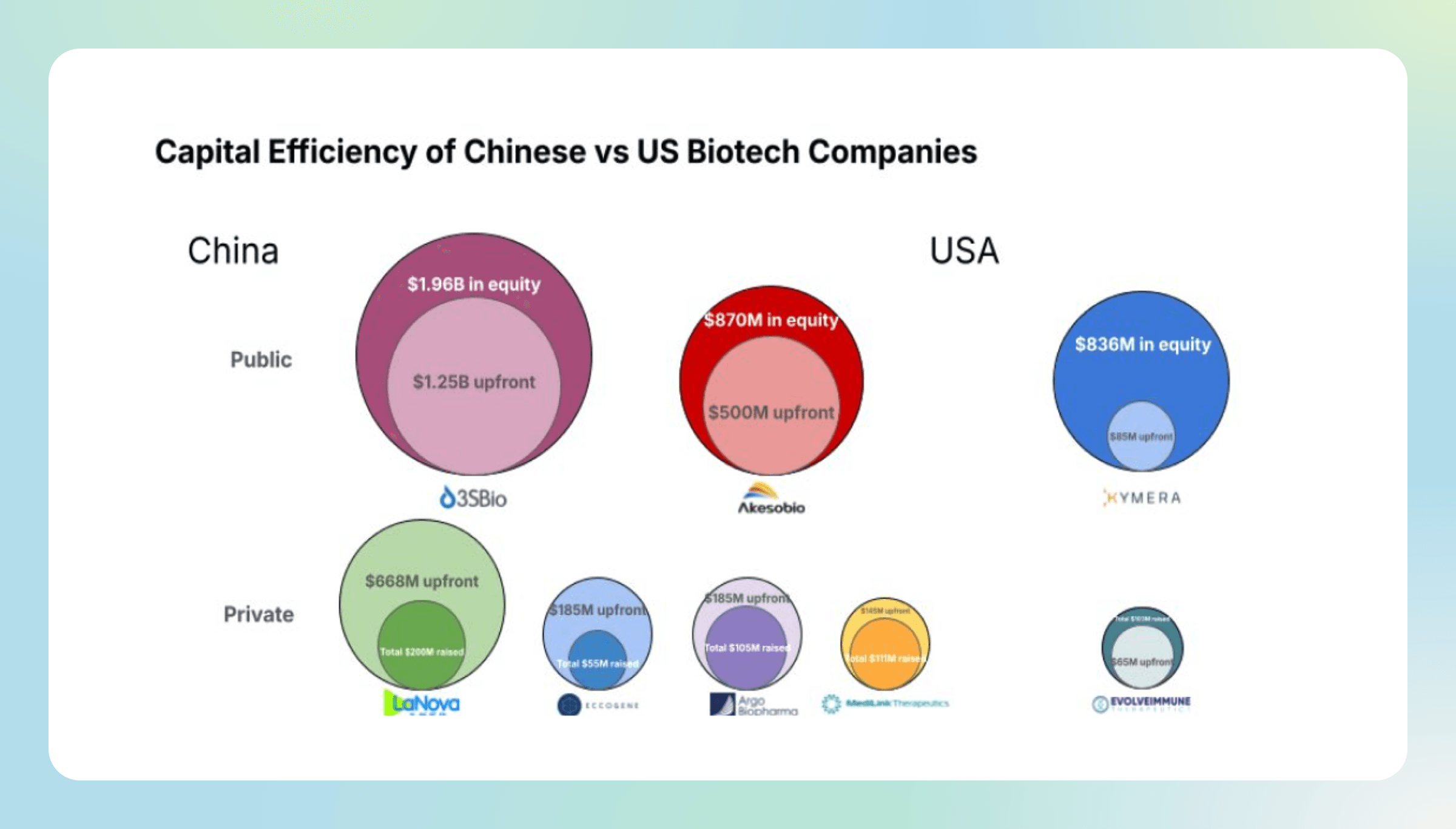
Comparative Analysis of Equity vs. Upfront Capital
| Company (Origin) | Status | Total Equity Raised | Upfront Payment Received | Ratio (Upfront/Equity) |
| 3SBio (China) | Public | $1.96B | $1.25B | ~0.64x |
| Akesobio (China) | Public | $870M | $500M | ~0.57x |
| LaNova (China) | Private | <$200M | $668M | >3.3x |
| Eccogene (China) | Private | <$55M | $185M | >3.3x |
| Argo Biopharma (China) | Private | $105M | $185M | ~1.76x |
| MediLink Therapeutics (China) | Private | $111M | $145M | ~1.3x |
| Kymera (USA) | Public | $836M | $85M | ~0.10x |
| EvolveImmune (USA) | Private | $103M | $65M | ~0.63x |
- LaNova Medicines exemplifies this trend. Prior to its acquisition by Sino Biopharmaceutical Limited, the company raised less than $200M. Yet, it secured multiple licensing deals (AstraZeneca, Merck) with upfronts totaling over $668M.
- Eccogene raised less than $55M but secured a $185M upfront payment for its GLP-1 asset.
- 3SBio Inc. received $1.25B upfront from Pfizer, a figure covering roughly 64% of its total equity capital of $1.96B.
In contrast, US comparables like Kymera show a traditional capital structure where equity funding ($836M) vastly dwarfs upfront licensing proceeds ($85M).
Prominent Licensing Deals (2022-2025)
The volume and magnitude of these transactions underscore the maturity of Chinese R&D assets. Global pharmaceutical leaders including Pfizer, Merck, AstraZeneca, and Novartis have validated these platforms through substantial upfront commitments.
Deal Ledger: Major Out-Licensing Transactions
| Licensor | Licensee | Date | Asset | Type | Upfront Amount | Total Deal Value (Biobucks) | Therapeutic Area |
| 3SBio | Pfizer | May 2025 | SSGJ-707 | PD-1/VEGF Bispecific Antibody | $1.25B | $4.8B | Oncology |
| Akesobio | Summit Therapeutics | Dec 2022 | SMT112 | PD-1/VEGF Bispecific Antibody | $500M | $5B | Oncology |
| LaNova | Merck | Nov 2024 | LM-299 | PD-1/VEGF Bispecific Antibody | $588M | $2.7B | Hematology |
| LaNova | AstraZeneca | May 2023 | LM-305 | GPRC5D-targeting ADC | $55M | $545M | Oncology |
| LaNova | Turning Point | May 2022 | LM-302 | Claudin 18.2-targeting ADC | $25M | $195M | Oncology |
| Argo Biopharma | AstraZeneca | Nov 2023 | ECC5004 | GLP-1RA | $185M | $1.8B | Obesity |
| Eccogene | Novartis | Jan 2024 | BW-02; BW-05 | siRNA | $185M | $4.2B | Cardiovascular |
| MediLink Therapeutics | Roche | Jan 2024 | YL211 | c-MET-targeting ADC | $50M | $1B | Oncology |
| MediLink Therapeutics | BioNTech | Oct 2023 | YL202 | HER3-targeting ADC | $70M | $1B | Oncology |
| MediLink Therapeutics | BioNTech | May 2024 | TMALIN® ADC platform | Tech platform | $25M | $1.8B | Oncology |
Investor Implications
The disparity in capital efficiency suggests that Chinese biotech companies offer a unique value proposition for global investors. By the time these companies enter major licensing agreements, they often possess:
Reduced Financing Risk: Significant non-dilutive capital reserves reduce the need for subsequent equity raises.
Validated Asset Quality: Rigorous due diligence by multinational pharma partners serves as external validation of the scientific platform.
Retained Franchise Value: Management teams and talent pools remain intact, supported by ongoing royalty streams from out-licensed assets.
This contrasts with markets where the upfront portion of a deal rarely exceeds the capital required to develop the asset to that stage. As cross-border activity accelerates, this high-efficiency model is reshaping expectations for return on equity in early-to-mid-stage biotechnology.