Advancing Beyond Statins: The Landscape of Emerging Cholesterol-Lowering Medicines

Over 50% of American adults have elevated cholesterol levels, yet the market remains dominated by statins approved decades ago. While statins remain first-line therapy, a significant portion of patients fail to achieve target lipid levels. A new wave of innovation involving injectable antibodies, small interfering RNA (siRNA), oral small molecules, and gene editing options is poised to alter this paradigm.
This report outlines the current state of non-statin therapies and the emerging pipeline candidates designed to improve cardiovascular outcomes through novel mechanisms of action.
The Standard of Care: Approved Non-Statin Therapies
When statin targets are not achieved, clinical guidelines increasingly recommend the addition of PCSK9 inhibitors or ACL inhibitors. These agents have demonstrated substantial LDL-C reductions and cardiovascular outcomes benefits.
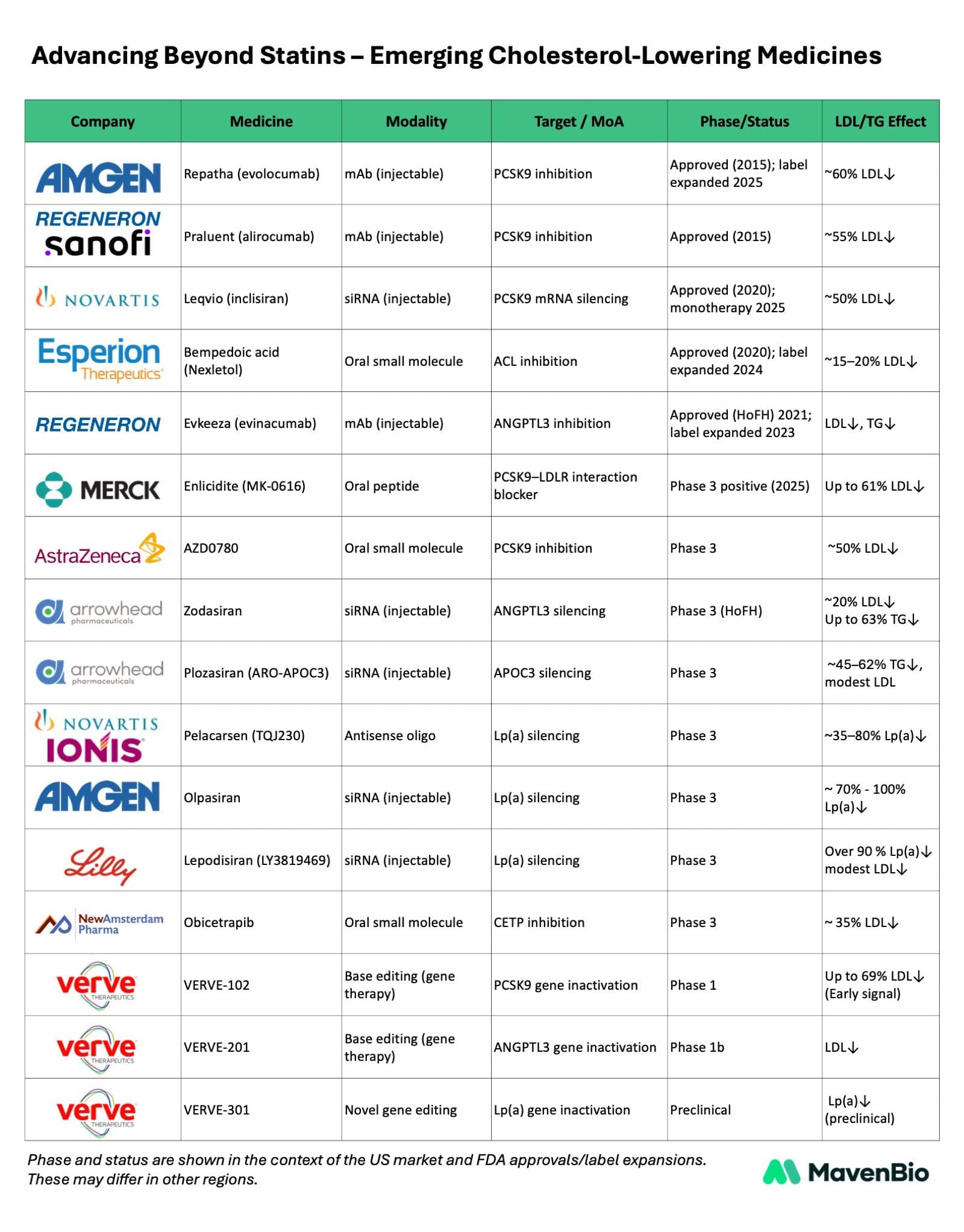
- Antibody Inhibitors: Repatha (evolocumab) and Praluent (alirocumab) remain essential therapies, particularly for very high-risk patients. These injectable monoclonal antibodies consistently deliver approximately 55% to 60% LDL-C reductions. In 2025, the label for Repatha was expanded, further cementing its role in the treatment hierarchy.
- siRNA Therapies: Novartis has reshaped clinical practice with Leqvio (inclisiran), an siRNA therapy that offers sustained LDL-C reductions of approximately 50% with twice-yearly office-based injections. In 2025, its U.S. label was broadened to enable earlier use in high-risk patients, signaling a shift toward more durable dosing schedules.
- Oral ACL Inhibitors: Esperion Therapeutics offers an oral alternative with bempedoic acid (Nexletol), which provides 15% to 20% LDL-C reduction. Its label was expanded in 2024.
- ANGPTL3 Inhibitors: For patients with Homozygous Familial Hypercholesterolemia (HoFH), Regeneron's Evkeeza (evinacumab) provides a mechanism to lower both LDL and triglycerides (TG) via ANGPTL3 inhibition.
The Next Wave: Oral PCSK9 Inhibitors
After years of the PCSK9 landscape being dominated by injectables, oral formulations are approaching commercialization. If approved, these options could expand access and adherence significantly compared to injectable biologic counterparts.
- Merck: Enlicitide (MK-0616), an oral peptide acting as a PCSK9-LDLR interaction blocker, has reported positive Phase 3 results (2025). Data indicates LDL-C reductions of up to 61%.
- AstraZeneca: AZD0780, an oral small molecule, achieved approximately 50% LDL-C lowering in the Phase 2b PURSUIT trial and has progressed to Phase 3.
Expanding Targets: Lp(a), APOC3, and CETP
Beyond LDL-C clearance via PCSK9, the pipeline includes therapies targeting other atherogenic lipids such as Lipoprotein(a) [Lp(a)], triglycerides, and non-HDL cholesterol.
- Lp(a) Silencing: Elevated Lp(a) is a genetically determined risk factor distinct from LDL-C. Several siRNA and antisense oligonucleotide candidates are in Phase 3 testing, including Pelacarsen (Novartis/Ionis), Olpasiran (Amgen), and Lepodisiran (Lilly). These agents have demonstrated the ability to lower Lp(a) by 70% to over 90%.
- CETP Inhibition: NewAmsterdam Pharma is advancing obicetrapib, an oral CETP inhibitor. Recent Phase 3 results suggest 35% LDL-C reductions. Unlike PCSK9 inhibitors, obicetrapib offers broader lipid effects, including raising HDL-C and lowering ApoB and Lp(a).
- APOC3 and ANGPTL3 Silencing: Arrowhead Pharmaceuticals is advancing plozasiran (targeting APOC3) and zodasiran (targeting ANGPTL3) through Phase 3 trials. These candidates show strong efficacy in lowering triglycerides (up to 63% reduction with zodasiran) and mixed hyperlipidemia profiles.
The Frontier: Gene Editing
Gene editing represents a potential "one-and-done" solution for lipid management. Verve Therapeutics is pioneering in vivo base editing to permanently inactivate specific genes.
- VERVE-102: This candidate targets PCSK9 via base editing. Early Phase 1 data showed mean LDL-C reductions of 53%, with some patients approaching 70%.
- Pipeline Expansion: Verve is also exploring ANGPTL3 inactivation with VERVE-201 (Phase 1b) and Lp(a) inactivation with VERVE-301 (Preclinical).
Summary of Market Landscape
The following table summarizes the key approved and emerging medicines in the cholesterol-lowering market, organized by development phase.
Outlook
While initial commercial expectations for first-generation PCSK9 inhibitors were not fully met upon launch, the landscape has evolved. The diversification of delivery mechanisms ranging from twice-yearly siRNAs to daily oral pills offers the potential to improve patient access and adherence. Furthermore, the expansion into novel targets such as Lp(a) and ANGPTL3 addresses residual cardiovascular risk factors that statins cannot mitigate.