Roche's Pharmaceutical Division Performance in Q2 2024 YoY

Ocrevus: Sustaining Market Dominance in Multiple Sclerosis
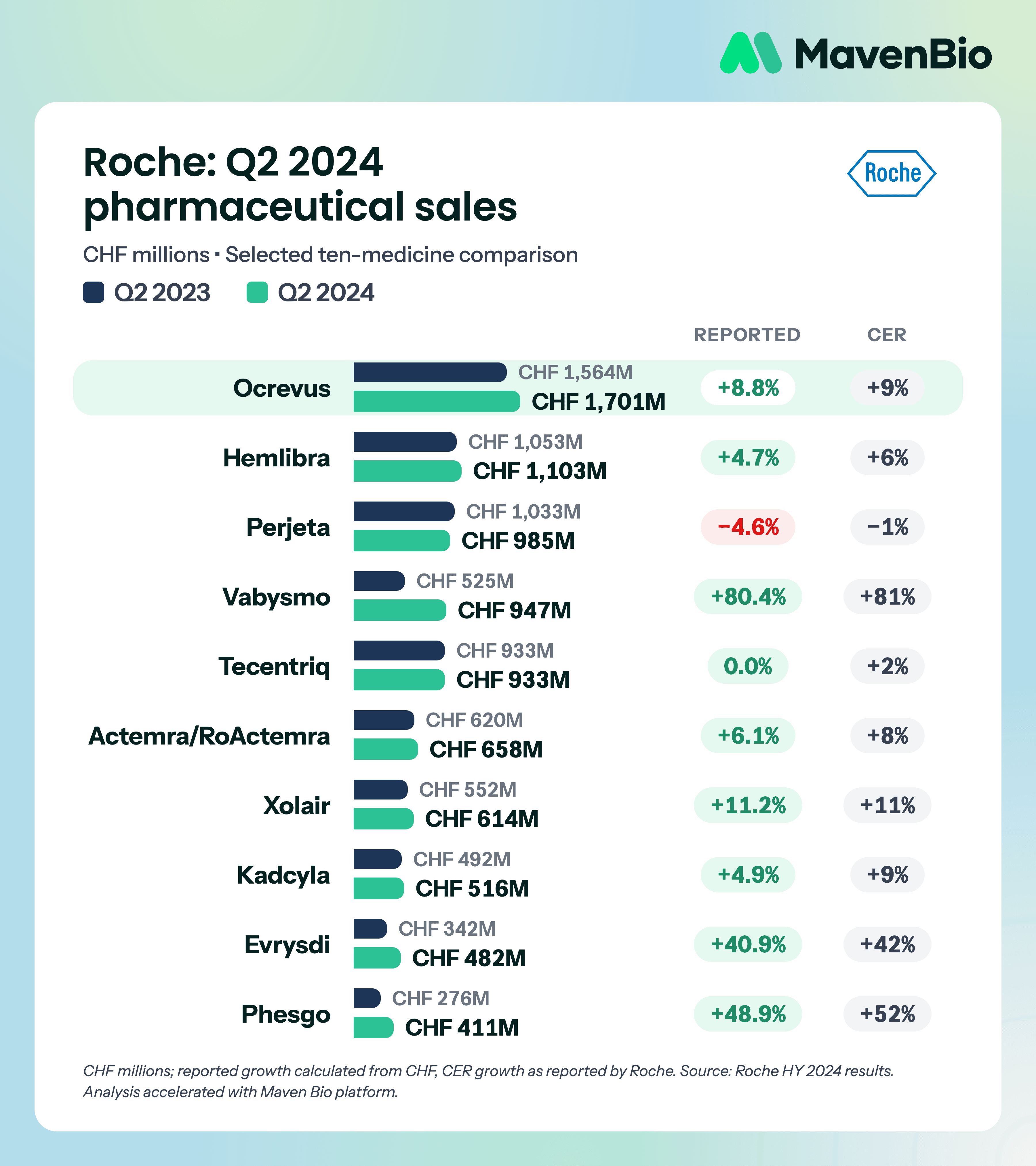
Despite increased competition, Ocrevus, Roche's flagship multiple sclerosis (MS) treatment, remained the US market leader according to Roche’s Q2 2024 presentation. Q2 sales rose from CHF1.564 billion to CHF1.701 billion, an 8.8% reported increase (9% at constant exchange rates). Roche attributed first-half growth to new and existing patients and a higher US retention rate than other MS medicines. Quarterly sales, appendix 4; Q2 commercial update, slide 45
Beyond the US, Roche reported first-half 2024 Ocrevus sales growth in the United Kingdom, Germany, Brazil and Canada. Its subcutaneous formulation was awaiting US approval at the time. Subsequent outcome — September 13, 2024: the FDA approved Ocrevus Zunovo for adults with relapsing forms of MS and primary progressive MS. First-half regional results; FDA approval
The subcutaneous version of Ocrevus received European Commission approval on June 25, 2024, based on the Phase 3 OCARINA II study. Its primary comparison established non-inferior drug exposure in the blood versus intravenous Ocrevus; clinical and MRI findings were also comparable. This was not a trial showing superior efficacy. The injection takes approximately 10 minutes. For adults, intravenous Ocrevus takes at least 2.5 hours for each initial infusion, then 3.5 hours for standard maintenance infusions, with a two-hour option for eligible patients. These are administration times: premedication and observation add to the visit. EU approval and study; IV administration; SC administration and monitoring
While Ocrevus faces competition from Novartis' Kesimpta, the subcutaneous formulation offers a different dosing arrangement. Ocrevus Zunovo is administered by a healthcare professional every six months; Kesimpta can be self-administered monthly after initial loading doses. Less frequent dosing may appeal to some patients, while self-administration may appeal to others. The schedules alone do not establish superior efficacy or adherence. Ocrevus Zunovo label; Kesimpta label
Vabysmo: Driving Growth in Ophthalmology
Vabysmo, Roche's ophthalmology therapy, emerged as a major growth driver for the Pharmaceuticals Division in the first half of 2024. Roche attributed around three-quarters of the division’s first-half growth to Vabysmo; that statement concerns the contribution to growth, not its share of revenue. Separately, Q2 2024 sales reached CHF947 million versus CHF525 million a year earlier, up 80.4% as reported and 81% at constant exchange rates. First-half growth commentary; Quarterly sales, appendix 4
In the first half of 2024, Roche reported continued US Vabysmo uptake among newly diagnosed patients and patients switching treatments. European growth included France, Spain, Italy, the United Kingdom and Germany; Canada, China and Australia supported growth in the International region. First-half regional results
Evrysdi: Advancing Spinal Muscular Atrophy Treatment
Evrysdi, Roche's oral treatment for spinal muscular atrophy (SMA), continued its upward trajectory: Q2 2024 sales were CHF482 million versus CHF342 million a year earlier, up 40.9% as reported and 42% at constant exchange rates. Its daily oral administration offers a different delivery option for people with SMA; convenience alone does not establish greater clinical benefit than other treatments. Quarterly sales, appendix 4; Evrysdi treatment background
At the time of these results, Roche had reported five-year follow-up from the FIREFISH open-label extension in children with Type 1 SMA. The June 2024 readout provided longer-term evidence on survival, motor function and safety. It concerned treatment within SMA, rather than approval for a new disease indication, and was not a randomized comparison with other SMA medicines. FIREFISH five-year readout
HER2 Oncology Franchise: Phesgo Driving Growth
In Roche's HER2 oncology franchise, Phesgo combines pertuzumab and trastuzumab with hyaluronidase for subcutaneous administration. Q2 2024 sales were CHF411 million versus CHF276 million a year earlier, up 48.9% as reported and 52% at constant exchange rates. Roche attributed growth to conversion from separate Perjeta and Herceptin treatment. Phesgo takes approximately eight minutes for the loading injection and five minutes for maintenance injections, versus approximately 150 minutes initially and 60–150 minutes subsequently for the two standard IV formulations. These times exclude observation and any accompanying chemotherapy; shorter administration does not imply superior anticancer efficacy. Quarterly sales, appendix 4; Conversion commentary; Administration comparison
Overall, Roche's Pharmaceutical Division demonstrated resilience and adaptability in the face of increasing competition and patent expirations. The company's strategic initiatives, including the development of innovative formulations and expansion into new indications, have positioned it for continued growth in various therapeutic areas.