J&J’s Q2 2025 Highlights: Innovative Medicine Drives Growth Despite Stelara Slowdown

J&J’s blockbuster drug Stelara saw sales plunge 43% in Q2 2025, yet the company still delivered a solid overall performance. Its Innovative Medicine segment reached $15.2 billion in quarterly sales. Overall revenue reached $23.7 billion, representing a 5.8% year-over-year increase, while adjusted EPS was $2.77. Management raised its full-year reported sales guidance to $93.2–$93.6 billion. [Source 1]
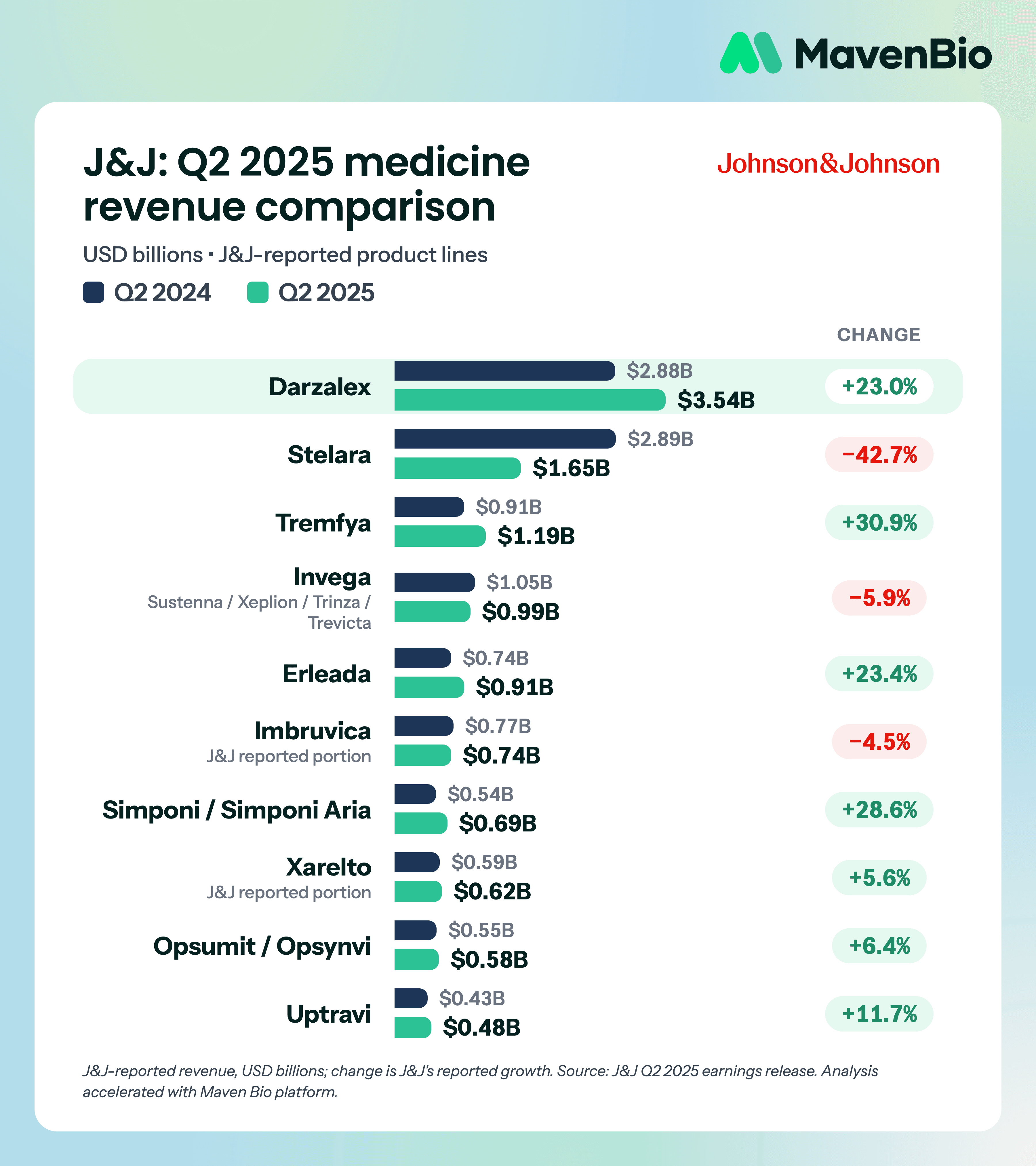
In oncology, Darzalex further cemented itself as the cornerstone of J&J’s portfolio, achieving sales of $3.54 billion, a notable 23% increase from the previous year. Management attributed growth to market expansion and share gains of approximately 4.1 percentage points across treatment lines and nearly 8 percentage points in frontline settings. [Source 1] [Source 2]
At the time of the Q2 results, J&J was seeking FDA approval of Darzalex Faspro for high-risk smoldering multiple myeloma. The FDA subsequently approved it for adults with this condition on November 6, 2025. J&J lists 2029 as the U.S. composition-of-matter patent expiry year for Darzalex; that date does not establish a worldwide end to protection or guarantee the timing of biosimilar entry. [Source 1] [Source 2]
Carvykti, J&J’s CAR-T cell therapy, also demonstrated strong sales performance with Q2 sales of $439 million, more than doubling year-over-year from $186 million. The five-year CARTITUDE-1 update reported median overall survival of 60.7 months among 97 heavily pretreated patients with relapsed or refractory multiple myeloma. This was a single-arm study, so it does not establish a survival advantage over another treatment. Management attributed the quarter’s sales growth to share gains and capacity expansion. [Source 1] [Source 2] [Source 3]
J&J reported $179 million for the Rybrevant/Lazcluze sales line this quarter, which includes Rybrevant and Rybrevant plus Lazcluze. In March 2025, the company reported an overall survival benefit versus Tagrisso in MARIPOSA, which studied first-line treatment of locally advanced or metastatic non-small cell lung cancer with EGFR exon 19 deletions or L858R mutations. The hazard ratio for death was 0.75; median overall survival for the combination had not yet been reached. Meanwhile, Erleada achieved sales of $908 million, up 23% year-over-year. [Source 1] [Source 2]
Blockbuster immunology drug Stelara faced a substantial 43% sales decline in Q2 2025, dropping to $1.65 billion. Management attributed the decline to biosimilar competition and Medicare Part D redesign. The earnings disclosure does not quantify the sales impact of individual competing biosimilars. [Source 1] [Source 2]
In immunology beyond Stelara, Tremfya emerged as a major growth driver, reaching $1.19 billion in sales, a robust 31% increase year-over-year. By Q2 2025, its U.S. indications included plaque psoriasis, psoriatic arthritis, ulcerative colitis and Crohn’s disease. The QUASAR long-term extension results concerned adults with ulcerative colitis: J&J reported 72% clinical remission and 43% endoscopic remission at maintenance Week 92 using nonresponder imputation. The extension followed patients who had responded to induction and completed maintenance; these rates should not be applied to everyone starting treatment or to the other indications. J&J’s expectation of at least $10 billion in annual peak sales was a management forecast. [Source 1] [Source 2] [Source 3] [Source 4]
Simponi/Simponi Aria, the combined immunology sales line, also posted strong performance with a 29% increase to $690 million. Neuroscience asset Spravato saw growth of 53%. In January 2025, the FDA approved its use as monotherapy for adults with treatment-resistant depression, allowing treatment without a concurrent oral antidepressant. [Source 1] [Source 2]
This quarter also featured significant pipeline advancements. On April 29, 2025, the FDA approved Imaavy for generalized myasthenia gravis in adults and children aged 12 and older who are anti-AChR or anti-MuSK antibody positive. Shortly after the quarter, on July 17, 2025, TAR-200 received priority review for non-muscle-invasive bladder cancer, with a decision then anticipated later in 2025. On September 9, 2025, the FDA approved TAR-200 as Inlexzo for adults with BCG-unresponsive non-muscle-invasive bladder cancer with carcinoma in situ, with or without papillary tumors. [Source 1] [Source 2]